








Last winter I spent about $140 on sleep supplements over six weeks. A gummy with eleven ingredients. A “calm” powder that tasted like chalk and lavender. A melatonin spray, because apparently sprays absorb faster — someone on Instagram said so. None of it really did much, and one of them gave me a headache that lasted into the next afternoon.
Then my friend, who happens to be a pharmacist, looked at the pile on my kitchen counter and said something I have not forgotten since.
“Most people are taking the wrong dose of the right thing.”
She picked up the melatonin spray specifically. Ten milligrams. “That’s ten times what the research actually supports,” she said. “No wonder you feel weird the next day.”
That conversation sent me down a rabbit hole. Here is what I found — the stuff that actually has evidence behind it, the doses that make sense, and the stuff that is mostly riding on a podcast mention and good marketing
Magnesium Glycinate Was the First Thing She Mentioned
“This one’s boring,” she said, “which is usually a good sign.”
Magnesium glycinate, somewhere in the 200 to 400mg range, has multiple randomized controlled trials behind it. Not one. Multiple. That alone puts it ahead of almost everything else on my old kitchen counter.
The form matters more than I realized. Magnesium oxide and chloride — common in a lot of cheap supplements — are mostly used for digestion. Constipation, heartburn, that kind of thing. Glycinate is different. It is the form tied to relaxation, and part of that might be glycine itself, separate from the magnesium.
I started taking it about three weeks ago. The honest result: falling asleep maybe ten minutes faster, which does not sound like much until you have spent six weeks lying awake doing math about how many hours of sleep you’ll get if you fall asleep right now versus in twenty minutes. The other thing — and I did not expect this — my legs stopped doing that restless twitchy thing they sometimes do at night. Apparently that is a magnesium thing too.
One more note from her: glycinate tends to be gentle on the stomach. The cheap stuff I had been taking before was not, though I had assumed that was just how magnesium felt.
L-Theanine, For the 11pm Thought Spiral
This was the one I actually needed most, though I did not know it at the time.
My problem was never really “I’m uncomfortable.” It was “why am I thinking about an email I sent four years ago right now, at 11pm, for no reason.”
L-theanine is an amino acid found naturally in green tea. Around 200mg, it appears to increase alpha brain waves — the pattern associated with calm, relaxed alertness. A 2019 study in Nutrients found 200mg daily reduced sleep disturbances and improved sleep efficiency in stressed adults.
The difference from a sedative, in my experience: it does not make you sleepy exactly. It just turns the volume down on whatever loop your brain is stuck on. The first night I took it, I remember thinking “okay, I’m still awake, but I don’t actually care that much” — which, it turns out, is most of the battle.
It pairs with magnesium glycinate too, with no known interaction issues. Together they cover both problems — the physical restlessness and the mental noise. That combination is what I have stuck with.
Ashwagandha — Good, But Only If This Is Your Actual Problem
I tried this one too, briefly, and it did not do much for me. Here is why, probably.
Ashwagandha is an adaptogen — it helps regulate cortisol, the stress hormone that is supposed to drop in the evening and, for chronically stressed people, sometimes just refuses to.
A 2019 double-blind study in Medicine found 300mg of ashwagandha root extract, taken twice daily, significantly improved sleep quality and lowered morning cortisol in stressed adults.
My pharmacist friend’s take: ashwagandha works for stress-driven insomnia specifically. If your sleep issue is something else — bad habits, an irregular schedule, whatever — it is probably not going to do much, which might explain my experience. It is not a general sleep aid. It is a stress-axis tool, and it only earns its keep if stress is actually the root cause.
If you do try it, she said to look for KSM-66 or Sensoril on the label specifically — those are the forms used in the actual studies, and a lot of products on shelves use neither.
Melatonin — The Spray That Started All This
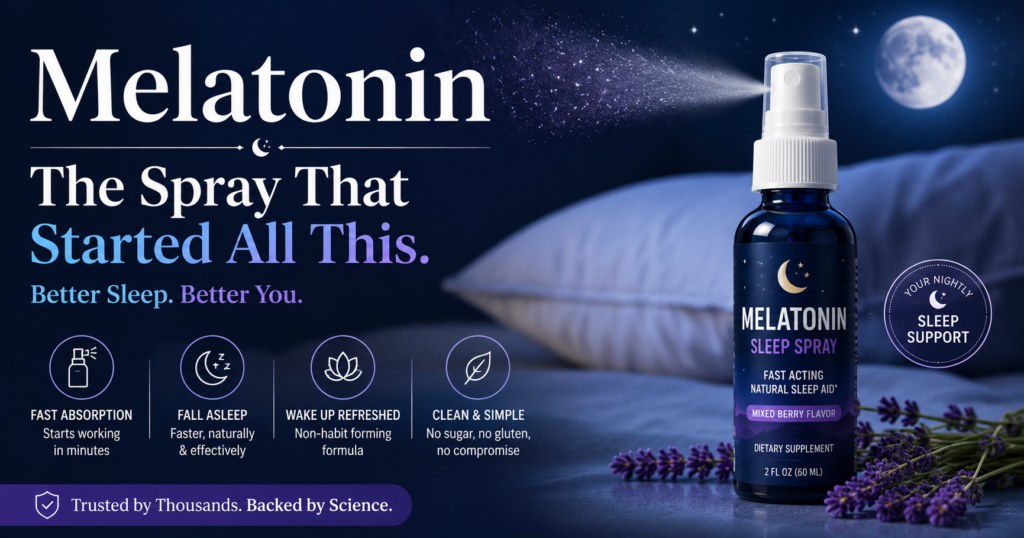
Back to that ten-milligram spray.
Melatonin is still the most recognizable name in this entire category, but — as I learned the hard way — most people, including me, are taking way too much of it.
Most pharmacy bottles are 5mg or 10mg. The research suggests 0.5mg to 1mg, taken 30 to 60 minutes before bed, actually works better. Melatonin is a timing signal, not a sedative. Taking more of it does not make the signal louder — it just means more of it is still in your system the next morning, which is exactly why I felt foggy after using that spray.
I have not gone back to melatonin since, but my friend said if I wanted to try it again, a tenth of what I was taking before would be the place to start. I have not gotten around to it. The magnesium and L-theanine combination has been enough so far.
Glycine — The One Nobody Mentioned to Me Until Now
This was new to me entirely. As an amino acid, glycine seems to help lower core body temperature slightly before sleep — and a drop in core temperature is one of your body’s natural “okay, time to wind down” signals.
Usually taken around 3 grams before bed. The evidence suggests it can improve how rested people feel, without the next-day fog that some other things — looking at you, ten-milligram melatonin spray — can cause.
I have not tried this one yet. It is on my list. Apparently it is one of those things that quietly works without anyone talking about it much.
And Apigenin — The One Everyone Else Was Talking About
This was actually on my original kitchen counter. The lavender powder had it. So did one of the gummies.
If you spend any time in sleep-optimization corners of the internet, you have heard of apigenin — usually thanks to a certain podcast stack that everyone seems to reference.
Here is the thing, though. As of 2026, apigenin has essentially no published human trials at the doses found in commercial supplements. None. The popularity has badly outrun the actual science.
That does not mean it does nothing. Maybe it does something. But if you are choosing where to spend money based on what is actually been studied — and at this point, after my $140 lesson, I am choosing based on that — apigenin sits near the bottom, regardless of how often it shows up in your feed.
The Part My Pharmacist Friend Kept Coming Back To
Every time I asked about a new supplement, she eventually said some version of the same thing.
“None of this matters much if you’re going to bed at 1am on Tuesday and 11pm on Thursday.”
Supplements amplify good sleep habits. They do not replace them. A consistent bedtime, a dark and cool room, less screen time before bed, no caffeine after early afternoon — these boring fundamentals matter more than anything in a bottle. I will be honest, I am still not great at the screen time part. But the magnesium and L-theanine combination, even with my inconsistent habits, made a noticeable difference.
Where I Landed
If I had to do that $140 over again, here is what I would buy instead: magnesium glycinate (200-400mg) and L-theanine (200mg) — the combination that has actually worked for me, and the one with the most consistent research behind it. I would add ashwagandha only if stress, specifically, felt like my main problem. I would try melatonin again, but at a tenth of the dose I used before. And I would skip the apigenin entirely, no matter how many times it shows up in my feed.
The lavender powder is still in my cupboard, by the way. Half-used. I keep meaning to throw it out.
This article is for informational purposes only and is not medical advice. Consult a healthcare professional before starting any new supplement, particularly if you are pregnant, breastfeeding, or taking other medications.

Mikhaila Olena is a lifestyle writer and content creator behind Living Smart Daily, dedicated to sharing practical ideas, thoughtful insights, and everyday inspiration. With a passion for simple living and meaningful choices, she crafts content that helps readers create a more balanced, organized, and fulfilling life.