









My friend texted me at week three. “The scale hasn’t moved much. Is this even working?”
She had started Ozempic in January, prescribed alongside her type 2 diabetes management. She was doing everything right — taking it on schedule, eating reasonably, walking most days. And the number on the scale was, by her account, “basically the same as three weeks ago.”
It was working. Nobody had told her what week three actually looks like. That gap — between what is happening inside the body and what shows up on a bathroom scale — turns out to be the single biggest source of confusion for almost everyone starting this medication.
So here is the honest version. Not the dramatic transformation videos. What the published research actually says.
Why the First Six Weeks Feel Slower Than Expected
Ozempic does not work like flipping a switch. There is no moment where hunger simply disappears. Semaglutide, the active ingredient, builds up gradually in the body over several weeks — and the standard dosing schedule is built around that fact, not against it. Most people start at 0.25mg weekly, primarily to let the body adjust, before increasing to 0.5mg somewhere around week four or five.
That means the first six weeks function mostly as a ramp-up period rather than the phase where the bulk of weight loss happens. Clinical trial data suggests people might realistically expect to lose less than 3% of body weight in those first six weeks. Less than three percent. Not the dramatic numbers that circulate in before-and-after posts.
I told my friend this around week three, and her response was something like — “so I’m not doing anything wrong?” No. She was doing exactly what the schedule predicts.
What Six Weeks Actually Looks Like
The pattern varies person to person, but research points to a fairly consistent general shape, and it roughly matched what my friend went through.
Weeks one and two: appetite changes show up before the scale does. Quieter hunger, smaller portions feeling sufficient, less of what some patients describe as “food noise” — the background mental chatter about eating. The scale, for many people, barely moves yet.
Weeks three and four: this is where my friend’s text came from, and it is genuinely the hardest stretch psychologically. Many users lose 5 to 15 pounds across the full six weeks, but a meaningful chunk of that range tends to land later rather than earlier. The dose typically increases to 0.5mg around this point, which is also when gastrointestinal side effects are most likely to show up — timing that makes week three or four feel, for a lot of people, like the medication is causing more problems than progress.
Week six: published data suggests roughly 5 to 10 pounds lost on average, around 2 to 4% of body weight, for people combining the medication with reasonable eating habits and regular movement. A real-world study found participants averaged 5.9% loss by three months — which tells you something important: more change happens in the months after week six than during it.
My friend’s six-week number ended up being close to that average. It just did not feel that way while she was living through week three.
Why Everyone’s Timeline Looks Different
What my friend experienced — frustratingly slow, then steadily building — is closer to typical than the rapid transformations that get attention online.
Starting weight plays a real role. People starting from a higher weight often see larger numbers in absolute terms early on. Dosage matters too, since the effect strengthens as the dose climbs toward 0.5mg and beyond. And lifestyle factors genuinely move the needle — in the clinical trials that established these results, participants combined the medication with a reduced-calorie diet and roughly 150 minutes of weekly exercise. People skipping that part tend to see smaller results.
There is also a metabolic variability that nobody can fully predict in advance. Some people respond faster to GLP-1 medications than others, and the research has not fully explained why yet.
The Side Effects Conversation
My friend got nauseous around week four, right after her dose increased. She called it “manageable but annoying,” which is roughly how most people describe it.
Gastrointestinal symptoms — nausea, occasional vomiting, diarrhea, or constipation — are the most commonly reported side effects, and they tend to cluster around dose increases specifically. Usually mild to moderate. Usually temporary, fading as the body adjusts to a given dose before the next step up.
What helped my friend: smaller, more frequent meals instead of three large ones. Staying upright for a while after eating rather than lying down. Cutting back on fried or heavy food during the rough weeks specifically. None of that is a substitute for talking to a doctor — if symptoms are severe or do not ease up, that conversation needs to happen with the prescribing provider, who may choose to slow the dose escalation.
More serious effects — pancreatitis, gallbladder problems — are documented in the FDA labeling and are rare but worth knowing, and worth contacting a provider about promptly if anything unusual comes up.
What Actually Helped During Her Six Weeks
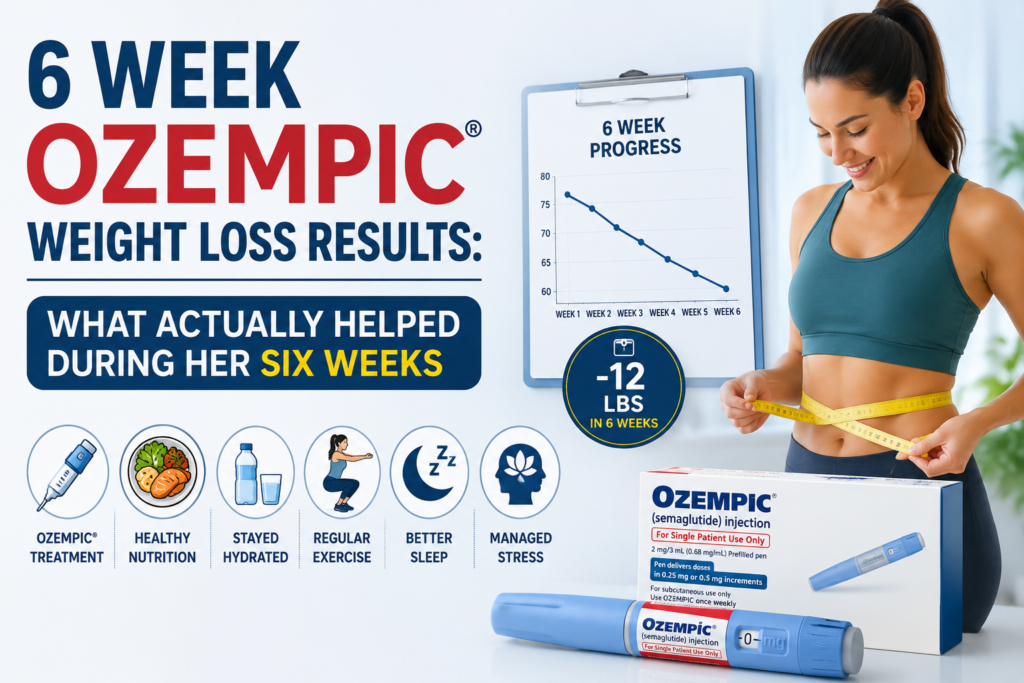
The clinical trials behind Ozempic’s weight loss data did not test the medication alone. They tested it alongside specific habits, and the published results reflect that combination.
Protein mattered more than my friend expected. Reduced appetite makes it surprisingly easy to under-eat protein without noticing, and research generally supports something in the range of 1.6 to 2.2 grams per kilogram of body weight for people in a calorie deficit who want to protect muscle. She started prioritizing protein at breakfast specifically, since that was the meal she was most likely to skip or shortchange.
Movement, broadly — not intense workouts, just consistent activity — shows up in essentially every study on optimal outcomes. The trial protocols generally included around 150 minutes of moderate activity weekly. For my friend, that meant a daily walk rather than anything resembling a gym routine.
Water came up more than she expected too — partly because it helps with some of the gastrointestinal side effects, and partly because reduced hunger cues sometimes come with reduced thirst cues, in a way that is easy to miss.
Reframing the Six-Week Mark
The most useful shift, based on what the data actually shows: six weeks is the foundation, not the result. The dose is still climbing for most people during this window. The body is still adjusting. The more substantial changes documented in clinical research — closer to 5 to 6% of body weight — tend to show up around the three-month mark.
That does not make the first six weeks meaningless. The appetite changes, the quieter food noise, the early downward trend on the scale — these are genuine signals the medication is working as designed. They are early-stage signals. Not the full story yet.
Worth Saying Plainly
Ozempic is FDA-approved for type 2 diabetes management. Its use for weight loss is generally an off-label application, prescribed at a provider’s discretion. Dosing decisions and any adjustments based on side effects or response belong to the prescribing provider — not to an online timeline, including this one.
My friend called again around week ten. Completely different tone. The scale had finally caught up to what her appetite had been telling her since week one.
That gap — between when the medication starts working and when it becomes visible — is the thing worth understanding before you start counting weeks at all.

Mikhaila Olena is a lifestyle writer and content creator behind Living Smart Daily, dedicated to sharing practical ideas, thoughtful insights, and everyday inspiration. With a passion for simple living and meaningful choices, she crafts content that helps readers create a more balanced, organized, and fulfilling life.





One comment on “6 Week Ozempic Weight Loss Results: What the Research Actually Shows”