









I did crunches for two years and got essentially nowhere.
Not zero progress — my core was stronger in ways I could feel during other exercises. But the visible results I was expecting, the actual definition I was training toward, were not appearing in any meaningful way. I was consistent. I was doing high volumes. I was doing them correctly, as far as I understood correctly. The problem, as I eventually discovered, was not the effort or the consistency. It was that I had fundamentally misunderstood what abdominal training is actually for and what it actually requires.
Here is what the research says, what a properly structured program looks like, and — most importantly — the thing that nobody wants to hear but that changes everything once you hear it.
The Thing Nobody Wants to Hear First
You cannot spot-reduce fat.
This is not a controversial claim in exercise science. It is settled. Doing 200 crunches a day will strengthen your rectus abdominis. It will not selectively burn the fat sitting on top of it. Abdominal definition — visible abs — requires the overall body fat percentage to drop below a threshold where the muscle underneath becomes visible. For most men, that threshold is roughly 10 to 12 percent. For most women, roughly 16 to 20 percent.
This means that an abdominal workout program has two distinct jobs. The first is developing the actual muscle tissue — making the rectus abdominis, obliques, and transverse abdominis thicker, stronger, and more defined. The second is operating within a broader approach to training and nutrition that reduces overall body fat enough for that development to become visible. A program that only addresses the first job will produce a stronger core that you will not be able to see. Both jobs need to happen in parallel.
I wish someone had said this to me before year one. It would have changed what I was doing significantly.
What the Abdominal Muscles Are Actually Doing
Most people think of abs as the six-pack muscle on the front of the stomach. The actual anatomy is more useful to understand.
The rectus abdominis is the long vertical muscle that creates the six-pack appearance when body fat is low enough. It runs from the pubic bone to the lower ribs and is responsible for spinal flexion — the movement that crunches are designed to train.
The obliques — internal and external — run diagonally along the sides of the torso. They handle rotation and lateral flexion. They are underworked in most abs programs that focus exclusively on crunches, and they are the muscles that create the athletic taper appearance when developed — the V-shape visible from the front, the definition visible from the side.
The transverse abdominis is the deepest layer, wrapping around the trunk like a corset. It does not contribute directly to visible appearance but is the muscle responsible for core stability — the ability to maintain intra-abdominal pressure during heavy compound lifts and athletic movements. Research highlights that resistance-based and functional core exercises are more effective than traditional crunches for muscle activation. Training only the surface muscles while neglecting the transverse abdominis produces an aesthetically developed core that underperforms functionally.
A program that trains all three muscle groups produces better visible results and better functional outcomes than one focused exclusively on the rectus abdominis.
The Four Movement Categories That Cover Everything
Effective abdominal training programs structure workouts around four distinct categories of movement, each serving a specific purpose.
Stabilization movements train the deep core — primarily the transverse abdominis — to maintain proper pelvic and spinal alignment. Planks are the most accessible version. Dead bugs, hollow body holds, and Pallof presses also belong here. These are not the glamorous exercises. They are the foundation that everything else builds on.
Flexion movements train the rectus abdominis through its primary function. Crunches qualify, but they are the entry point rather than the endpoint. Decline sit-ups, cable crunches, and hanging knee raises train the same motion with more resistance or greater range of motion. Research confirms that incorporating weighted abdominal exercises leads to greater muscle thickness — meaning progressive overload applies to abs the same way it applies to every other muscle group. Doing 100 bodyweight crunches is not the same as doing 12 weighted cable crunches from a meaningful resistance.
Rotation movements train the obliques. Cable woodchops, Russian twists with resistance, and rotational medicine ball throws target the diagonal fibers that crunches entirely miss. A study noted the superior engagement of oblique muscles during rotational movements with resistance. If your program does not include rotation, your obliques are being undertrained regardless of how many other exercises you do.
Hip flexor dominant movements work the lower portion of the rectus abdominis, which is consistently the underdeveloped section. Hanging leg raises are the gold standard — more demanding than any floor-based alternative and more effective for targeting the lower abs. Reverse crunches and leg raises on a decline bench also qualify.
The Program — Four Weeks, Three Sessions Per Week
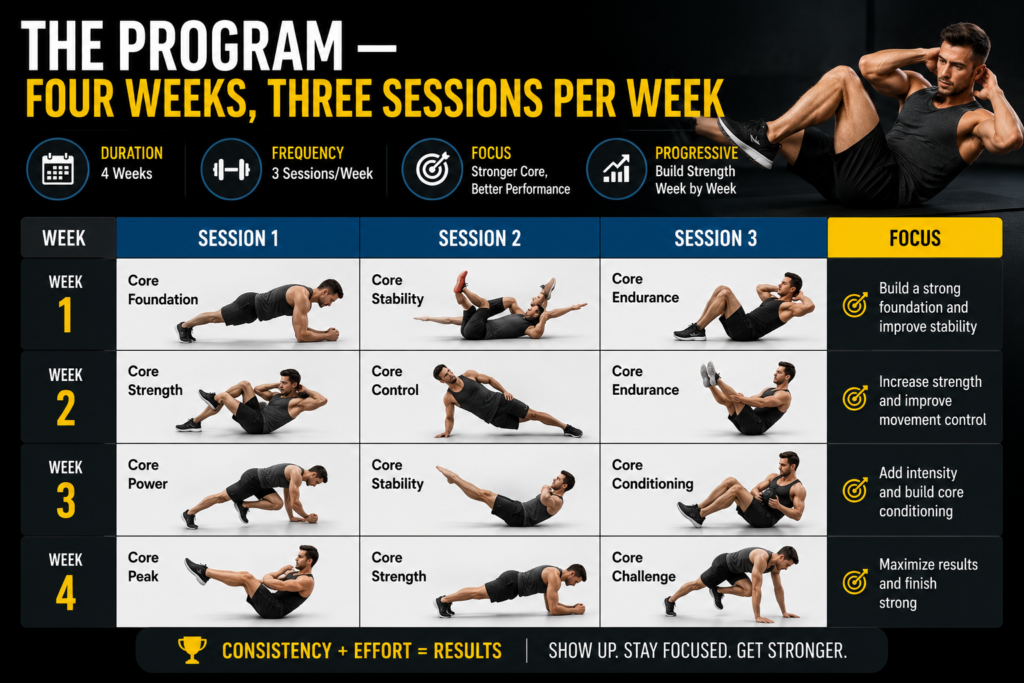
This is a program structured around progressive overload rather than volume. The number of repetitions matters less than the quality and the resistance. Each session takes 20 to 30 minutes and can be added after any other training or done as a standalone session.
Week One and Two — Foundation Phase
Plank: 3 sets, 30 to 45 seconds Dead bug: 3 sets of 8 per side Cable crunch: 3 sets of 12 to 15 (light resistance) Reverse crunch: 3 sets of 12 Cable woodchop: 3 sets of 10 per side
The goal in the first two weeks is learning to feel the target muscle contracting rather than relying on momentum. The cable crunch is most commonly done incorrectly because people pull with their arms instead of flexing through the spine. The movement initiates from the abs, not the arms.
Weeks Three and Four — Loading Phase
Plank: 3 sets, 45 to 60 seconds Hanging leg raise: 3 sets of 8 to 10 Cable crunch: 3 sets of 10 to 12 (increased resistance) Decline sit-up with weight plate: 3 sets of 10 Cable woodchop: 3 sets of 10 per side (increased resistance) Ab wheel rollout: 3 sets of 6 to 8
The ab wheel rollout is the exercise that separates people who have built real core strength from people who have done high-volume low-resistance training. It requires the entire core — transverse abdominis, rectus abdominis, and obliques — to work simultaneously to control a lengthening movement. It is uncomfortable. Start with a limited range of motion and extend further as strength develops.
The Frequency Question
Three sessions per week with a rest day between each is the standard recommendation, and it is well-supported. The abdominal muscles recover faster than larger muscle groups because of their fiber composition and the lower systemic demand of isolated core work, but they still require recovery. Daily training at high volumes is a common mistake — it creates fatigue without additional development and often increases cortisol levels in ways that work against abdominal definition.
Exercise programs need to follow an appropriate progression of first creating stability and proper sequencing of muscle contractions before progressing to complex, dynamic movements. This is why the first two weeks of the program above emphasize stabilization and lighter resistance — not because it is the most exciting phase, but because it is the phase that makes everything after it work properly.
Compound Lifts — The Part of the Program That Is Not in This Program
Deadlifts, squats, overhead pressing, barbell rows — these compound movements train the core as a stabilizer under heavy load in ways that no amount of isolated ab work can replicate. The transverse abdominis engagement during a heavy deadlift is more intense than anything on the program above.
This is not an argument to replace the dedicated ab program with heavy compound lifting. It is an argument to do both. People who do heavy compound lifting and dedicated ab work typically develop more functional and visible core strength than people doing either one exclusively.
If your current training does not include compound movements, adding them alongside this program will accelerate results significantly.
What Changed After I Changed the Program
Two things. The weighted cable crunches replaced the high-volume bodyweight crunches almost immediately, and the oblique work — which I had been neglecting almost entirely — went from nothing to a consistent part of every session.
The visible change started around week six. Not dramatic. But real — the kind of definition that showed up first in photographs before it became obvious in the mirror, which is a pattern I have heard from almost everyone who makes this kind of shift.
The thing that actually produced visible definition, though, was not the program change alone. It was the program change alongside the thing I said nobody wants to hear — the body fat percentage dropping below the threshold where the muscle underneath becomes visible. Both things needed to happen. Only one of them happens in the gym. That is still the honest summary of abdominal training. Build the muscle with a structured, progressive program that covers all four movement categories. Create the conditions for the muscle to become visible through consistent training and, eventually, nutrition that supports a calorie deficit.

Mikhaila Olena is a lifestyle writer and content creator behind Living Smart Daily, dedicated to sharing practical ideas, thoughtful insights, and everyday inspiration. With a passion for simple living and meaningful choices, she crafts content that helps readers create a more balanced, organized, and fulfilling life.





One comment on “Abdominal Workout Program: What Actually Works (And Why You Have Probably Been Doing It Wrong)”