









I almost booked a self-guided trip.
Flights shortlisted. A rough hotel list. A Google Maps folder called “Spain — maybe” with forty-three saved pins that I had been adding to for approximately eight months. I had traveled independently before and it had worked. But Spain specifically kept defeating me at the planning stage. Too many cities that felt non-negotiable. Too many train connections that were either obvious or completely unclear depending on which website I was on. And Spanish that extends, generously assessed, as far as ordering coffee and apologizing for my pronunciation.
My colleague Rachel had done an Intrepid Spain tour fourteen months before I started planning. She mentioned it once, I asked about it, and then she spent forty minutes telling me things that were not on any website I had found. That conversation is mostly why I ended up booking.
Here is what she told me and what I found when I went myself.
What Made Me Actually Stop Comparing and Book
Rachel’s version of the deciding moment was not about the itinerary. It was about an olive oil mill.
Between Cordoba and Granada, the tour stops at a family-run olive oil mill in the Andalucía region. The owner — who has been making olive oil the same way for decades — walks the group through the entire process himself. Not a presentation. Not a video followed by a gift shop. The man who makes the oil explains how he makes the oil, and then you eat lunch there: olives, olive marmalade, olive pate, wine, the oil itself in several variations.
“I didn’t know I cared about olive oil,” Rachel told me. “I left caring about olive oil.”
That is the detail that convinced me. Not the hotel tier or the number of included meals — those things matter and I checked them — but the fact that someone at Intrepid had decided a family olive oil producer in the Andalusia countryside was worth building into the middle of a fifteen-day itinerary. That kind of decision reflects a philosophy, not just a logistics operation.
The groups are small. Twelve to sixteen people. That is intentional — it is the size that fits into spaces that larger tours literally cannot enter, and it is the size where the social dynamic either works or does not, and where it works, it works well.
The First Night in Madrid
The tour starts with a welcome meeting, usually at six or seven in the evening on day one. Insurance details collected, next of kin information noted, the group sitting in a hotel somewhere in Madrid looking at each other for the first time.
It sounds administrative. It is also the moment when the trip actually starts.
Rachel described her group: two people in their late twenties on their first group tour ever, a couple in their mid-fifties who had done several, a woman in her thirties traveling alone, a retired teacher, a pair of friends from Australia who had been planning the trip for two years. Fourteen people total. By the end of the fifteen days, the Australian pair and the woman traveling alone had plans to meet in three months in Portugal.
Madrid has a particular quality on a first evening. The city does not really start until late — dinner at nine is early, locals eat at ten or eleven, and the Gran Via runs at full noise until well past midnight. You are jet-lagged or travel-tired or both, and the city is moving at a pace that makes you feel like you have arrived somewhere genuinely different. Which you have.
Seville
Rachel said Seville was her favourite. I had expected this — it comes up constantly when people talk about Spain — but I was not prepared for how specifically it would be her favourite.
“It’s the streets,” she said. “The Barrio Santa Cruz specifically. I got completely lost in it on the second morning and I didn’t care at all.”
The Barrio Santa Cruz is the old Jewish quarter — a maze of narrow whitewashed alleys designed, the story goes, to provide shade from the Andalusian summer heat. It is the kind of neighborhood that reveals itself as you walk it rather than presenting itself. The Triana quarter, across the Guadalquivir river, has a completely different energy: older residents, working-class pride, local bars that have not changed their interior since the 1970s and seem entirely unconcerned about it.
The flamenco performance on the Intrepid itinerary is in a venue small enough that the distinction between performance and experience collapses. Flamenco in a large tablao designed for tourists is one thing. Flamenco in a room where you can hear the heel strikes and see the sweat and feel the stomp through the floor is another thing entirely. I did not know that before I went. I know it now.
Seville is also, genuinely, the tapas capital of Spain. Not just a marketing claim. The density of good tapas bars per street is meaningfully higher than anywhere else I have been in the country.
Cordoba
The Mezquita is one of those buildings that photographs have robbed of their impact and presence has restored.
I had seen it hundreds of times in images. The red-and-white striped arches, 856 columns of marble and granite and jasper, extending in every direction. The cathedral built inside it during the Reconquista, sitting in the center of the mosque, an architectural record of a city that has been Muslim and Jewish and Christian in a sequence that is still visible in the streets around it.
None of that prepared me for the physical experience of standing inside it.
The guided tour through the Mezquita and the surrounding quarters of Cordoba is included in the itinerary. I would not have understood what I was looking at without the context, and the context changes everything. The interplay of Christian and Muslim cultures in Cordoba is not a historical footnote — it is the building itself, and understanding the history of the building changes what it is.
Granada
The Alhambra has limited daily entry and requires advance booking. This sounds like a logistical footnote. It is not.
Tours that have not pre-booked access are turned away at the entrance. This is not rare — it happens regularly to people who assumed they could purchase tickets on the day. The Intrepid itinerary handles the booking as part of the tour, which is one of those things that is invisible when everything works and would be catastrophic if it did not.
The Alhambra is a fourteenth-century Moorish palace complex on a hill above the city. The detail of the tilework and the carved plasterwork and the gardens is the kind of thing that takes time to see properly — rushing through it would be a waste of the booking. The free time built into the Intrepid itinerary means you have time to sit in the Generalife gardens and not be anywhere else.
Granada’s Albayzin — the old Arab quarter on the facing hill — has a mirador at the top that looks directly across at the Alhambra. Rachel told me to go there at dusk specifically. She was right. The view at dusk with the palace lit from within and the Sierra Nevada behind it is not something I will forget particularly quickly.
Valencia and Barcelona
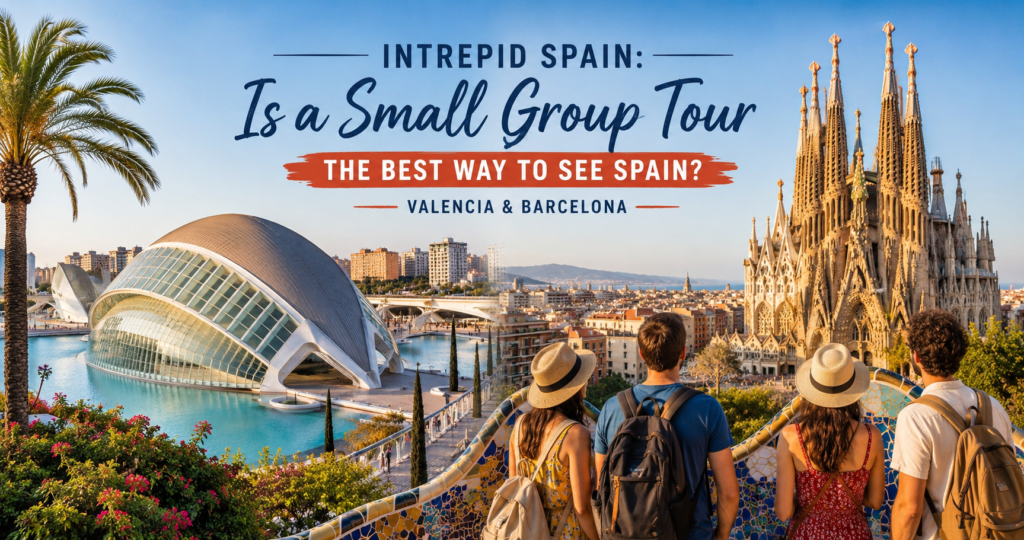
Valencia surprised me more than anywhere else on the route, which is probably because I had done the least preparation for it.
The Old Town is genuinely old — two thousand years of occupation, Roman foundations under medieval streets under baroque facades under contemporary restaurants. The Mercado Central is a modernist building filled with every ingredient of the Mediterranean diet and is worth an hour before it becomes a meal. The paella in Valencia is not the paella that has traveled internationally and lost something in translation. It tastes like it was made for a specific place, which it was.
Barcelona is where the tour ends, and it earns that position. The Sagrada Familia. Park Guell. Casa Batllo. The Gothic Quarter. The Boqueria. The beach. The particular energy of a city that has spent decades insisting on being itself rather than what other people assume it should be.
Rachel described the last night of the tour dinner in Barcelona as the kind of meal where nobody checks their phone and the conversation goes on long past when anyone planned to stay. I cannot confirm this directly — my group’s experience was its own thing — but the shape of it is accurate.
What Intrepid Spain Is and Is Not
It is not the cheapest way to see Spain. That is simply true.
What it is: pre-booked access to high-demand sites including the Alhambra, a locally-based leader who has relationships in the cities they work, groups of twelve to sixteen people rather than fifty, and access — the olive oil mill, the tapas bar in Seville where the owner knew the leader and brought out dishes that were not on the menu — that cannot be arranged with a search engine and a booking platform.
There are three price tiers. Original is tourist-class hotels, some meals included, a genuine mix of structured activities and free time. Comfort is more comfortable accommodation, a more relaxed pace, more included meals. Premium is the highest accommodation tier and the most experienced leaders. The difference between Original and Premium is real and measurable. The difference between Original and a carefully planned self-guided trip is harder to quantify and ultimately personal.
Rachel’s version: “I would have spent half the trip on my phone trying to figure out where I was. Instead I spent it actually being somewhere.”
I booked the Original fifteen-day itinerary from Madrid to Barcelona. I would book it again. Which is, probably, the most efficient summary I can offer.

Mikhaila Olena is a lifestyle writer and content creator behind Living Smart Daily, dedicated to sharing practical ideas, thoughtful insights, and everyday inspiration. With a passion for simple living and meaningful choices, she crafts content that helps readers create a more balanced, organized, and fulfilling life.



2 Comments on “Intrepid Spain: Is a Small Group Tour the Best Way to See Spain?”