




Morocco nearly broke me on day two.
Not in a dangerous way. Just in the way a place can when it’s louder, faster, more layered, and more alive than anything you prepared yourself for. I turned down a wrong alley in Fes and ended up in what I can only describe as a donkey traffic jam — three donkeys, a cart of copper pots, six men shouting in Darija, and me flattened against a wall holding my bag like a complete fool.
I loved every second of it.
That’s the thing about Morocco. It doesn’t ease you in. It just… begins. And if you let it, if you stop trying to control the experience and just walk into it, it becomes one of those trips that reorganizes something in you permanently.
This guide is for people who want that Morocco. The intrepid Morocco. Not the version that happens between the hotel lobby and the tour bus.
Before Anything Else — Know What You’re Getting Into
Morocco is not difficult to travel. I want to be clear about that upfront, because some people read “intrepid” and assume it means dangerous or grueling. It doesn’t.
What it means is that Morocco rewards the traveler who shows up curious rather than cautious. Who doesn’t need every meal to be predictable. Who can handle being stared at, spoken to in three languages they don’t know, and handed tea by someone who genuinely just wants to sit and talk.
The infrastructure is fine. The people are, overwhelmingly, kind. The food is extraordinary. What trips people up is expectation — specifically, the expectation that Morocco will behave like somewhere else.
It won’t. That’s the whole point.
Where to Go (And What the Maps Won’t Show You)
Marrakech — Walk North, Not South
Everyone goes to Jemaa el-Fna. Fine. Go there once, late evening, when the food stalls are set up and the smoke from the grills drifts across the square. Watch the storytellers and the musicians. Buy some olives from the market.
Then don’t go back.
The medina above the square — north toward Bab Doukkala, up past the dyers’ souk and the carpenters’ alley — that’s where Marrakech is still doing its actual job of being a city rather than a backdrop for photographs. It’s louder, messier, and about fifty times more interesting. Go early morning, around seven, when the bread sellers are out and the schoolkids are everywhere and the whole thing smells like charcoal and fresh mint.
The Ali Ben Youssef Medersa is worth the small entry fee twice over. Twelfth-century Islamic architecture with tilework so intricate you’ll stand in front of it for longer than you planned. The Jardin Majorelle is fine if you like blue and cacti, which I do, but get there before ten or it’s a photography scrum.
One thing most guides skip: the rooftops. Half the riads in the medina will let you climb up to the terrace if you ask politely and offer a small tip. The view over the medina at dusk — just the minarets and the rooftops and the sound of the evening prayer — is the kind of thing you came to Morocco for.
The High Atlas — Where Morocco Gets Quiet
The drive from Marrakech over the Tizi n’Tichka pass toward Ouarzazate is something I think about regularly. It’s about three hours of switchbacks and altitude and views that open up suddenly around corners and make you grip the door handle.
At the top of the pass, around 2,260 meters, there are men selling amethysts and fossils from folding tables. Stop. Not necessarily to buy anything — though the fossils are genuinely good — but because standing at that altitude with the Atlas spreading out around you in every direction is a properly vertiginous experience.
Aït Benhaddou is down the other side. Yes, it’s famous. Yes, you’ve probably seen it in a film without knowing it was Morocco. It still earns its reputation in person — the ksar rises out of the valley floor in these layers of mud brick that seem to change color by the hour depending on where the sun is. Stay the night if you can. The day-trippers leave by four and then it’s just you and the resident families and the light going golden on the walls.
The Draa Valley — Slow Down Here
South of Ouarzazate, the road follows the Draa River through a corridor of palm groves and kasbah ruins for nearly two hundred kilometers. Nobody seems to be in a hurry here. Small towns appear and disappear. Goats cross the road without concern.
I’d argue this stretch of driving is better than arriving anywhere. The valley is that good.
Zagora is at the far end — a hot, low-key town that’s mainly useful as a jumping-off point for deeper desert experiences. There’s a famous sign here pointing toward Timbuktu with the mileage in camel days. It’s old, weathered, and excellent.
If you have the flexibility, ask locally about the piste routes that cut through the valley off the main road. They’re rough in places but passable, and the villages you pass through — places that see maybe a handful of foreign visitors a year — are among the most quietly remarkable things Morocco offers.
Merzouga and the Erg Chebbi — Yes, Do the Dunes
I was skeptical. Dunes feel like they might be overhyped. They’re not.
The Erg Chebbi dunes near Merzouga come up out of absolutely nothing — flat gravel plain for miles and then, suddenly, these enormous orange mountains of sand. The biggest top out above 150 meters. The color shifts constantly. At sunrise they’re almost red. By midday they’re pale gold. At sunset they go deep amber.
Wake up early — embarrassingly early, like four-thirty — and climb the nearest dune on your own before the guided groups head out. Sit at the top when the sky starts turning. Cold, quiet, enormous. Worth every minute of lost sleep.
The desert camps range from genuinely special to actively bad. Don’t book based on photos alone; the photos lie. Ask your riad host in Marrakech or Fes — they usually have an honest opinion about which camps are actually worth staying at rather than the ones paying the highest commission.
Fes — The City That Hasn’t Decided What Century It Is
Fes el-Bali is the oldest continuously inhabited medieval city on the planet, and it feels like it. Not in a dusty museum way — in the sense that it is still, right now, doing medieval things. Tanners treating leather in stone vats the way they have for nine hundred years. Copper workers hammering in the same quarter they’ve occupied for centuries. Mule carts carrying deliveries down streets too narrow for anything with an engine.
It is genuinely disorienting in the best possible way.
The Chouara Tannery is the famous stop — colorful vats, leather drying on rooftops, the smell that the mint leaves the shopkeepers give you only partially address. But don’t rush it. The overlooks get crowded; find one of the quieter ones a little further along the ridge and spend some time watching. It’s a working place, not a performance, and it deserves more than a quick photograph.
My real advice for Fes: find a local guide, not through your hotel (they get commission), but through a recommendation or a quick ask around the medina. Not for the tourist circuit. Ask them to walk you through their neighborhood. The Andalusian quarter on the east bank — quieter, older-feeling, almost no visitors — is the version of Fes I think about most.
Chefchaouen — The Blue City That Actually Earns It
I almost skipped Chefchaouen because the Instagram version of it looked too perfect to be real. Then I went and realized that sometimes a place genuinely is what the photos suggest, and in fact the photos can’t quite capture it because they can’t capture the quietness.
It sits in the Rif Mountains in the north. The streets really are that blue — not uniformly, but in layers of indigo and powder blue and pale turquoise that shift depending on how the light hits them. The whole city moves slowly. Cats appear on every corner (there are a lot of cats). People sit. The market in the main plaza is actual and functional, not decorative.
Go in the early morning or around four in the afternoon. The light is different and most of the day-trippers are either not there yet or have left. The medina without the crowd is a completely different experience.
The Things That Actually Matter for Planning
When to go: March to May is the best Morocco I’ve heard described consistently — wildflowers in the Atlas, comfortable temperatures in the south, manageable crowds. September and October are also excellent. Avoid July and August inland; Marrakech in peak summer is genuinely brutal (40°C or above and nowhere to hide), and Fes is worse.
Getting around: The train between Casablanca, Rabat, Fes, and Marrakech is good — reliable and cheap. For the south, either rent a car (the roads are fine on main routes), hire a driver for a day or a few days (surprisingly affordable), or use supratours buses which cover most routes the train doesn’t.
Food rule: If the menu is in English and has photographs, keep walking. Find the place with the handwritten chalkboard and the table of older men eating lunch. Order whatever they’re having.
Harira — the tomato and lentil soup — is one of the best things you’ll eat in Morocco and it costs almost nothing. Msemen (the flaky pan-fried bread) with argan oil and honey at breakfast is non-negotiable. And fresh orange juice from a street stall is so good it borders on unfair.
On local interaction: The hospitality in Morocco is real. The tea invitation from someone with no apparent agenda is usually exactly that — just someone who wants to talk. In heavy tourist areas, particularly around Jemaa el-Fna, there are persistent commission hustlers. “La, shukran” — no, thank you, in Darija — said once, firmly and without breaking stride, works better than any other response.
Learn a few words of Darija before you arrive. Even mangled attempts at “sbaH l-khir” (good morning) or “shukran bzaf” (thank you very much) will earn you a warmth that completely changes how you’re received. Moroccans genuinely appreciate the effort in a way that doesn’t feel performative.
On dress and culture: Morocco is conservative outside major cities. Covering shoulders and knees costs you nothing and matters a great deal in smaller towns, rural areas, and anywhere near a mosque. In the medinas, follow the lead of local women. In the mountains and the south, cover up without being asked to.
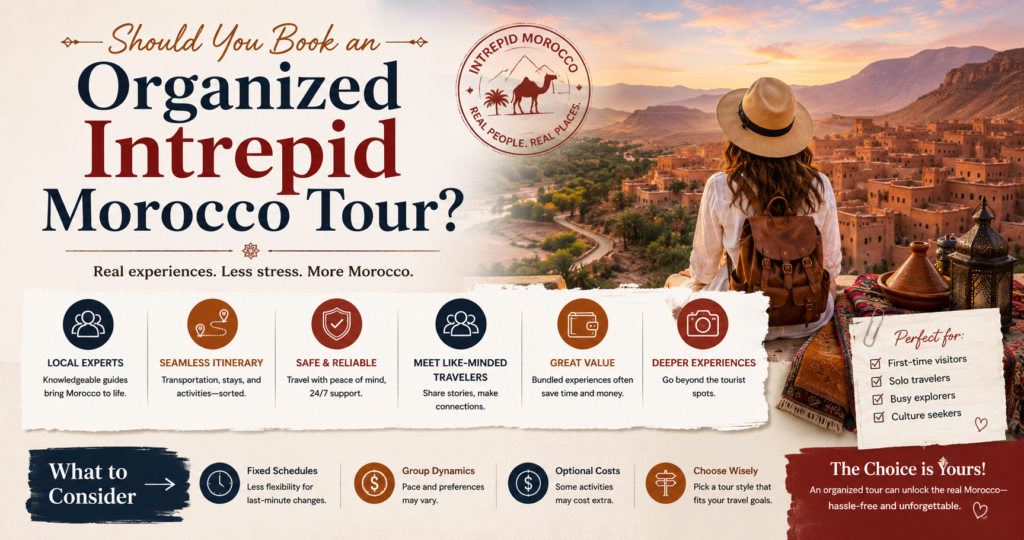
Should You Book an Organized Intrepid Morocco Tour?
Depends entirely on what you want from the trip.
If it’s your first time and you want to cover ground without the overhead of figuring out transport, guides, and accommodation in a place that doesn’t always make those things easy, then yes — a well-organized Morocco tour does that job properly. You get to Aït Benhaddou, you get to the dunes, you don’t spend a day stranded waiting for a bus that turns out to only run on Tuesdays.
The cost is spontaneity. You can’t follow the donkey cart down the alley it turned into. You can’t spend an extra night in Chefchaouen because you realized you needed to. You’re on someone else’s clock.
The solution I’d suggest: do the organized trip first to understand the country’s geography and rhythm, then come back independently for the parts that grabbed you. Morocco is the kind of place that earns a return visit. Most people who go once are back within three years.
One Last Thing
The best moment of any intrepid Morocco trip is almost always something unplanned. It’s the wrong turn in the medina. It’s the roadside mechanic in the Atlas who fixes your tire and refuses any payment. It’s the family who spots you looking lost outside their village and brings out a carpet and tea and fifteen minutes of warmth before pointing you back toward the road.
That’s what Morocco gives the traveler who stays curious.
Go. Get a little lost. Drink the tea. Stay longer than you planned.

Mikhaila Olena is a lifestyle writer and content creator behind Living Smart Daily, dedicated to sharing practical ideas, thoughtful insights, and everyday inspiration. With a passion for simple living and meaningful choices, she crafts content that helps readers create a more balanced, organized, and fulfilling life.


One comment on “Intrepid Morocco: What Nobody Tells You Before You Go”