




You need an image. Doesn’t matter if it’s for a blog post, a school project, a flyer for a garage sale — you need one, and the good ones cost money, and the free ones come wrapped in licensing terms that somehow feel more complicated than the actual project you’re trying to finish. Public domain images solve this in about the cleanest way possible. They belong to no one and everyone simultaneously. Use them, edit them, remix them, sell work built around them — no permission needed, no fee, no email to some photographer asking nicely.
Here’s the catch though: “public domain” gets thrown around loosely all over the internet, and a lot of what’s labeled free isn’t actually public domain. It’s something else entirely, with its own set of rules attached that nobody bothered to read before hitting download. So let’s actually sort this out — what the term means, how something legally becomes public domain in the first place, where to find images you can trust, and the mistakes that trip up people who really should know better.
What “Public Domain” Actually Means
A work is public domain when nobody holds exclusive copyright over it anymore. No license to track. No attribution technically required, though you should probably do it anyway. No expiration date on your right to use it, ever. This is a real, meaningful difference from “free” images licensed under specific terms — those can still carry restrictions even when no money changes hands.
A few different paths lead there:
Copyright just runs out eventually. In the US that’s generally the life of the author plus 70 years for individually authored work, though the exact rules have shifted over the decades depending on when something was published — it’s genuinely a little messy. Every year a new batch of older material crosses that line and becomes public domain.
Government work is different by design. Anything created by a US federal employee doing their job is automatically public domain from day one. That’s why NASA, NOAA, the Library of Congress — agencies like that — have such massive freely usable photo collections. The law set it up that way intentionally, on the idea that taxpayer-funded work shouldn’t then be copyrighted against the taxpayers who funded it.
Sometimes a creator just dedicates their work to the public domain directly, often using something formal like a CC0 waiver, which gives up basically every right they’d otherwise hold.
And some things never qualified for copyright to begin with — plain facts, most government documents, very old material that predates modern copyright systems entirely.
Where People Get Tripped Up
“Free image” gets slapped on a lot of things that aren’t public domain, and understanding the gap matters more than most people assume going in.
Creative Commons isn’t the same thing as public domain, and this trips people up constantly. A lot of “free stock photo” sites blend genuinely public domain images with Creative Commons ones, and those two categories are not interchangeable. Some CC licenses need attribution. Some ban commercial use outright. Some won’t let you modify the image at all. Only CC0 functions like true public domain — everything else in that family comes with strings, even when the download itself is free.
Then there’s public domain photos of copyrighted subjects, which is a subtler trap. A photograph can be public domain while showing something that’s still protected separately — a trademarked logo, artwork still under copyright, a recognizable branded product sitting in the background. Using that image commercially can still get you into trouble even though the photo’s own copyright expired years ago.
And honestly, mislabeling happens all the time. Nobody’s actively policing public domain claims on random aggregator sites, so images get tagged wrong constantly — sometimes by accident, sometimes because someone uploaded copyrighted material and just claimed it was free. Which is exactly why sourcing from institutional collections beats trusting a random “100% free images!” site every time.
Reliable Sources Worth Bookmarking
Wikimedia Commons is probably the biggest curated collection out there, and every single file has its own license tag rather than one blanket claim covering the whole site. Click through to the actual file page. Don’t just trust the thumbnail — the collection genuinely mixes license types alongside its public domain content.
Museum collections have gotten really good over the last decade. The Met, the Rijksmuseum, the Art Institute of Chicago, the Smithsonian — all of them have digitized huge chunks of their out-of-copyright holdings and released them as high-res public domain downloads. If you need fine art or historical portraiture or archival photography, start here. The scan quality tends to be excellent too, since these are professionally done, not someone’s phone photo of a painting.
NASA’s image library is entirely public domain, full stop, because it’s produced by federal employees. First stop for anything space-related, obviously.
The Library of Congress has an enormous archive of historical American photography and documents — a lot of it public domain, especially documentary and photojournalism work from the early-to-mid 1900s, plus old maps, posters, government records.
The New York Public Library’s Digital Collections cover similar territory — historical photos, maps, illustrated material that’s aged into public domain status.
Unsplash and Pexels deserve a mention even though, technically, they’re not public domain archives. They use their own permissive licenses that in practice let you use images freely for most personal and commercial purposes, no attribution required — functionally similar to public domain for everyday use, even if the legal structure underneath is different. Worth knowing that distinction rather than assuming these are literal public domain sites, because they’re not, not exactly.
Verifying Before You Use Something Commercially
A little effort here goes a long way, and it matters more the higher the stakes.
Do a reverse image search. Takes under a minute. Can reveal whether an image is floating around with conflicting license claims on different sites, or tied to a photographer who never actually released it for free use.
Check the license on the specific file, not the site’s general vibe. Even the good archives host a mix of license types. Look at what’s documented for that individual item rather than assuming everything on the platform is equally free.
Look for an actual rights statement. Good institutional sources publish one for each item, often naming the specific legal basis — expiration date, government work status, formal CC0 dedication, whatever it is.
Keep records. For commercial work especially, write down where each image came from and what its license status was when you got it. If a dispute ever comes up, a documented trail beats “I think I found it on some free site” every time.
Where People Actually Use These
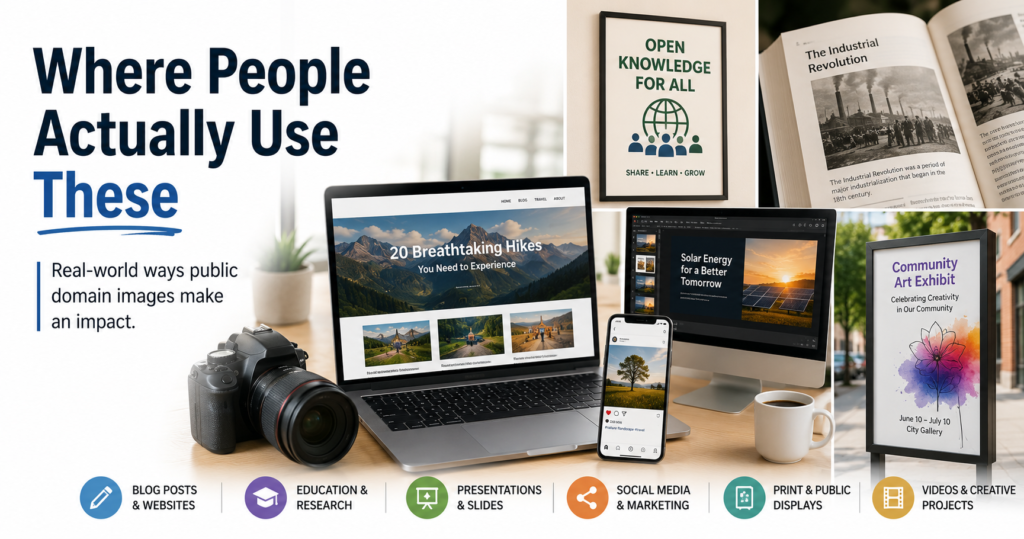
Blogging and content marketing is the obvious one — public domain images work well for headers and illustrative photography since there’s no ongoing licensing cost no matter how much traffic the post ends up getting.
Print projects too. No license restricting physical reproduction means these work for greeting cards, posters, merchandise — anywhere a Creative Commons “non-commercial” clause would otherwise be a real problem.
Educational material leans on this constantly. Teachers pull historical photos, scientific imagery, classic artwork from public domain archives because it can go into course packets and presentations without navigating some institution’s licensing department.
Design work sometimes incorporates public domain illustrations or vintage photography into branding, since there’s zero risk of a licensing dispute resurfacing years after a product’s already launched and the whole thing’s out of your hands.
Quick Questions People Actually Ask
Do I need to credit the source even though it’s public domain? Legally, no — that’s kind of the whole point of public domain versus other free-use licenses. But crediting the museum or archive costs you nothing and helps keep these institutions funded to keep digitizing more material. Worth doing anyway.
Can I modify public domain images? Yes. No copyright holder means nobody can stop you from cropping, recoloring, combining, altering however you want.
Is something public domain just because it doesn’t have a watermark? No, not remotely. Plenty of copyrighted stuff floats around unwatermarked. That tells you nothing about legal status.
Are all old photos automatically public domain? Not automatically, no. Age alone isn’t proof — depends on when and where it was published, who made it, what legal framework applies. Verify, don’t assume just because something looks old.
Bottom Line
Public domain images are one of the few genuinely free things left on the internet that come with real legal certainty attached — as long as you actually verify before you use them. The gap between a true public domain image and a loosely-licensed “free” one can matter a lot, especially for commercial work, and the extra few minutes it takes to check is cheap insurance against a much bigger headache later.

Mikhaila Olena is a lifestyle writer and content creator behind Living Smart Daily, dedicated to sharing practical ideas, thoughtful insights, and everyday inspiration. With a passion for simple living and meaningful choices, she crafts content that helps readers create a more balanced, organized, and fulfilling life.


2 Comments on “Public Domain Images: The Complete Guide to Finding and Using Them Legally”