









If you’ve had a dog or cat for more than a season, you’ve run into Frontline somewhere — a vet recommended it, or you spotted the box at the pet store, or another owner mentioned it while dealing with a flea problem of their own. It’s one of the most widely used topical flea and tick preventatives out there, and it’s been around long enough to build a real track record. But like any pet medication, it’s worth actually understanding it rather than just grabbing whatever box is on the shelf — how it works, how to apply it right, what to watch for, how it stacks up against other options.
So let’s get into it. What Frontline actually is, what’s happening biologically when you use it, how to apply it correctly, what can go wrong, and where it fits next to the alternatives.
What Frontline Actually Is
Frontline is topical — goes directly on the skin, not swallowed like a pill. The core active ingredient across most of the product line is fipronil, an insecticide that targets the nervous system of fleas and ticks. A lot of formulations, Frontline Plus especially, pair fipronil with something called (S)-methoprene, an insect growth regulator that stops flea eggs and larvae from maturing into adults that bite and reproduce.
That combination is part of why Frontline gets marketed as handling two problems simultaneously — the fleas and ticks already on your pet right now, and the quieter risk of a new infestation building up from eggs and larvae already sitting in the carpet or the bedding or wherever your pet spends time outside.
How the Two Ingredients Actually Work
Fipronil messes with chloride ion channels in the nervous systems of insects and arachnids, basically overstimulating them until they’re paralyzed and die. It’s formulated to settle into the sebaceous glands in a pet’s skin, which is why one application keeps killing fleas and ticks for roughly a month instead of washing off or breaking down after a few days.
Methoprene works completely differently — it doesn’t kill adult insects at all. It mimics a juvenile hormone that keeps flea eggs and larvae from maturing into reproducing adults, cutting off the next generation before it starts. Using both together handles the visible adult flea problem and the invisible life-cycle problem at the same time, which is a big part of why combination products tend to outperform single-ingredient ones for ongoing control.
Applying It Correctly
Frontline goes on as a spot-on treatment — a small, pre-measured amount placed directly on the skin, usually at the back of the neck or between the shoulder blades, somewhere the pet can’t easily reach to lick off. Over roughly a day it spreads across the skin through the coat’s natural oils, rather than getting absorbed into the bloodstream the way an oral medication would.
A few things actually make a real difference here:
Get it on skin, not just fur. It needs to reach the skin to spread properly and reach those sebaceous glands. Applying it on top of a thick, matted coat without parting down to skin can seriously cut how well it works.
Match the product and dose to species and weight — this one’s important. Frontline is formulated differently for dogs versus cats, and dosed by weight range within each. Using a dog product on a cat is a real and unfortunately common mistake. Certain flea-tick combination products can be genuinely dangerous, even fatal, for cats — their metabolism processes some compounds very differently than a dog’s does. Always use exactly what’s labeled for your pet’s species and weight. No exceptions here.
Don’t bathe too close to application, before or after. Most labels say wait a day or two, since the product needs time to spread and settle into the skin’s natural oils. Bathe too soon and you can meaningfully reduce that month’s effectiveness.
What It Actually Covers
Frontline products are generally labeled to kill fleas at every life stage present on the pet, along with several tick species — including, in a lot of formulations, the ones that carry Lyme disease. Some versions in the line handle chewing lice too. Coverage isn’t identical across every product (Frontline Plus versus other variants), so check the actual label on whatever you’re using rather than assuming the whole brand covers the same things.
What to Actually Expect, Timeline-Wise
A common misconception — that a topical treatment gives instant, total protection the second it’s applied. Not quite. There’s usually a window of several hours before full effectiveness kicks in against parasites already present. A tick already attached when you apply it might not detach immediately, though the product should still work to kill it over the following hours or so.
Reinfestation from the environment is still possible even with a correctly applied treatment, especially in homes or yards already dealing with an active flea population. Bedding, carpet, outdoor areas — not just the pet — often need attention too, especially in the first month or two of getting an infestation under control.
Safety and Side Effects
Every pet reacts a little differently, and most reactions, when they happen, are mild. Temporary irritation or redness right at the application site is the most commonly reported issue, and it usually clears up in a day or two on its own.
More significant reactions — excessive drooling if a pet licks the spot before it’s dry, lethargy, upset stomach — are less common but not impossible, and worth a call to the vet if you see them. This is really why it’s worth talking to a vet before starting any new flea or tick product, especially for very young or senior animals, pregnant or nursing pets, or anything with existing health issues.
Store it securely too, out of reach — accidental ingestion, by pets or curious kids, is a real concern with any concentrated topical insecticide sitting around the house.
Frontline vs. the Alternatives
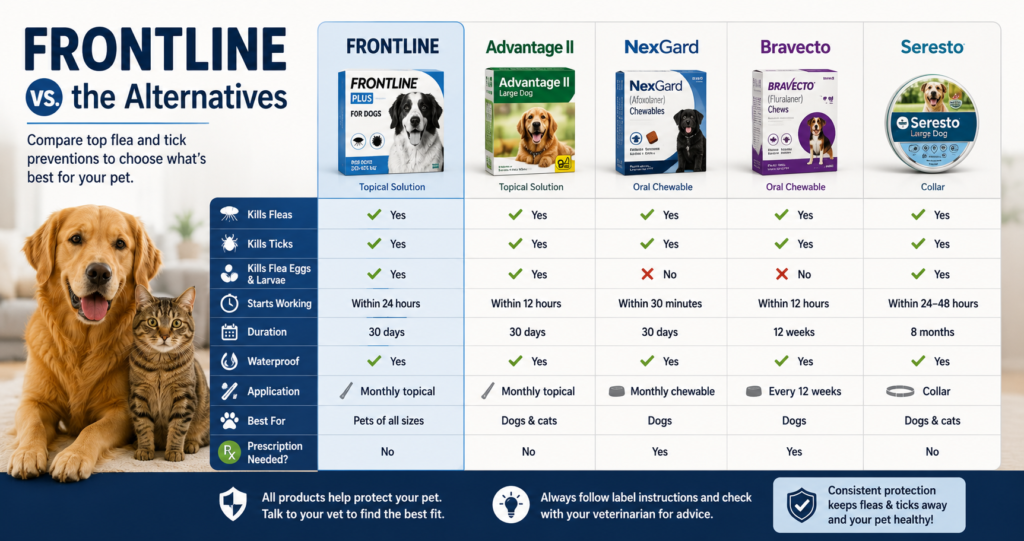
Oral preventatives work systemically, through the bloodstream, instead of topically. Some owners prefer this — no residue, nothing that wears off from bathing or swimming, no worry about it rubbing off on human skin through contact. Others specifically want to avoid a systemic medication, particularly for pets with certain sensitivities, and go topical for that reason instead.
Flea collars can offer longer coverage in some cases, though effectiveness varies a lot, and protection tends to concentrate more around the head and neck rather than spreading evenly across the body.
“Natural” or chemical-free alternatives exist, sure, but they generally show weaker, less consistent results in controlled studies compared to fipronil-based or prescription systemic options — and shouldn’t be assumed to offer the same level of protection, especially against tick-borne disease.
There’s no single “best” answer here. It depends on your pet’s health, lifestyle, how much pest pressure exists where you live, and honestly how you’d prefer to administer something. A vet is genuinely the best resource for sorting through the tradeoffs for your specific animal.
Misconceptions Worth Clearing Up
“My cat’s indoor-only, so it doesn’t need protection.” Fleas hitch rides inside on clothing, on other pets, through window screens. Indoor cats sometimes end up at higher risk precisely because owners assume prevention isn’t necessary and skip it entirely.
“One dose means I’m covered indefinitely.” No — it’s formulated for about a month per application, not a one-time fix. Consistent monthly use is what actually prevents infestations, rather than treating one after it’s already happened.
“More product works better.” It doesn’t. Going over the labeled dose doesn’t improve protection and meaningfully raises the risk of a bad reaction. The safety and efficacy data are built around correct, weight-appropriate dosing — nothing more.
When to Loop In Your Vet
Flea and tick prevention isn’t one-size-fits-all, and there’s no reason to figure it out solo. Where you live, your pet’s specific lifestyle — indoor versus outdoor, time spent in wooded or grassy areas, contact with other animals — plus any existing health conditions, all factor into what actually makes sense. A vet can weigh Frontline against oral options or other topicals, confirm the right dose for your pet’s exact weight and species, and flag anything that might interact with other medications your pet’s already on.
Bottom Line
Frontline’s stuck around this long for a reason — decades of use, a well-understood mechanism, a solid track record when used correctly. Matched to the right species and weight, applied properly to skin, kept on a consistent monthly schedule, it’s a genuinely effective tool against two of the more common — and more genuinely risky — external parasites pets deal with. Consistency ends up mattering more than which specific product you pick. Most flea and tick preventatives, Frontline included, work best as an ongoing routine, not something you reach for only after you’ve already spotted a problem.

Mikhaila Olena is a lifestyle writer and content creator behind Living Smart Daily, dedicated to sharing practical ideas, thoughtful insights, and everyday inspiration. With a passion for simple living and meaningful choices, she crafts content that helps readers create a more balanced, organized, and fulfilling life.





One comment on “Frontline for Flea and Tick Prevention: A Complete Guide for Pet Owners”