




Nobody warns you about this before your first session: a lot of therapy isn’t talking. Not really. Behavioral therapy is built around doing things specific, repeatable actions meant to break patterns that just talking about feelings tends to leave untouched. I’ve sat in on enough conversations with people mid-treatment to notice the same confused question comes up constantly. “Okay but what am I actually supposed to do differently this week?” Behavioral techniques are usually the answer.
Quick disclaimer before we go further. None of this replaces an actual licensed therapist. Consider it a map instead something that helps you understand what a technique is doing and why, whether you’re researching this for yourself, a client, or a worried family member trying to make sense of a diagnosis.
The Whole Idea, Stripped Down
Behavior is learned. What’s learned can be unlearned, or at least reshaped. That’s really the entire premise behavioral therapy rests on.
It doesn’t spend much time digging through childhood that’s psychodynamic territory, a different animal entirely. Behavioral work looks at right now. What triggers the behavior. What reinforces it. What small, structured change might actually break the cycle instead of just naming it.
Different approach than processing feelings for an hour. And that’s exactly why it keeps showing up in treatment for anxiety, OCD, phobias, and those grinding habit-driven struggles nail-biting, skin-picking, the stuff people are embarrassed to even bring up.
Exposure Therapy: You Face the Thing. On Purpose.
Most well-known technique on this list. Also the most misunderstood one, by a wide margin. People hear “exposure therapy” and picture something closer to “just get over it,” which isn’t remotely what’s happening. It’s structured. Gradual. A controlled climb from mildly uncomfortable toward genuinely difficult, one rung at a time.
Take someone with a fear of flying. Step one might just be looking at pictures of airplanes. Step two, visiting an airport without boarding anything. Eventually, a short flight, support person in the seat next to them. Each step teaches the nervous system something that talking never quite manages the feared outcome doesn’t actually happen, and if you stay with the anxiety long enough, it fades on its own.
A few variants worth knowing by name:
- In vivo exposure — facing the real situation, no substitutes
- Imaginal exposure — vividly imagining the feared scenario, common in trauma work
- Interoceptive exposure — deliberately triggering physical sensations like a racing heart or dizziness, so the sensation itself stops feeling dangerous. Used a lot in panic disorder treatment.
CBT: Where Thoughts and Behavior Argue With Each Other
CBT pairs behavioral work with cognitive restructuring catching distorted thoughts and actually testing whether they hold up under pressure. The behavioral half looks like homework, honestly. Mood tracking. Testing a belief against real-world evidence. Trying something new specifically to gather data that contradicts an old, tired assumption.
Here’s a scenario I think about a lot: someone convinced that speaking up in meetings will make everyone think they’re incompetent. The behavioral move isn’t debating that belief in the therapist’s office it’s speaking up once, on purpose, then actually watching what happens. Not assuming. Watching. That’s the difference between cognitive and behavioral, and it matters more than people expect.
Behavioral Activation: Action First, Motivation Whenever It Shows Up
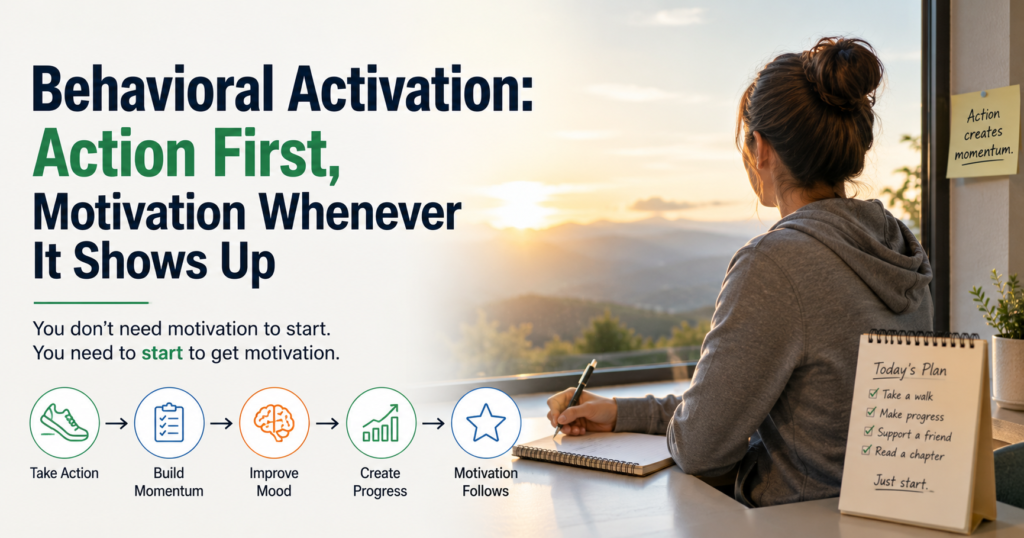
This one flips the usual order on its head. Most of us wait to feel motivated before we do anything. Behavioral activation says that’s backward action tends to come first, motivation trails behind it, sometimes by days.
Heavily used in depression treatment, where withdrawal and inactivity feed a downward spiral that gets harder to climb out of the longer it runs. The technique itself is unglamorous: scheduling small, values-aligned activities, even the ones that feel completely pointless in the moment. A short walk. Calling a friend instead of letting the phone sit there. Actually cooking a meal instead of skipping it again. None of it looks dramatic on paper. The cumulative effect on mood, though that part is well documented.
Habit Reversal Training
Built specifically for repetitive behaviors: hair-pulling, nail-biting, tics, skin-picking. Two stages here. First, building plain awareness of the behavior and what triggers it a lot of people do these things almost unconsciously, which sounds strange until you notice how often it’s true for you too. Second, introducing a competing response. Something physically incompatible with the habit, deployed the instant the urge shows up.
Someone working on nail-biting might be trained to clench both fists for sixty seconds the second they feel the urge. Sounds almost too simple to work. The awareness-plus-substitution combination has real research behind it for these specific behaviors, though, and that’s not nothing.
Systematic Desensitization
Close cousin of exposure therapy. This one pairs relaxation techniques with a gradual climb through a fear hierarchy, on the logic that fear and deep relaxation can’t really occupy the body at the same time. Stay relaxed while facing progressively harder steps on the ladder, and the anxious response slowly gets crowded out.
Still widely used for specific phobias needles, heights, small enclosed spaces where the fear is narrow, well-defined, and doesn’t sprawl into everything else.
Token Economies
More common in classrooms, inpatient programs, and parenting strategies than in one-on-one adult therapy. Straightforward reinforcement: desired behaviors earn tokens, tokens convert into rewards. Not glamorous. Not exactly cutting-edge either. But the underlying principle reinforced behavior tends to repeat is one of the oldest, most consistently supported ideas in all of behavioral psychology. Old doesn’t mean wrong here.
DBT Skills
Technically a branch of CBT, but it earns its own section because the skill set is so specific: distress tolerance, emotion regulation, interpersonal effectiveness, mindfulness. TIPP is a good example temperature, intense exercise, paced breathing, progressive muscle relaxation. One job: get through an intense emotional spike without making the situation worse in the process.
Originally built for borderline personality disorder. It’s since spread into general anxiety and emotion regulation work, and honestly, that spread makes sense. Most people could use a sturdier toolkit for handling emotional spikes than “just calm down.”
So Which One Actually Fits?
No universal answer, and I’d be suspicious of anyone claiming otherwise. Exposure-based work tends to fit fear and anxiety disorders. Behavioral activation fits depression and low-motivation states. Habit reversal fits repetitive body-focused behaviors. DBT skills fit intense, hard-to-regulate emotions. A trained therapist usually mixes and matches based on what’s actually driving the pattern underneath which is exactly why self-diagnosing off a blog post only gets you so far. If any of this sounds familiar, the honest next step is talking to a licensed therapist who can actually assess what’s going on and build something around it. This overview is a starting point for understanding the language and logic behind treatment. It’s not a replacement for it, and it was never meant to be.

Mikhaila Olena is a lifestyle writer and content creator behind Living Smart Daily, dedicated to sharing practical ideas, thoughtful insights, and everyday inspiration. With a passion for simple living and meaningful choices, she crafts content that helps readers create a more balanced, organized, and fulfilling life.





One comment on “Behavioral Therapy Techniques That Actually Change How You Respond to Life”