









Nobody warns you about the airport.
You land at Juan Santamaría, drag your bag off the carousel, and before you even reach the exit doors, three separate men are holding signs and telling you they can get you to Jaco for $120. One of them looks official. He has a lanyard. He might even have a clipboard. And you are tired, it is humid, and Jaco is still two hours away.
That moment — that exact moment — is where most visitors to Jaco spend more money than they should. Not because they are stupid. Because nobody told them what to look for before they arrived.
This guide fixes that.
The Red Taxi Rule. Simple. Non-Negotiable.
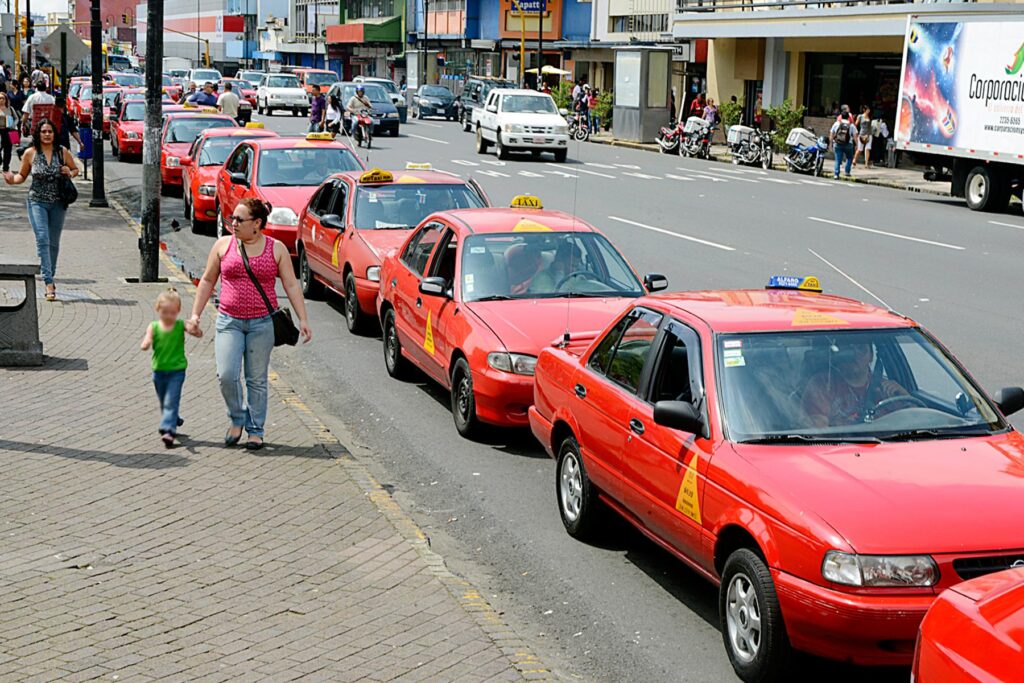
Costa Rica’s licensed taxis are red. Bright red. With a yellow triangular medallion painted on the door. That is it. That is the entire rule. If the taxi is not red with a yellow triangle, it is not officially licensed, and you have no protection if the fare triples mid-journey or the driver decides he wants an extra $20 for your luggage.
Inside the taxi, there should be a meter. Locals call it a “María.” For any trip within Jaco town itself — beach to restaurant, hotel to surf shop, anywhere within the immediate grid — that meter should be running. If the driver reaches over and conveniently does not turn it on, say something. “¿Puede usar el taxímetro?” — can you use the meter? — covers it. Most drivers will comply. A few will claim the meter is broken. Those drivers can be skipped.
Short trips within Jaco run $3 to $8 USD. You will not need the meter conversation often. But knowing it exists matters.
Leaving Town Is a Different Conversation
Here is where things shift. Once you leave Jaco — heading south to Playa Hermosa, north to Carara, inland toward San José — meters no longer apply. The driver is not legally required to run the meter for inter-zone travel. Which means the price is whatever you two agree on before the car moves.
Before. Not after.
Negotiate the fare before you open the door. Confirm it again before you close it. This is not paranoia — it is standard practice that every Costa Rican will tell you the same thing. Agreeing on $25 to Carrera National Park and then being told it was actually $50 because of traffic is a conversation that happens to unprepared tourists regularly. The drivers who pull this are a minority. But they exist.
Rough benchmarks for fares out of Jaco:
Playa Hermosa sits about 8 kilometers south. Expect $10 to $15. Herrera and Los Sueños, where the marina is, runs about $15. Carara National Park — the crocodile bridge area — comes in around $25. Esterillos further south is $30. Bejuco beyond that, $35. San José is $90 to $100 for the full run, though some drivers will start higher if they think they can.
The airport pickup specifically — if someone is coming to get you at Juan Santamaría — varies between $100 and $175 depending on traffic, luggage, and frankly how you present yourself. Arriving in fluent Spanish and knowing the fair price in advance changes the negotiation significantly. Arriving visibly exhausted and speaking no Spanish at all changes it in the other direction.
Call Ahead. Seriously.
Most visitors to Jaco try to hail taxis on the street. That works fine during daytime hours. But Jaco after dark is a different pace — busier in some ways, less predictable in others — and standing on a street corner at midnight hoping a red cab appears is less fun than it sounds.
The Jaco taxi cooperatives have phone numbers. Use them.
2643-3030. 2643-2020. 2643-1919. Any of those will get you a dispatch. There is also a WhatsApp line at +506 8933 6161 if calling feels awkward. Save these before you land. It costs nothing and saves a lot of late-night standing around.
Uber Exists Here. Sort of.
Uber works in Jaco. Sometimes. On a good day, with reasonable timing, in the right part of town, you can open the app and have a driver in eight minutes. On a bad day — holiday weekend, late night, off-peak hours on a quiet Tuesday — you might wait forty minutes or get three cancellations in a row.
The deeper issue is that Uber occupies a legal grey area in Costa Rica. The government’s transport regulator does not officially recognise Uber drivers as licensed operators. This mostly creates friction near airports, where enforcement is more visible, but it is worth knowing before you stake your schedule on an app.
For quick daytime rides around Jaco town, Uber is fine as a backup. For anything time-sensitive — early morning airport runs, tours with fixed departure times, getting somewhere you actually need to be — book a confirmed taxi or private transfer. The convenience of an app is not worth missing your boat to Manuel Antonio.
Groups Change the Maths Completely
Four people going to Playa Hermosa in a taxi at $12 total. That is $3 per person. The public bus from Jaco to Hermosa exists and costs less, but it drops you at a stop and you walk. The taxi drops you at the sand.
This arithmetic repeats across almost every fare. The more people in the vehicle, the more the taxi stops making sense to avoid. Split between four travellers, even the San José run at $100 becomes $25 each — comparable to a shuttle and far more direct.
If you are travelling solo, the calculus shifts. Public buses become more relevant. For solo travellers heading to San José, the bus from Avenida Pastor Diaz departs every two hours from 7am to 7pm, costs a fraction of a taxi, and delivers you to the city centre without negotiation. You sit next to locals, get a genuine sense of the country’s geography, and arrive in San José having spent maybe $4.
Just bring exact change in Colones. Bus drivers do not always carry change for larger bills.
The Shuttle Option People Overlook
Somewhere between “taxi from the airport” and “bus from town” sits the private or shared shuttle — and it genuinely deserves more attention than it gets from first-time visitors.
Shuttles for the San José to Jaco route operate in large, air-conditioned vans, properly licensed, with drivers who usually speak functional English. Groups of four or more travelling together will almost always find this the best combination of price, comfort, and certainty. You book in advance. You know exactly what you are paying. The driver meets you where you are. Nobody argues about luggage fees at the end.
For solo travellers on shared shuttles, you split the van with other tourists heading the same direction. It costs more than the bus and less than a private taxi. The trade-off — some flexibility lost, some money saved, air conditioning gained — suits a lot of travellers well.
Getting Around Jaco Without Any of This
Here is the thing most guides bury at the bottom: for most of what you actually want to do in Jaco, you do not need a taxi at all.
The town is flat. The beach runs parallel to the main street. The distance from one end of Avenida Pastor Diaz to the other is walkable in twenty minutes. Restaurants, surf rentals, supermarkets, pharmacies, tour operators — everything is close.
Bicycle rentals are everywhere and run cheap. Playa Hermosa to the south is a pleasant flat ride along a paved coastal road, maybe twenty-five minutes each way. Many visitors make this their default morning. The breeze off the ocean at 7am makes it better than it sounds.
Scooters are popular too. $25 to $45 for a full day gives you genuine freedom — the kind where you can turn up an unmarked road toward the jungle on a whim and see what is there. Wear the helmet. The roads are fine. The other drivers are occasionally not.
For day trips further out — Carara, Manuel Antonio, Quepos, the waterfall hikes — pre-arranged transport through your hotel or a local tour operator removes every logistical problem at once. You pay upfront, they sort the rest
A Few Things Worth Knowing Before You Go
Carry small bills. Always. A taxi driver who owes you $7 change from a $20 bill may or may not have it. Carrying 500 and 1000 Colone notes keeps every transaction clean.
Pay in Colones where possible. USD is accepted widely but not always at a fair rate. Colones from an ATM — La Fortuna, Quepos, and Jacó all have plenty — is the cleanest option.
Do not share rides with unmarked vehicles. Especially at night. This is not excessive caution. It is the same logic you would apply in any unfamiliar city.
Confirm your destination before you close the door. Not because drivers are dishonest — most are excellent and genuinely helpful — but because miscommunications happen, and being dropped at the wrong beach at dusk is an inconvenience that a five-second conversation prevents.
The Honest Summary
Jaco is easy to navigate once you know the system. Red taxis, yellow triangle, meter on for local rides, negotiated fare for anywhere outside town. Phone numbers saved before you land. Shuttle booked for the airport run. Bicycle or feet for everything within the town itself.
The visitors who struggle with transportation in Jaco are almost always the ones who arrived without this information and made decisions under pressure at the airport. The visitors who arrive knowing these things spend their energy on the actual point of being there — the surf, the food, the national parks, the sunsets, the particular quality of doing absolutely nothing on a Pacific beach that Costa Rica does better than almost anywhere.
Get the transport right. The rest takes care of itself.Always use officially licensed red taxis with yellow medallions. Confirm fares before travel begins, carry local currency in small denominations, and book airport transfers in advance whenever possible.

Mikhaila Olena is a lifestyle writer and content creator behind Living Smart Daily, dedicated to sharing practical ideas, thoughtful insights, and everyday inspiration. With a passion for simple living and meaningful choices, she crafts content that helps readers create a more balanced, organized, and fulfilling life.