









My dog developed a hot spot last summer.
Not a dramatic one — just a small, angry patch on his back leg that he would not leave alone. By the time I noticed it properly, he had been licking it for two days and it was red, inflamed, and clearly uncomfortable. I called my vet. She was booked for three days.
So I did what most dog owners do when the vet cannot see them immediately. I went online.
Two hours later I had a browser full of tabs about oregano oil, Manuka honey, turmeric paste, colloidal silver, and garlic. Some of it was from blogs. Some of it cited actual research. Some of it was enthusiastic in ways that made me slightly nervous. I did not know where to start, what was safe, what was overstated, or whether any of it would actually help.
What I eventually learned — partly from that experience, partly from the conversation I had with my vet three days later — is that natural antibiotics for dogs exist on a real spectrum. Some have genuine evidence behind them and are used by integrative veterinarians regularly. Some are helpful for specific, mild situations and useless or dangerous in others. And some are best left alone entirely, regardless of what the internet says.
Here is the version that took me considerably longer to piece together than it should have.
The Disclaimer That Actually Matters
Before any of the options, one thing needs to be said clearly.
Natural antibiotics are not a replacement for veterinary care when veterinary care is what the situation requires. A growing number of veterinarians are embracing integrative medicine, combining pharmaceuticals with herbal and nutritional approaches — but those same vets are clear that natural remedies work as first-line support for mild infections, with prescriptions reserved for severe cases.
The distinction between mild and severe matters enormously. A 2025 case report described a dog with a paw infection treated with oregano oil for five days. By the time antibiotics were started, sepsis had set in. Early vet care could have prevented this. Natural does not mean risk-free. It means using the right tool for the right stage of illness.
My hot spot, it turned out, was genuinely mild. The vet confirmed this three days later. For something more serious — a deep wound, a persistent fever, an infection that was spreading — the conversation would have been very different.
Manuka Honey — The One With the Strongest Evidence
Of everything I researched in those two hours, Manuka honey was the one that kept coming up in clinical contexts rather than just blog posts.
Veterinarians at the UC Davis Veterinary Medical Teaching Hospital use medical-grade Manuka honey in wound care, noting faster healing and reduced infection rates. One study showed a 65% reduction in wound bacteria after 48 hours of application. The medicinal use of honey dates back 5,000 years, all the way to Ancient Egypt, and raw honey has demonstrated antimicrobial properties against many bacteria that tend to attack the skin — including E. coli, MRSA, and Pseudomonas aeruginosa, all common in canine skin infections.
Manuka honey specifically contains methylglyoxal (MGO), a compound that gives it antimicrobial properties beyond those of regular honey. Not all Manuka honey is the same — the UMF (Unique Manuka Factor) rating indicates potency, and UMF 10+ is the minimum threshold for therapeutic use. A 2024 ConsumerLab test found that 60% of off-brand “Manuka” products contained no detectable methylglyoxal at all. Labels matter.
For topical use on minor wounds, hot spots, or skin infections, Manuka honey applied under a breathable bandage is something integrative vets actually recommend. Internal use — a small amount given orally for mild cough or throat irritation — is also considered reasonable for healthy adult dogs, with the same caveats that apply to honey generally: not for puppies, not for diabetic dogs, not as a replacement for antibiotics when an infection is serious.
My hot spot got Manuka honey. It worked, along with keeping the dog from licking it, which honestly required more effort than the honey.
Turmeric — Useful for What It Is Actually Good At
Turmeric comes up in almost every natural remedy guide for dogs, usually described as antibacterial, anti-inflammatory, and antioxidant. All of that is true, with one nuance worth understanding: turmeric’s primary strength is anti-inflammatory, not antibacterial. The active compound is curcumin, which is a genuine anti-inflammatory agent with solid research behind it. Its antibacterial properties are real but secondary.
This means turmeric is most useful for conditions involving chronic inflammation — arthritis, skin conditions with an inflammatory component, digestive issues — rather than as a first-line response to active bacterial infection. Framing it as an antibiotic slightly overstates what it does most reliably.
The absorption problem is also real. Curcumin is not easily absorbed without fat and black pepper present. The golden paste that circulates in dog wellness communities — turmeric powder with coconut oil and black pepper — exists for this reason. It genuinely increases bioavailability. Without fat and pepper, much of the turmeric passes through without being absorbed.
One of the most effective ways to give your dog turmeric is by preparing a golden paste. Mix half a cup of turmeric powder with one cup of water in a pan, and stir over medium-low heat for seven to ten minutes until a thick paste forms. Once ready, add one and a half teaspoons of ground black pepper and a quarter cup of coconut oil or ghee, stir well, and let it cool. Store in the fridge for up to two weeks. Start with a small amount — around an eighth of a teaspoon per ten pounds of body weight — and increase gradually.
Start slow. Turmeric can cause digestive upset in some dogs, particularly at higher amounts.
Garlic — The Complicated One
Garlic has a complicated reputation in the dog world, and it deserves a clear-eyed look rather than a reflexive verdict in either direction.
The concern comes from a study that fed five grams of garlic per kilogram of body weight to dogs daily. That works out to approximately five whole heads of garlic for a Golden Retriever. At those levels, garlic causes oxidative damage to red blood cells and can lead to anemia. Those results are real. The dose is not remotely realistic.
In moderation — which means small amounts, used appropriately — garlic has genuine antimicrobial properties. The active compound, allicin, is released when garlic is minced and left to sit for about ten minutes before use. It has demonstrated antibacterial properties against multiple pathogens.
The practical guidance: garlic is best used as an occasional addition to food rather than a daily supplement, and at amounts that are genuinely small relative to body size. It should be avoided entirely in dogs with existing blood conditions or those prone to anemia. And it should be discussed with a vet before use, particularly if the dog is on any other medication.
Onions, in any form, are a different story — they are genuinely toxic to dogs and should never be given. The garlic concern mostly arises from garlic being in the same botanical family as onions, but the toxicity profile and safe dose range are meaningfully different.
Coconut Oil — Gentle, Versatile, Lower on the Evidence Scale
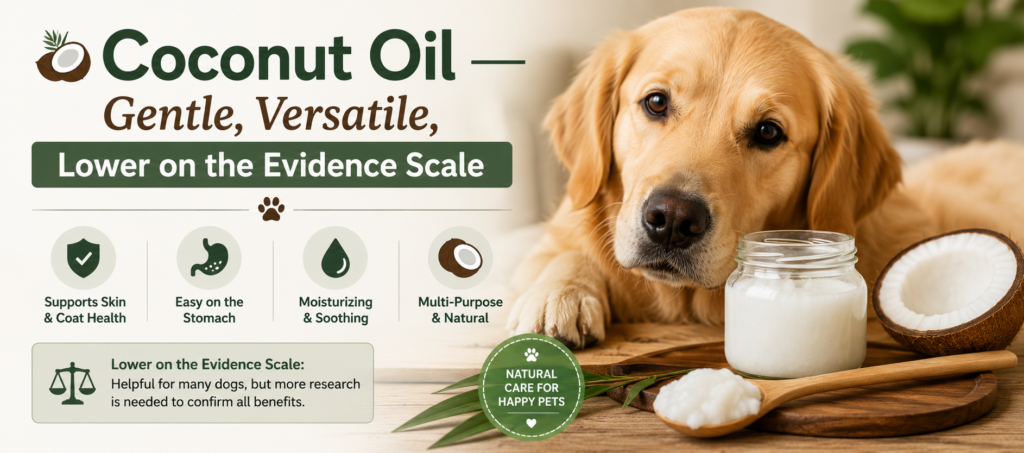
Coconut oil is high in lauric acid, a medium-chain fatty acid with demonstrated antimicrobial properties. It is safe for dogs both topically and orally, which makes it one of the more accessible natural options.
For topical use, coconut oil can be applied to minor skin irritation, dry paws, or superficial wounds. For internal use, it can support gut health and is commonly used as a carrier for other supplements like turmeric or diluted essential oils.
The antibacterial properties of coconut oil are real but mild relative to some of the other options on this list. It is most useful as a supportive measure and a carrier, not as a primary treatment for anything more than very minor skin issues. Start with a small amount — around a quarter teaspoon for small dogs, a teaspoon for large dogs — when introducing it orally, as some dogs experience digestive upset initially.
What My Vet Said About All of This
Three days after the hot spot appeared, I sat in her office and described what I had found online and what I had tried. She was not dismissive. She asked which sources I had used. She confirmed that Manuka honey for surface skin infections was legitimate and that she used it herself in clinical contexts.
She was less enthusiastic about some of the more aggressive oregano oil protocols circulating online and said what she tells most clients: these options work best as early-stage or preventive measures, not as alternatives to prescription antibiotics when something has progressed.
Natural antibiotics can boost the immune system and encourage good bacteria — they offer antibacterial and antifungal support as well as general wellness and health benefits. But regular antibiotics should still be used when prescribed by a veterinarian. Natural remedies do not replace veterinary advice. When in doubt, go to the vet.
My dog’s hot spot cleared up in five days. The Manuka honey helped. So did the cone he wore for three of those five days and was deeply unhappy about.
The online research was not wasted. But the most useful part of it was knowing what to ask the vet — not what to use instead of seeing her.

Mikhaila Olena is a lifestyle writer and content creator behind Living Smart Daily, dedicated to sharing practical ideas, thoughtful insights, and everyday inspiration. With a passion for simple living and meaningful choices, she crafts content that helps readers create a more balanced, organized, and fulfilling life.