









Japan is one of those rare countries where every single season tells a completely different story. The Japan you experience in March, wrapped in a soft pink haze of cherry blossoms, is a world apart from the one you’ll find in January — blanketed in silence and snow. If you are sitting there trying to figure out the best time to visit Japan, the honest answer is: it depends on what kind of traveler you are.
This guide does not just throw months at you. We are going to walk through each season, what it actually feels like on the ground, who it suits best, and what you should realistically expect — crowds, costs, and all. Whether you are a first-timer chasing sakura or a seasoned explorer looking for off-peak magic, there is a perfect window for you.
Japan Seasons at a Glance
Before we dive deep, here is a quick overview of each season so you can find your fit fast:
| Season | Months | Weather | Crowd Level | Best For |
| 🌸 Spring | Mar – May | Mild, 10–20°C | ⭐⭐⭐⭐⭐ Very High | Cherry blossoms, sightseeing |
| ☀️ Summer | Jun – Aug | Hot & Humid, 28–35°C | ⭐⭐⭐ Moderate | Festivals, beaches |
| 🍁 Autumn | Sep – Nov | Cool, 10–22°C | ⭐⭐⭐⭐ High | Foliage, hiking, culture |
| ❄️ Winter | Dec – Feb | Cold, -5–10°C | ⭐⭐ Low | Snow, skiing, hot springs |
Spring (March to May) — The Most Popular Season
Let’s be real — spring is why most people come to Japan. The cherry blossom season, known locally as sakura, transforms the entire country into something that looks almost fictional. Parks, riverbanks, castle grounds, temple courtyards — everywhere you look, soft pink and white petals are drifting through the air.
The blooms typically begin in late March in Tokyo and Kyoto, spreading northward through April. The full bloom window is narrow — usually just one to two weeks per location — so timing matters enormously. If you miss peak bloom by even three or four days, you will see mostly green leaves. Use official forecasts (Japan Meteorological Corporation releases bloom predictions each year) to plan.
What Spring Actually Feels Like
Temperatures are comfortable — usually between 10°C and 20°C depending on where you are. You will want a light jacket in the mornings and evenings. It rains occasionally, but nothing like the summer monsoon. The weather is genuinely pleasant for walking, which is exactly what you will be doing a lot of.
The Crowd Reality
Spring is Japan’s busiest tourist season, full stop. The Golden Week holiday cluster (late April to early May) piles domestic travelers on top of international visitors. Trains, temples, and parks get packed. Book accommodation at least three to four months in advance for spring travel, and buy Shinkansen tickets early.
Best Places to Visit in Spring
- Maruyama Park, Kyoto — one of the most beautiful hanami (flower viewing) spots in Japan
- Ueno Park, Tokyo — the classic urban sakura experience
- Hirosaki Castle, Aomori — blooms later (late April/early May), huge moat reflections
- Philosopher’s Path, Kyoto — a two-kilometer canal walk lined with hundreds of cherry trees
- Yoshino, Nara — over 30,000 cherry trees on a mountain; staggered bloom over several weeks
Spring in a Nutshell
Best for: First-time visitors, romance, photographers, families. Not ideal for: budget travelers, crowd-averse personalities, spontaneous planners.
Summer (June to August) — Festivals, Heat, and Hidden Rewards
Summer in Japan is intense — and intentionally so. Yes, it is hot and humid, particularly July and August when temperatures regularly sit between 30°C and 36°C in major cities. June brings the rainy season (tutu), where grey skies and daily showers are the norm for three to four weeks.
But here is the thing: summer is also when Japan comes alive in ways you simply cannot experience any other time of year. The country’s festival culture peaks between July and August. Fireworks festivals (Manabí taka) light up skies across the nation. Bon Odori dancing, lantern floats, Obon ceremonies — the cultural richness is extraordinary.
Summer Highlights Worth the Heat
- Gion Matsuri (Kyoto, July) — one of Japan’s three great festivals; month-long with a grand parade
- Awa Odori (Tokushima, mid-August) — the biggest dance festival in Japan; infectious and joyful
- Nebuta Matsuri (Aomori, early August) — enormous illuminated floats parading through the city at night
- Sumida River Fireworks (Tokyo, late July) — over 20,000 fireworks in one evening
- Okinawa and Hokkaido — both are far more comfortable in summer than mainland Japan
Who Summer Is Right For
Summer suits travelers who are genuinely curious about Japanese culture at its most expressive, those heading to beach destinations like Okinawa or the Ogasawara Islands, and anyone visiting Hokkaido — which stays comfortably cool through August and is absolutely stunning with lavender fields in full bloom.
If you are spending summer in Tokyo, Osaka, or Kyoto, pack lightweight clothing, carry a small folding fan, and embrace the rhythm of Japan’s convenience store culture. Hydration is not optional.
Autumn (September to November) — The Traveler’s Sweet Spot
Ask most experienced Japan travelers which season they prefer and a significant number will quietly say autumn. The reason is simple: autumn gets you almost everything spring offers — spectacular natural beauty, comfortable temperatures, rich cultural programming — with slightly thinner crowds and a different kind of magic entirely.
The autumn foliage season (koyo) begins in Hokkaido in late September and sweeps southward through November. By mid-November in Kyoto and Tokyo, temple gardens and mountain landscapes turn brilliant shades of crimson, amber, and gold. It is genuinely breathtaking.
What Makes Autumn So Good
Temperatures are ideal — typically between 10°C and 22°C. The rainy season is firmly over. The oppressive humidity of summer has lifted. You can walk for hours comfortably. Food is exceptional in autumn: matsutake mushrooms, new sake, sweet potatoes, persimmons, Pacific saury — Japan’s autumn culinary calendar is serious business.
Best Spots for Autumn Foliage
- Eikan-do and Nanzen-ji, Kyoto — illuminated autumn nights are among Japan’s finest sights
- Nikko, Tochigi — UNESCO shrines surrounded by mountains ablaze with color
- Obara, Aichi — rare four-petal cherry trees bloom simultaneously with golden autumn leaves
- Daisetsuzan National Park, Hokkaido — earliest koyo in Japan, typically September
- Rikugien Garden, Tokyo — elegant pond reflections of red and gold maple
Practical Notes for Autumn
Autumn is also popular, especially in late October and November. Kyoto in particular sees hotel prices climb. That said, the crowds are generally slightly more manageable than spring cherry blossom season. Book at least two months ahead for popular destinations.
Winter (December to February) — The Underrated Season
Winter is Japan’s most underrated travel season, and if you are willing to dress for it, the rewards are substantial. Crowds thin dramatically after the New Year holiday period (which runs roughly December 29 to January 3 and is extremely busy domestically). From mid-January through February, you will find shorter queues at temples, better accommodation availability, and noticeably lower prices.
Japan is also one of the world’s premier winter sports destinations. Niseko in Hokkaido, Nozawa Onsen and Hakuba in Nagano, and Zao Onsen in Yamagata all receive exceptional snowfall. Powder snow conditions in Hokkaido in particular have an almost cult following among skiers and snowboarders from Australia, Southeast Asia, and North America.
Beyond Skiing — Why Winter in Japan Is Special
The onsen (hot spring) experience reaches its peak in winter. There is genuinely nothing quite like soaking in an outdoor rotenburo while snow falls silently around you. Ryokan (traditional inn) culture is at its most immersive in winter — thick futons, kaiseki meals, steaming baths, and the particular stillness of a snow-covered garden.
Sapporo Snow Festival (early February) is one of Asia’s most spectacular winter events, attracting nearly two million visitors for enormous ice sculptures. Shirakawa-go, a UNESCO-listed village in the Japanese Alps, looks like it belongs inside a snow globe from December through February.
What to Expect Temperature-Wise
Tokyo winters are cold but manageable — usually between 2°C and 12°C. Kyoto can feel bitter on particularly cold days. Hokkaido is genuinely frigid, often dropping below -15°C. Layer properly, invest in good thermal base layers, and you will be comfortable anywhere.
Best Time to Visit Japan by Traveler Type
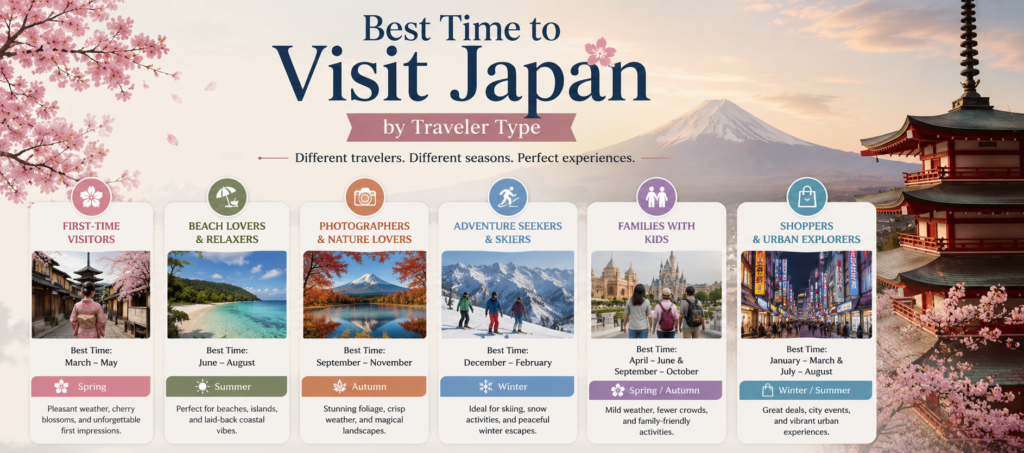
The single biggest variable in choosing when to visit Japan is not actually the weather — it is who you are as a traveler. Here is a straightforward breakdown:
| Traveler Type | Recommended Season |
| First-time visitor | Spring (late March to mid-April) — you want to see Japan at its most iconic |
| Budget traveler | Winter (mid-January to February) or early June — lower prices, thinner crowds |
| Culture enthusiast | Summer (July to August) — festivals are unmatched |
| Foodie | Autumn (October to November) — peak seasonal ingredients across the country |
| Photographer | Spring or Autumn — both offer extraordinary visual opportunities |
| Skier / Snowboarder | January to February — peak powder season in Hokkaido and Nagano |
| Families with children | Spring or Autumn — comfortable temps and manageable energy level |
| Couple / Honeymoon | Spring or early Autumn — romantic atmosphere, gorgeous scenery |
Periods to Plan Around Carefully
Japan has several major holiday windows when domestic travel surges, accommodation prices spike, and popular attractions become genuinely overcrowded. Be aware of:
- Golden Week — late April to early May. One of Japan’s three major holiday periods. Extremely busy.
- Obon — mid-August. Millions of Japanese return to hometowns. Trains are packed, cities can feel emptier but rural areas get crowded.
- New Year (Shogatsu) — December 29 to January 3. Many shops and restaurants close; major shrines see enormous crowds for hatsumode (first shrine visit of the year). Beautiful but logistically demanding.
- Cherry blossom peak weekends — any Saturday or Sunday during full bloom in March or April sees enormous crowds at popular spots.
Practical Tips for Visiting Japan
Book Early for Peak Seasons
For spring and autumn travel, book accommodation three to five months in advance. Popular ryokan in Kyoto book out even earlier. For budget travelers using hostels, two months is usually sufficient.
Buy Your JR Pass Before You Arrive
The Japan Rail Pass must be purchased outside Japan through an authorized vendor. It offers unlimited Shinkansen and JR train travel and pays for itself quickly if you are covering multiple cities. Buy it before your flight.
Download Hyperdia or Google Maps
Japan’s train network is extraordinary but complex. Google Maps now handles Japanese transit very well. Keep a transit app on your phone — navigating stations like Shinjuku or Osaka’s Umeda without one is genuinely confusing.
Pack for the Season — Seriously
Japanese weather is more extreme than many first-time visitors expect. Summer is legitimately hot and sticky. Winter in Hokkaido is seriously cold. Do not underestimate either. Check regional weather forecasts for wherever you are going, not just the national average.
Cash Still Matters
Japan is increasingly card-friendly, particularly in cities. But many smaller restaurants, temple admission gates, rural accommodations, and vending machines still require cash. Carry some yen at all times. 7-Eleven ATMs accept most international cards reliably.
Final Thoughts
The best time to visit Japan is ultimately the time that aligns with what you actually want to experience. If cherry blossoms are on your bucket list, plan for late March to mid-April and accept the crowds as part of the deal. If you want a slower, more intimate Japan with thinner queues and lower costs, autumn shoulder periods or mid-winter are quietly brilliant.
What Japan does better than almost any other country is make every season feel like a reason to come back. Many travelers visit once and find themselves planning a second trip before they have even landed home. Whatever season you choose, you are not getting it wrong — you are simply choosing which version of Japan to fall in love with first.
Happy travels.

Mikhaila Olena is a lifestyle writer and content creator behind Living Smart Daily, dedicated to sharing practical ideas, thoughtful insights, and everyday inspiration. With a passion for simple living and meaningful choices, she crafts content that helps readers create a more balanced, organized, and fulfilling life.





2 Comments on “Best Time to Visit Japan: A Season-by-Season”