







My uncle had a photograph on the wall of his garage gym.
Not Arnold. Not Franco Columbu. Not any of the names I grew up hearing most often when people talked about the golden era of bodybuilding. It was Sergio Oliva — a photograph from what looked like the late 1960s, standing on a posing platform in a posture that made the word “human” feel like it needed qualification. My uncle refused to take it down for thirty years, through two house moves and an eventual basement conversion. When I asked him why, he said the same thing every time.
“Because nobody who ever saw that man compete has been able to properly explain what they saw. That is why they called him The Myth.”
I did not fully understand what he meant until I started reading the accounts from the people who were actually there.
Where He Came From — The Part That Makes Everything Else Make Sense
Sergio Oliva was born on July 4, 1941, in Guantanamo, Cuba. The Cuba he grew up in was not a place that produced bodybuilding champions — it barely had the infrastructure for organized sport of any kind. His upbringing involved hard physical labor. As a child, he worked in sugar-cane fields, building an early foundation of strength and endurance.
The first indication that something unusual was happening came early. As a teenager, Oliva’s raw strength was already evident — he reportedly could clean and jerk over 400 lbs, an extraordinary feat for a young athlete. He was selected for the Cuban weightlifting team, which is how he ended up at the 1962 Central American and Caribbean Games in Jamaica — and which is how everything changed.
While representing Cuba in Jamaica, he successfully claimed political asylum in the United States. Soon after, 65 other Cuban nationals, which included Castro’s entire weightlifting team and their security guards, followed Oliva by seeking asylum in the US.
He ended up in Chicago. He worked in foundries, in a butcher’s shop, and eventually as a TV repairman. Spending long days working in a foundry, and following them with brutal 3 to 4-hour gym sessions, his work ethic was tireless. The gym he trained at was Duncan YMCA on Chicago’s north side — known in local circles as the muscle factory, a place that drew serious lifters and generated crowds of spectators who came specifically to watch Oliva train.
The thing that nobody could explain then and that nobody has fully explained since is what happened to his body between 1965 and 1967. In preparation for his first Mr. Olympia appearance, he was able to push his bodyweight up from 215 to 228 in one incredible six-week period. Not just heavier. Bigger, more defined, more proportional. Joe Weider’s photographers documented the transformation in Muscle Builder magazine. The readers wrote in saying it looked like two different people.
What He Actually Looked Like — Why Words Keep Failing
Oliva was 5’10 and weighed 225 to 235 lbs competing. He was known to have the smallest waist and an unbelievable V-taper.
Those numbers do not communicate anything useful without context. The V-taper — the proportional relationship between shoulder width, chest breadth, and waist circumference — is what every bodybuilder is attempting to create. On Oliva it was not created. It was simply present, in dimensions that made other competitors on the same stage look structurally incomplete.
The first truly superhero physique was Sergio Oliva. Bill Pearl and Reg Park came close. However, it was Sergio that first presented gargantuan yet proportional size with, at his peak, fantastic muscle clarity, as crisp as any other competitor of that time.
Arnold Schwarzenegger described their first encounter in his 1977 autobiography. “Then, for the first time, I saw Sergio Oliva in person. I understood why they called him The Myth. It was as jarring as if I’d walked into a wall. He destroyed me. He was so huge and fantastic, there was no way I could even think of beating him. I admitted my defeat and felt some of my pump disappear.”
Arnold was not a man who admitted anything easily. That he wrote this in a book, under his own name, tells you something about the impression Oliva made on even the most competitive people in the sport.
The Olympia Years — Three Titles and a Controversy That Never Ended
Oliva won his first-ever bodybuilding competition, the Mr. Chicagoland contest, in 1963. He then won Mr. Illinois the very next year. In 1966, Oliva won the Junior Mr. America and Mr. World titles before winning the Mr. Olympia contest in 1967, a feat that he repeated in 1968 and 1969.
The 1968 win was uncontested — the only time in Olympia history a champion won unopposed. The field simply did not show up to compete against him. This is an almost incomprehensible fact in a sport built on competition and ego. The other competitors looked at what Oliva had done in 1967 and decided the most rational response was to not enter the contest.
Then 1969. Arnold was there. Oliva pumped up backstage in a large butcher’s coat, which hid his muscularity from competitors. Before going on stage, “The Myth” removed the coat to reveal size none could rival. The result was jaw-dropping and, as Arnold wrote in his book, discouraging.
Oliva won. Arnold shook his hand and left.
What followed across the next few years was a complicated sequence of politics, federation disputes, and judging controversies that Oliva spent decades discussing and that the bodybuilding community has never fully resolved. Arnold won the Olympia title by edging The Myth the following year with a score of 4-3 when Joe Weider switched judges at the last minute. In 1971, Oliva was banned from the Olympia because he had competed in a rival show — a rule that was highly controversial because Schwarzenegger had competed in that same contest the year before, and without Sergio to challenge Arnold, many felt that the contest was fixed.
In 1972, by all accounts, Sergio was in his all-time greatest shape and completely confident he would regain the Mr. Olympia title. Arnold himself wrote that Sergio was more impressive than he had ever seen him. The judges gave Arnold the win in what is still considered the most controversial decision in bodybuilding history. Arnold was named the 1972 Mr. Olympia. Oliva finished second. Some fans and experts still argue that Oliva deserved the win.
Tired of the politics, Oliva left the IFBB entirely.
Life Outside Bodybuilding — The Part Most People Do Not Know
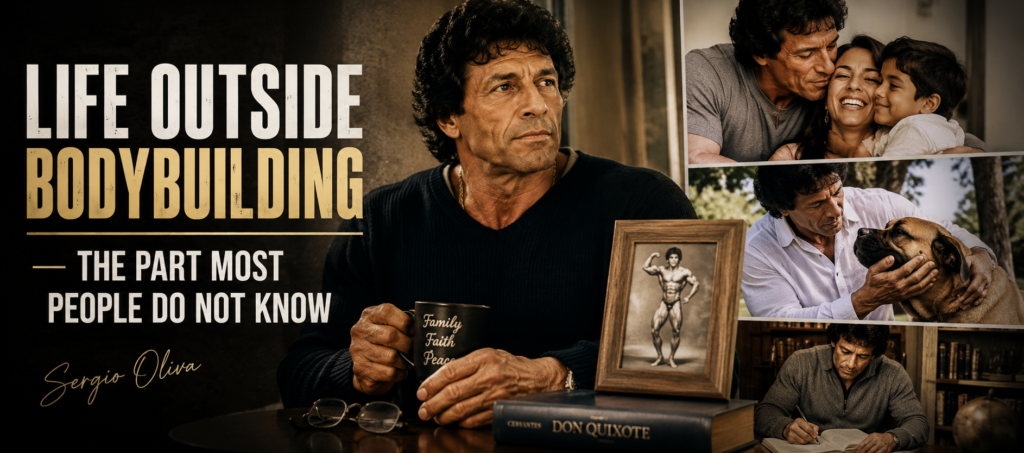
27 years of his professional life was spent serving in the Chicago Police Department, in custom-made uniforms accommodating his 60-inch chest.
The image of Sergio Oliva in a police uniform is one of those details that does not quite fit the mental picture most people have of a three-time Mr. Olympia champion. But it is accurate. He joined the force in 1976 and served until 2003, working in the Rogers Park neighborhood where he eventually lived. Amongst neighbors he was a beloved police officer and community member, described as “friendly with all the neighborhood kids who knew and respected his accomplishments.”
In 1986, Sergio survived being shot by his then-wife. Fatally wounded, Sergio still managed to drive himself to the Chicago hospital where he recovered. He had sustained five bullet wounds. He drove himself to the hospital. This is the kind of detail that would sound fabricated in a film script and is simply documented fact in his case.
At the 1984 Mr. Olympia, after finishing eighth, Oliva held up his infant son before the crowd. “No matter what happened tonight, 8th, 17th or 20th, I’ll forever be The Myth,” Oliva said. “And I hold in my arms Sergio Junior, the next Myth.”
He was right about the nickname. He was right about his son. Sergio Oliva Jr. is an IFBB Pro bodybuilder who won the 2015 NPC Nationals bodybuilding competition and has since competed on Mr. Olympia, Arnold Classic, and New York Pro stages.
His Training — What Is Actually Known
The foundry work and the long working-class hours that preceded Oliva’s training sessions are not incidental backstory. They are part of the explanation for what his body became. The manual labor provided a stimulus that was supplementary to his gym sessions in ways that are difficult to replicate with exercise alone.
Sergio’s early weightlifting days had taken their toll on his joints. Fellow bodybuilders said “After a while, he couldn’t lock out lifts because his elbows would dislocate or his knees would bend backward,” so Sergio changed his approach. Using partial movements he could use big weights, as without the full range of motion there is much less risk of injury.
The partial movement approach was unconventional by the standards of the time, which largely held that full range of motion was mandatory for complete muscle development. Oliva’s results did not support that orthodoxy. His bicep peak and his tricep development — both areas theoretically disadvantaged by partial movements — were among the most impressive in the sport’s history.
In 1972, under the High-Intensity Training methodology of Arthur Jones, the designer of Nautilus training equipment, Oliva trained for what he considered his all-time best conditioning. Whether HIT specifically produced that result or whether Oliva was simply in the best shape of his life for reasons beyond programming is impossible to know. What is documented is that Arnold, seeing him backstage in Essen, acknowledged he was the most impressive he had ever seen him.
The Legacy — What He Left Behind That Cannot Be Argued About
Sergio Oliva was the first true mass monster with aesthetics, bridging the gap between classic physiques and the modern era of bodybuilding. This is not a small claim. The history of competitive bodybuilding is essentially divided into the period before Oliva established what was possible and the period after.
He was the first non-white athlete to win Mr. Olympia — a milestone in the sport’s history. He remains the only bodybuilder to defeat Arnold Schwarzenegger on the Olympia stage.
Arnold’s tribute, written on the occasion of Oliva’s death in 2012, was brief and is worth reading in full: “Sergio Oliva was one of the greatest bodybuilders of all time and a true friend. A fierce competitor with a big personality — one of a kind.”
The photograph is still on my uncle’s wall. I have a better answer now when I look at it. The Myth was what they called him because no other word worked. A man who defected from Cuba with nothing, worked foundry shifts followed by four-hour gym sessions, won three Mr. Olympia titles, drove himself to the hospital after being shot five times, served 27 years on the Chicago police force, and died in 2012 in the city that had given him everything his country could not.
That is not a bodybuilding story. It is something larger than that. The bodybuilding is just the most visible part of it.

Mikhaila Olena is a lifestyle writer and content creator behind Living Smart Daily, dedicated to sharing practical ideas, thoughtful insights, and everyday inspiration. With a passion for simple living and meaningful choices, she crafts content that helps readers create a more balanced, organized, and fulfilling life.





One comment on “Sergio Bodybuilding: The Man They Called The Myth and Why He Still Matters”