






My aunt used to tear pages out of magazines.
Not fashion magazines. Muscle Builder. Flex. The Joe Weider publications that arrived at her house through the early 1980s when female bodybuilding was doing something that nobody had quite figured out how to describe yet. She kept a folder — a brown cardboard folder she had labeled in her own handwriting — full of the pages she saved. Women on competition stages. Women holding trophies. Women photographed mid-pose in ways that made the word “possible” feel like it needed revising.
She was not a bodybuilder herself. She was a schoolteacher in a small town in the midwest who had grown up being told that women who lifted weights would look like men, and who had watched that specific prediction dissolve in real time on the pages she was filing away.
I found the folder in her attic twenty years after she had put the last thing in it. Going through it properly, in order, sitting at her kitchen table while she made coffee and commented on each photograph as I held it up — that afternoon is why I can tell this story at all.
Before There Were Competitions
The first photograph in the folder was not from a competition. It was a clipping from an article about Muscle Beach in Santa Monica — the famous outdoor gym that had been drawing crowds since the 1930s. My aunt could not remember exactly when she had clipped it. She said she had included it because of the woman in the foreground.
Abbye “Pudgy” Stockton. Standing with weights, visibly muscular, on a public beach in the 1940s. Not competing — there were no women’s competitions to compete in yet. Performing, which was different. Demonstrating, which was more accurate. Proving a point that nobody had formally asked her to prove.
My aunt pointed at the photograph and said: “She did all of this without any of what came later. No contest. No prize. No federation. She just showed up and lifted.”
Stockton became known as the “Queen of Muscle Beach” and is generally considered the first female bodybuilder in any meaningful sense. The 1940s. A beach in California. A crowd that showed up to watch. No organization behind her, no competition structure in front of her.
The first women’s bodybuilding contest sponsored by the FIBB did not come until the 1960s. The first Ms. Olympia was not until 1977. From Stockton to the first Olympia, the gap is roughly thirty years.
Rachel McLish — The First Page That Made My Aunt Stop
She knew exactly when she had torn this one out. August 1980. Rachel McLish had just won the first Ms. Olympia contest in the sport’s history, and the photograph of her onstage had made it onto the back page of an issue of Muscle Builder.
“I remember reading the caption three times,” my aunt said. “Because it said she was the winner and I kept thinking, the winner of what. It hadn’t existed a year before.”
Rachel McLish won the very first Ms. Olympia contest in 1980, helping to solidify female bodybuilding as a legitimate competitive sport. She won again in 1982. The debate about what kind of body should win a women’s bodybuilding contest had not started in earnest yet, partly because there had not been enough contests for the argument to develop.
McLish was muscular by the standards of early 1980s competition. Compared to what the judges would be rewarding a decade later, her physique was moderate in scale. This is not a dismissal — it is context. She existed at the opening moment of the sport, and what she did at that moment was make the thing real. The folder was started because of Rachel McLish.
Cory Everson — My Aunt’s Favorite
The thickest section of the folder. Magazine covers, competition photos, one clipping from what appeared to be a television listing for something on ESPN.
Cory Everson won her first Ms. Olympia in 1984. Then 1985. Then 1986, 1987, 1988, and 1989. Six titles. Every competition she entered professionally. She retired undefeated and has remained undefeated since.
My aunt had seen her compete in person once — a Ms. Olympia at Madison Square Garden in the mid-1980s. She described the crowd as unlike anything she had expected. “It was sold out,” she said. “Madison Square Garden, sold out, for a women’s bodybuilding contest. I don’t know if people remember that it was like that.”
She was right that people don’t remember. The sold-out Garden atmosphere of those Everson years is consistently cited by people who were there as something the sport has never recovered — a mainstream moment that arrived and then passed. Everson did more than win. She appeared on over 50 magazine covers. She co-authored books on training. She hosted an exercise show on ESPN for years. She appeared in films after retiring. In January 1999, Everson was inducted into the IFBB Hall of Fame as part of the inaugural group. At the 2007 Arnold Classic, she became the first woman to be presented with the Lifetime Achievement Award.
Six wins, no losses, Madison Square Garden sold out, and a post-competition career that kept her in public view for decades. My aunt’s folder agreed with the argument that makes Cory Everson the most defensible answer to the GOAT question.
Lenda Murray — The Page My Aunt Added With a Question Mark
“I wasn’t sure about her at first,” my aunt said, holding up a photograph of Lenda Murray from 1991. “She was bigger than Cory. I didn’t know if that was a good thing or if the sport was going somewhere I didn’t understand yet.”
Lenda Murray stepped into the gap Everson left. A former cheerleader and track star, she won six consecutive Ms. Olympia titles from 1990 to 1995. After a brief retirement, she returned and won two more, bringing her total to eight — a record at the time she held it.
Her physique represented the transition. More muscle than the McLish era had required, more symmetry than the extreme mass direction the sport would eventually travel. Eight titles. My aunt stopped adding the question mark after 1993.
Murray’s legacy includes more than her titles. When Andrea Shaw was competing as a physique competitor and considering a move to bodybuilding, it was Lenda Murray who encouraged her to make the switch. The line from Murray to Shaw is a direct one.
Iris Kyle — The Section My Aunt Did Not Have
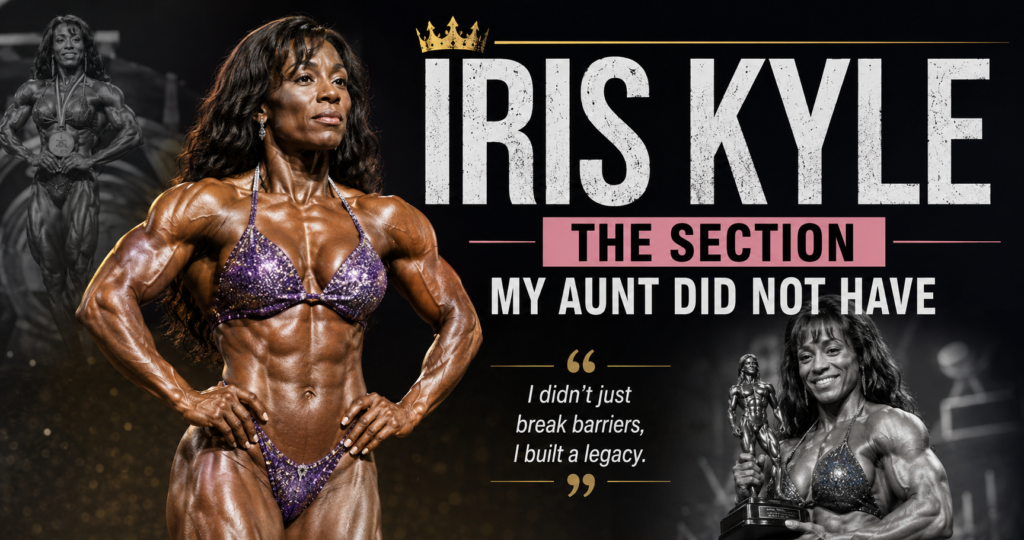
The folder ends in the mid-1990s. Iris Kyle‘s career did not begin in any meaningful competitive sense until the early 2000s. My aunt was no longer collecting by then.
This is the gap in the folder that makes the story incomplete, because Iris Kyle is the number that makes every other number in women’s bodybuilding look modest.
Ten Ms. Olympia titles. Seven Ms. International titles. Nine consecutive Olympia victories from 2006 to 2014. A further title in 2022 that took the total to ten. Often called “The Female Ronnie Coleman,” Iris holds more Olympia titles than any other bodybuilder, male or female.
Born in Benton Harbor, Michigan, she grew up as the fifth of six children. Cross-country running and basketball in school. A move to Orange County, California, where the gym culture around her motivated a shift toward weightlifting. From that beginning to ten Olympia titles is a distance that is almost impossible to convey in biographical summary.
The counter-argument — the one that keeps the Everson GOAT debate alive despite the numerical gap — is that Kyle dominated during a period when the sport was contracting. The mainstream attention that sold out Madison Square Garden in the 1980s had faded by the time Kyle was at her peak. Ten wins in front of a shrinking audience is the version of the argument my aunt articulated when I described Kyle’s record to her.
Both things are true. Everson created the mainstream moment. Kyle created the record. Which one matters more depends on what you think bodybuilding is for.
Kyle presented a trophy at the 2025 Mr. Olympia. She continues to advocate for women’s divisions at major events, arguing publicly for equality in prize money and visibility. The sport she dominated is still working out what it owes the women who built it.
The Division Problem and Andrea Shaw
The sport’s response to the size debate that developed through the Kyle era was to add more categories. Bikini. Wellness. Figure. Fitness. Physique. And in 2025, a new Fit Model division that launched in NPC amateur competitions and is expanding to IFBB Pro in 2026.
For most women, Wellness, Bikini or Fit Model is the right starting point. Bikini is the most-entered division globally. Fit Model is the most accessible entry point for women who look strong and athletic but aren’t competition-lean.
The current era’s dominant figure in traditional bodybuilding is Andrea Shaw, who switched from physique to bodybuilding in 2019 after encouragement from Lenda Murray and won Ms. Olympia four consecutive times from 2020 through 2023. Her balance of size and symmetry is described as redefining what modern bodybuilding looks like — a middle ground between the extreme mass of the Kyle era and the more balanced aesthetic that audiences appear to be responding to again.
The through line from Lenda Murray encouraging Andrea Shaw is a direct one. The through line from Pudgy Stockton on a beach in the 1940s to Andrea Shaw on an Olympia stage in 2023 is harder to draw but worth drawing.
What the Folder Showed
My aunt closed the folder when I was done going through it and said something I have thought about since.
“Every single one of those women was told she was doing something wrong. Too big. Too muscular. Too much. Not what a woman should look like.” She paused. “They did it anyway. Every one of them.”
That is the story the folder contains that the competition records do not fully capture. Abbye Stockton performing on a beach with no contest to enter. Rachel McLish winning a competition that had not existed twelve months before. Cory Everson filling Madison Square Garden for a sport that had been told it had no audience. Iris Kyle winning ten times in a sport that was supposed to be dying.

Mikhaila Olena is a lifestyle writer and content creator behind Living Smart Daily, dedicated to sharing practical ideas, thoughtful insights, and everyday inspiration. With a passion for simple living and meaningful choices, she crafts content that helps readers create a more balanced, organized, and fulfilling life.