








Let me tell you something nobody puts in the brochure.
You will go to a Brazilian grill thinking you are a person of moderate appetite and reasonable self-control. You will leave approximately two and a half hours later, shirt slightly untucked, having eaten cuts of beef you didn’t even know existed before tonight, quietly promising yourself you’ll be back within the month. And you will keep that promise.
That’s what churrasco does to people.
The Short Version of a Long History
Churrasco — that’s the Brazilian word for this whole tradition, pronounced roughly shoo-HA-sko — didn’t begin in a restaurant with linen napkins and a wine list. It started on the open grasslands of southern Brazil, in a state called Rio Grande do Sul that shares more cultural personality with Uruguay than it does with Rio de Janeiro. The gaúchos who worked the cattle ranches there were practical men. Long day done, animal slaughtered, fire already going — you put the meat on a stick and you cook it. Coarse salt if you had it. Nothing else needed.
That’s still mostly how it’s done. That’s the part that always surprises people.
A tradition that old — we’re talking centuries — could have gotten complicated. It didn’t. The whole philosophy of Brazilian grill is that if you start with good meat and you understand fire, you don’t need to do much else. No marinades. No rubs made of seventeen ingredients. No sauce drizzled over the top at the end. The fat on the meat does the basting. The charcoal does the flavoring. Salt draws out what’s already there.
Simple, but not easy. There’s a difference.
Walking Into a Churrascaria for the First Time
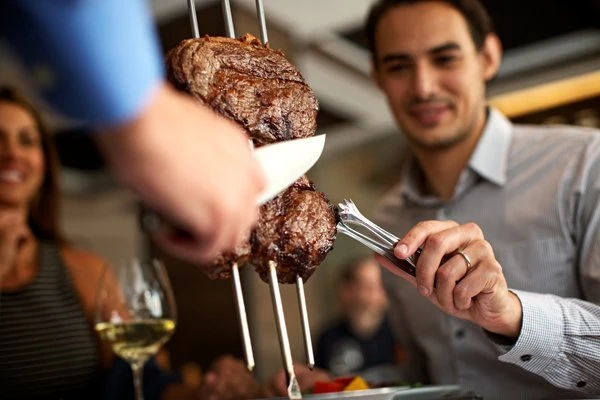
The restaurant version of churrasco operates on what’s called the rodízio system. Rodízio means rotation, which tells you basically everything — servers called passadores walk the floor all night long with different cuts of meat on long metal skewers, slicing directly onto your plate. You sit. Meat comes to you. You eat it. More meat comes. You eat that too.
To control the flow, you get a small card. Green side up means yes. Red side up means please stop, I need a moment. It’s an elegant system and I say that as someone who is naturally skeptical of gimmicks — it actually works, because it puts you in charge without requiring you to flag anyone down or feel like you’re being a nuisance.
Here’s the thing about the buffet, though. Every churrascaria has one, and at a good place it’s genuinely worth your time. Pão de queijo — small, warm cheese rolls made with tapioca flour that are somehow both crispy and chewy at the same time — will disappear from your plate faster than you expect. Farofa is toasted cassava flour, nutty and a little savory, and you sprinkle it over your meat the way you’d use breadcrumbs on a schnitzel. Vinaigrette — not the dressing, but a chunky salsa of tomatoes and onion in oil and vinegar — cuts through the fat perfectly.
Eat a little of all of it. Do not eat a lot of it. The meat is coming and you need the space.
The Cuts — What’s Actually Worth Knowing
Most people have heard of picanha by now. It’s had a moment in the food world over the last several years, and honestly the attention is deserved. But there are things worth knowing about all the cuts before you sit down, because part of the pleasure of a churrascaria is knowing what to ask for.
Picanha sits at the top of the sirloin, capped in a thick layer of fat that doesn’t get trimmed off the way it would in most American butcher cases. That fat isn’t decorative. It renders down over the heat and bastes the meat from the outside in, which is why picanha stays so juicy even when it’s been on a skewer over charcoal for twenty minutes. It’s cooked folded into a C-shape with the fat cap facing outward, pulled at medium-rare, sliced thin. The outer edge gets a little charred and crispy. The inside stays pink. If you don’t ask for anything else all night, ask for picanha.
Costela is the real test of a kitchen, though. Beef ribs. They take four hours minimum done properly — some churrasqueiros go six — and that low-and-slow time is what collapses the collagen into something almost gelatinous and rich. Bad costela is just chewy beef on a bone and it’s not worth eating. Good costela slides apart at the lightest pressure and tastes like the platonic ideal of beef. When you’re trying a new churrascaria, the costela tells you immediately whether they care.
Fraldinha is a belly cut — similar to flank steak but marbled more generously and a bit softer in texture. It’s a good call when you want something with deep beef flavor that isn’t as rich as the rib cuts.
Linguiça is the pork sausage, garlicky, mildly spiced, and the skin blisters on the grill in a way that’s incredibly satisfying. Think of it as a reset button between heavier courses. Order it whenever it comes around.
Chicken hearts. I know. Stay with me. Coração de frango is a beloved staple of Brazilian churrasco — small, threaded tightly together on skewers, cooked over high heat until slightly charred on the outside. The texture is firmer than regular chicken and the flavor is rich and mineral in a way that is genuinely delicious. If you’re eating with someone skittish about offal, just tell them it’s a small dark-meat cut and deal with the consequences later. They’ll thank you.
The Fire Is Not a Detail
This matters more than people realize. Brazilian grill is not a gas grill situation. It’s not a pellet smoker situation. It is charcoal — specifically hardwood charcoal, dense and hot-burning and clean — and the difference between that and everything else is not subtle once you know what you’re looking for.
Hardwood charcoal burns hotter than briquettes, produces less ash, and gives off a dry heat that sears meat efficiently without steaming it. The faint smokiness it contributes is background flavor, not the main event — it supports the meat rather than overwriting it. Gas produces no smoke at all, which is fine for a lot of cooking, but it’s not churrasco. The food will taste different. It just will.
A skilled churrasqueiro manages several different cuts at different distances from the coals simultaneously. Ribs sit far back over indirect heat and cook for hours. Sausages go right up close to a high flame for a quick blister. Picanha lives somewhere in the middle. All of this is active management — the fire gets fed, the coals get moved, the skewers get rotated constantly. It looks effortless when it’s done well, which is how you know it isn’t.
Making Churrasco at Home (Honest Version)
You can do this at home. People do it all the time. But I’m going to be straight with you: the first attempt probably won’t be perfect, and that’s fine.
What you actually need: a charcoal grill where you can adjust grate height, or a kettle grill where you can push coals to one side. Hardwood charcoal. Long flat metal skewers — the kind designed for churrasco, available online, not the thin wooden things that come in a bag at a grocery store. Coarse rock salt. That’s it.
Finding proper picanha is the first obstacle. Most standard butchers trim the fat cap off, which defeats the purpose entirely. Look for a Brazilian or Latin American butcher, or order online from a specialty supplier. You want the full cap, fat intact, at least an inch thick. Season aggressively with coarse salt on all sides and leave it alone for twenty minutes at room temperature before it goes on the fire.
Fold it into the C-shape, fat side out, run the skewer through it, cook over hot coals with the grate at a medium distance, rotating every three or four minutes. Pull it when the fat is golden and rendered and the thickest part reads around 130°F. Slice thin, immediately.
Make farofa while the meat rests. Melt butter in a pan, add finely diced onion, cook until soft, add cassava flour, toast it until golden and fragrant. Season with salt. Put it in a bowl on the table. Watch it go.
The first time you get it right, it will click. The whole thing will make sense in a way that’s hard to articulate until it happens.
How to Spot a Place That’s Actually Good
The fat cap test is quick and reliable. When picanha arrives at your table, look at the edge of the slice. Is there a band of rendered, slightly charred fat? Good sign. Was the fat trimmed off before cooking? Walk out. Not really. But mentally note it.
The rib situation reveals more. If costela is on the menu, order it early and pay attention. Tough and chewy means it was rushed. Soft and almost gelatinous means someone started the fire at the right time and had the patience to leave it alone. That kind of patience — or the absence of it — tells you a lot about a kitchen’s overall approach.
Ask about the heat source. Some places use gas rotisseries or electric ovens, especially in high-volume locations. The food isn’t bad, necessarily. But it’s a different product than wood charcoal churrasco and charging the same price for it is, let’s say, optimistic.
Also just pay attention to the pace. A good rodízio feels like the restaurant is taking care of you. A bad one feels like they’re trying to process you. There’s a texture to the service — how often passadores swing by, whether they’re relaxed or harried, whether you feel like a guest or a conveyor belt item — and you’ll notice it immediately.
The Part That Doesn’t Translate Easily
Here’s what a menu doesn’t tell you about churrasco.
In Brazil, the Sunday grill isn’t really about the food. Or — it is about the food, deeply, but the food is also just the reason everyone is there for four hours on a Sunday afternoon. The churrasqueiro tends the fire while everyone else mills around, and checking on the progress of the meat becomes a rhythmic excuse to wander over, have a conversation, open another beer, wander back. Kids are underfoot. Someone’s uncle is giving unsolicited advice about coal placement. There’s no fixed time to eat because the food comes in waves and you just keep going.
The best churrascarias understand this and design around it. The rodízio format isn’t just operationally efficient — it mirrors the way Brazilians actually eat this food at home. Continuous, unhurried, social. The meal is the evening. You’re not meant to finish and leave.
So go with people. Order the caipirinha early. Flip the card to red when you need to, flip it back to green when you’re ready, and don’t be in a hurry.
The ribs took six hours. You can take your time.

Mikhaila Olena is a lifestyle writer and content creator behind Living Smart Daily, dedicated to sharing practical ideas, thoughtful insights, and everyday inspiration. With a passion for simple living and meaningful choices, she crafts content that helps readers create a more balanced, organized, and fulfilling life.