





Nobody talks about the pageboy the way they talk about, say, a pixie or a lob. It doesn’t get the same breathless magazine coverage. It’s not the cut everyone’s suddenly asking for all at once, in that trend-cycle way where your hairdresser hears the same reference name forty times in a single week.
And yet. Walk into any decent salon and ask how often someone comes in with a reference photo that turns out to be a pageboy — a blunt hemline, ends curled under, that rounded helmet silhouette — and the answer is almost always: more than you’d think. People just don’t always know what to call it.
That’s sort of the pageboy’s whole thing. It’s been quietly there, the whole time, in the background of every decade since the 1960s. Never the loudest cut in the room. Always the one that looks good in photographs twenty years later.
What Actually Makes a Pageboy a Pageboy
People mix this up constantly, so let’s just get it straight.
A pageboy is not simply a blunt cut. It’s not just a bob with clean ends. The thing that makes a pageboy a pageboy — the actual defining feature — is that the ends turn under. Toward the face. Creating that smooth, rounded, inward curl at the bottom that gives the whole cut its shape.
Without the inward curl, you have a blunt bob. Nice, but different. The curl is what makes it a pageboy, what gives it that slightly structured, almost architectural quality that people either love immediately or need a minute to warm up to.
Length-wise it traditionally sits somewhere between the jaw and the collarbone. Though there are shorter versions — jaw-grazing micro pageboys that are extremely 1960s in energy — and slightly longer versions that land nearer the shoulders. The length changes the feel considerably. Shorter reads more severe, more graphic. Longer softens the whole thing.
The original name, since people always ask, comes from medieval pageboys — young male court attendants who wore their hair in this exact neat, bowl-shaped style. Which is either charming historical context or mildly horrifying depending on how you feel about being compared to a medieval teenager. Either way, the name stuck.
The Honest History (Shorter Than You Think)
Here’s what actually matters about the history of this cut, stripped of the usual filler.
It got its modern identity in the 1960s. Vidal Sassoon was doing what he did — treating haircuts as geometry, as architecture — and the pageboy fit perfectly into that moment. Clean. Structured. A shape you could actually see. It was the opposite of the big, set, sprayed hair that came before it and people lost their minds over it.
The 70s kept it going. The 80s nearly killed it with shoulder pads and perms. The 90s quietly revived it in minimalist fashion circles — you see it all over 90s runway photography if you look — and then the early 2000s happened and everyone got distracted by chunky highlights and flat-ironed-to-death straight hair and the pageboy went underground for a bit.
It came back properly around 2016, 2017. Maybe because the 70s came back, maybe because people were tired of undone beachy waves and wanted something with actual structure again. Since then it’s been in a slow steady resurgence. Not a trend spike. Just a gradual return to the conversation, which is honestly more appropriate for a cut this classic.
Who It Actually Works For — Face Shapes, Honestly
Oval faces: easy. The rounded silhouette works with oval proportions rather than against them. Any length variation. No real caveats here.
Round faces: this one gets complicated and most people get told the wrong thing. The common advice is “avoid the pageboy, it’ll make your face look rounder.” That’s not quite right. A jaw-length pageboy on a round face? Yes, potentially problematic — the width of the cut sits right at the widest point and exaggerates the roundness. But a collarbone-length pageboy on a round face? Often genuinely beautiful. The longer length creates a vertical line. The inward curl frames rather than widens. The key is length. Don’t avoid the cut, adjust the length.
Square faces: the pageboy is excellent here and doesn’t get enough credit for it. The inward curl at the ends softens a strong jawline without hiding it, which is the hard thing to achieve. If you have a square face and you’ve been avoiding blunt cuts because someone somewhere told you they’d look harsh — a pageboy is worth trying. The curl at the bottom does real work.
Heart-shaped faces: wide forehead, narrower chin — the pageboy adds visual weight at the jaw and below, which is exactly where a heart-shaped face needs it. Balancing effect. Works well.
Long faces: here you actually do need to be a little careful. A very long pageboy on a very long face can just extend the vertical line rather than interrupt it. Chin-length or jaw-length is the safer call. The width of the cut creates a horizontal break, which is what long faces generally benefit from.
The Texture Conversation Your Stylist Should Be Having With You
Straight and fine hair: this cut was genuinely made for you. Blunt ends on fine hair create an illusion of fullness and density that layered cuts can’t match. The weight sitting at the bottom makes fine hair look thicker than it is. Real upside. The only honest caveat is that fine hair loses its shape faster — you’ll need trims more regularly than someone with thicker hair to keep the hemline crisp.
Medium texture, slight wave: also very good. The wave can enhance the inward curl naturally, which means less work to style it. Some people find they barely need a round brush — the hair just wants to go that direction anyway.
Thick hair: this is where things get interesting and where bad haircuts happen. Thick hair has the volume to carry the shape easily, but if the interior isn’t properly texturized, the whole thing can go wide and round in ways that feel less chic and more helmet-y in the worst sense. A good stylist will thin the underneath slightly — not layer the outside, thin the inside — to keep the shape from ballooning. If you have thick hair and you’ve gotten a pageboy before that felt too big, that’s almost certainly what went wrong.
Curly and coily hair: the traditional pageboy shape requires either straightening the hair or working with the curl pattern in a more specific way. There’s a version — sometimes called a curly pageboy — where the natural curl creates the inward movement rather than a blow-dry does. It looks less structured and more romantic. Genuinely beautiful. But it needs a stylist who actually understands curly hair cutting, not just someone who thinks they can figure it out. Do not compromise on this one.
The Variations That Have Developed Their Own Identity
The shaggy pageboy. Keeps the rounded shape and the turned-under ends but adds texture and some internal layering, usually around the face. More lived-in. Less polished. Considerably more forgiving to maintain between cuts. This is the version that’s been all over editorial work for the last several years — you see it constantly in Italian Vogue-type spreads, slightly undone, slightly 70s.
The micro pageboy. Short. Jaw or just-below-jaw length. Very graphic. Very 1960s in energy. This is a cut that announces itself — there’s no reading it as anything other than intentional. It works best on people who are genuinely comfortable with a shorter silhouette and have the bone structure to carry something this close-cropped. Not a starter cut.
The side-part pageboy. The classic version is center-parted, which gives it that symmetrical, almost formal quality. A side part breaks that symmetry and softens the whole thing — it becomes more wearable, less severe. Good option for people who like the shape but find the center-part version slightly too structured for daily life.
The curtain bang pageboy. Curtain bangs — that face-framing fringe that parts in the middle and falls to either side — are doing a lot of work in hair right now, and they pair almost suspiciously well with a pageboy. It softens the top of the cut, adds movement around the face, and tilts the whole thing from architectural toward romantic. Very 70s. Very warm. If the classic pageboy feels a little cold for your taste, curtain bangs fix that.
How to Ask for It Without Walking Out with Something Wrong
This section exists because the pageboy is a precise cut and imprecision gets punished. Here’s what to actually say.
First: bring a reference photo. Not of the concept — of the specific version you want. Because “pageboy” means different things to different stylists. Your stylist’s mental image of a pageboy might be a micro jawline cut. Yours might be a collarbone-length soft shag version. Without a photo you’re having different conversations using the same words.
Second: specifically say you want the ends turned under. Don’t assume this is implied. In some salons it is. In others the stylist will cut a blunt hemline and send you on your way expecting you to blow-dry the curl yourself. Be explicit.
Third: tell them the exact length. Not “somewhere around the jaw” — actually show them on your own neck where you want it to land. Stylists are good at what they do but mind-reading is not part of the training.
Fourth: if you have thick hair, bring up texturizing before they start cutting. Ask whether they plan to thin the interior to control volume. If they look confused by this question, that’s information.
Fifth: ask how they’re going to finish it. The inward curl is partly built into the cut through how the ends are graduated, but it’s also achieved in the blow-dry. You want to know they have a plan for both.
Styling It at Home Without Losing Your Mind
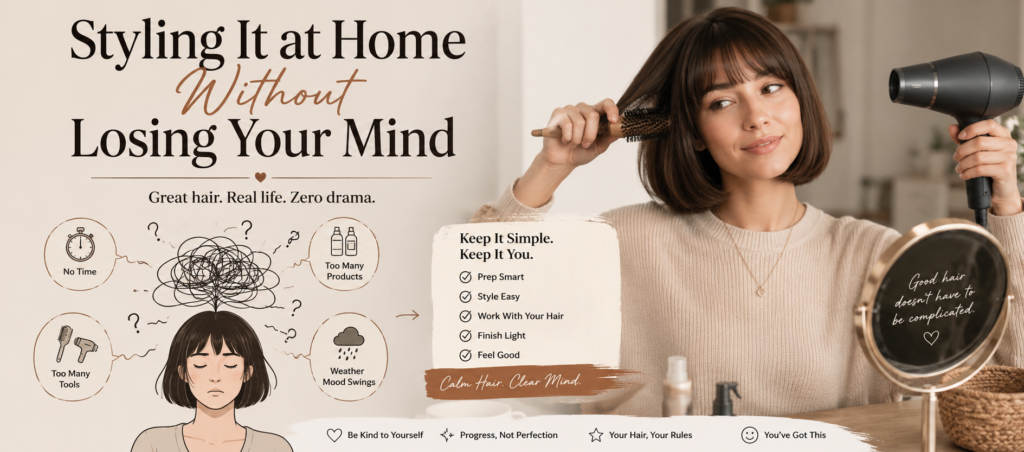
The good news is that once the cut is done properly, daily styling is not complicated. The shape wants to do most of the work.
The round brush blow-dry is the classic method and the one that gives you the cleanest result. Section the hair, work from underneath upward, rolling the ends inward as you dry each section. Takes practice. The first three times you try it, it won’t look right. By the tenth time it’s faster than doing your makeup. Worth learning.
If you don’t have time for a full blow-dry — and most people don’t, most mornings — a large-barrel curling iron or a straightener can flip the ends under in under five minutes. Run it along the last couple of inches, roll toward your face. Not identical to the blow-dry version but close enough that most people won’t notice the difference.
Product: a small amount of smoothing cream on damp hair before blow-drying controls texture and helps the ends stay where you put them. On dry hair, a tiny bit of pomade or serum on the ends adds definition and keeps flyaways down. The goal is controlled, not lacquered. This cut looks best when it looks like it took less effort than it did.
Trim schedule: every six to eight weeks, and this is not negotiable the way it is with other cuts. The blunt hemline grows out quickly and messily. When it starts to look uneven or the ends start to flick outward instead of under, the whole thing goes wrong fast. Budget for the maintenance before you commit to the cut.
Pageboy vs. Bob: Clearing This Up Once and For All
These two get used interchangeably. They shouldn’t.
The bob is a category. It covers essentially any blunt-cut style from the ear to the shoulder. The ends can go wherever — straight across, flicked out, turned under, whatever.
The pageboy is a specific style within that category. The defining features are: turned-under ends, rounded silhouette, weight sitting at the hemline.
Every pageboy is technically a bob. But calling a pageboy a bob is like calling a Marguerite pizza just “food.” Technically correct. Missing the point.
Color That Works With This Cut
The pageboy’s clean, strong shape makes it work well with some color approaches and genuinely fight against others.
Solid single-process color — one shade, end to end — is the most classic pairing and there’s a reason for that. The cut itself provides all the visual interest. Adding a rich, glossy single color amplifies the shape rather than competing with it. Dark, glossy single-process on a pageboy is one of the most permanently elegant looks in hairdressing. It’s the hair equivalent of a well-tailored blazer.
Face-framing highlights — money pieces, lighter sections around the front — work well because they draw attention to the face, which is already where the cut is pointing. Subtle, not dramatic. Think sun-kissed rather than highlighted.
Balisage can work but it can also fight with the blunt hemline. If the color gets too chunky or too varied near the ends, it visually disrupts the clean line that makes the cut work. If you want balisage, keep it concentrated in the mid-lengths and ask your colorist to keep the ends more uniform.
High-contrast chunky highlights throughout: not here. The cut depends on its simplicity and anything that fragments that simplicity — visually breaking up the shape — works against it. Save the dramatic color for a different cut.
The Bottom Line
The pageboy is a commitment in the sense that it has a specific personality and doesn’t try to be something else. It’s not the chameleon that a long layered cut is. It doesn’t air-dry into something effortless and undone. It wants to look like itself.
But what it looks like is good. Reliably, photographably, decades-from-now-still-good.
The version of it matters enormously. The sleek, center-parted classic is a different experience than the shaggy textured variation, which is a different experience again from the curtain-bang soft version. There’s enough range within the style that “pageboy” is almost a starting point rather than a finished answer.
Find someone who actually wants to cut it — not someone who’ll do it because you asked, but someone who has opinions about it, who might suggest a slightly different length than you were thinking, who asks about your texture before picking up the scissors. That interest in the cut usually means they understand its geometry. And a pageboy without good geometry is just a haircut. A pageboy with it is something people notice.
Mikhaila Olena is a lifestyle writer and content creator behind Living Smart Daily, dedicated to sharing practical ideas, thoughtful insights, and everyday inspiration. With a passion for simple living and meaningful choices, she crafts content that helps readers create a more balanced, organized, and fulfilling life.