








My father had a stack of them in the garage.
Not the English editions — the Spanish ones. Revista Muscle and Fitness, issue after issue, stacked in two rows against the back wall between his weight bench and a set of dumbbells that had not moved in probably three years. He had been collecting them since the early 1990s. Some of them had Arnold Schwarzenegger on the cover. Most of them had training programs circled in red pen, with handwritten notes in the margins that I spent a lot of time reading as a teenager without really understanding what I was looking at.
I understood later. What I was looking at was an education.
What Revista Muscle and Fitness Actually Was
Muscle and Fitness — Revista Muscle and Fitness in the Spanish-speaking world — is one of the longest-running fitness publications in history. It was founded in 1935 by Canadian entrepreneur Joe Weider, originally published under the title Your Physique, before being renamed Muscle Builder in 1954, and acquiring its current name in 1980.
The Spanish edition — Muscle and Fitness España — ran for hundreds of issues across several decades, bringing the same training programs, nutrition research, and athlete profiles that English-speaking readers had been following to a Spanish-speaking audience that had almost no other equivalent resource available to them.
My father was one of those readers. He had no gym membership in the early 1990s. He had a weight bench, those dumbbells, a barbell, and issues of Revista Muscle and Fitness that he had been collecting since a friend recommended it to him. He built his training entirely from the programs in those pages. Not perfectly — he will freely admit this — but consistently, and with an understanding of why he was doing what he was doing that he could not have gotten anywhere else at the time.
Joe Weider and Why the Magazine Existed at All
Understanding Revista Muscle and Fitness properly requires understanding the person behind it, because the publication was not a corporate product that emerged from a boardroom decision. It was the extension of one person’s obsession.
Born in Montreal during the Great Depression, Joe Weider left school at just 12 years old to support his family. After being bullied for his size, he started lifting weights — using barbells he made himself from scrap metal. That scrappy beginning sparked a lifetime obsession. By 1940, with only $7 to his name, Weider launched Your Physique magazine.
The trajectory from there is remarkable. For years Joe oversaw a publishing empire that included the “Bible” of bodybuilding, Muscle and Fitness, Muscle and Fitness Hers, Flex for the hard-core bodybuilder, Men’s Fitness for the active man, Shape for the active woman, and Fit Pregnancy and Natural Health.
But the origin is the part that matters for understanding what made the magazine different. Weider was not a publisher who decided fitness would sell. He was someone for whom fitness had been personally transformative — a skinny kid from a hard neighborhood who discovered what training could do and spent the rest of his life trying to tell other people about it.
That shows in the pages. My father’s annotated editions were not annotated because the content was generic. They were annotated because the training programs were specific, the nutritional guidance was practical, and the athlete profiles gave him something to aim at that felt achievable — even though most of it was not, which was beside the point.
The Weider Principles — What Made the Content Different
The content of Revista Muscle and Fitness was not just a collection of exercise descriptions and meal plans. It was built around a system of training principles that Weider had been developing since the 1940s.
For his magazine, Joe would spend countless hours in various gyms studying and cataloging the movements and techniques that were effective for bodybuilders, weightlifters and power-lifters alike. By 1950, he had compiled 12 years’ worth of such observations, and he christened them The Weider Training Principles — over 30 theories and techniques that forever changed the means by which someone could build a strong, muscular body.
These principles — progressive overload, supersets, drop sets, pre-exhaustion, muscle confusion, the mind-muscle connection — were not invented by Weider in the sense of appearing fully formed from nowhere. But he was the one who systematized them, named them, and distributed them at scale through his publications.
From progressive overload to supersets, Weider’s influence is everywhere — even if lifters don’t realize they’re following his blueprint.
That last part is the most accurate summary. The language of modern training — the way gym-goers think about progressive overload, the instinctive use of supersets to save time, the attention to mind-muscle connection that serious lifters develop — most of it traces back, directly or indirectly, to the content that ran in Muscle and Fitness and its Spanish counterpart across decades of monthly issues.
My father did not know this when he was reading those issues in his garage. He was just following the programs. But the programs worked, because the principles behind them were sound, because they had been field-tested by champions and refined by someone who had been obsessively studying training for thirty years before the first edition of Your Physique appeared.
Arnold Schwarzenegger and the Magazine’s Global Impact
No account of Muscle and Fitness — in any language — is complete without acknowledging the role Arnold Schwarzenegger played in making it what it became globally.
When I was a young boy in Austria, Weider’s muscle magazines provided me with the inspiration and the blueprint to push myself beyond my limits and imagine a much bigger future. Joe didn’t just inspire my earliest dreams; he made them come true the day he invited me to move to America to pursue my bodybuilding career.
Schwarzenegger became one of the magazine’s most prominent faces throughout the 1970s and into the 1980s, at a time when his bodybuilding achievements and later his film career were giving him a global profile that the magazine leveraged brilliantly. When Schwarzenegger appeared on a cover of Revista Muscle and Fitness España, that issue sold.
But the relationship was not purely commercial. Weider genuinely believed in what Schwarzenegger represented — not just the physique, but the possibility of complete transformation through dedicated training. A kid from Montreal who had built barbells from scrap metal and a kid from Austria who had read about bodybuilding in a magazine and decided to make it his life. The parallel was not lost on either of them.
My father had several issues with Schwarzenegger on the cover. They were the most annotated ones. I asked him about this once. He said Schwarzenegger’s training splits, which were detailed extensively in the Spanish editions, were the first ones that made him understand periodization — training different muscle groups on different days in a structured sequence — rather than trying to train everything in a single session and wondering why he was exhausted all the time.
The Spanish Edition — What Made It Specific
Revista Muscle and Fitness España was not simply a translation of the American edition, though translation was a significant part of it. The Spanish editions ran localized content — Spanish and Latin American athletes, regional competitions, training advice adapted for readers who might not have access to the same facilities or supplements that American readers had.
Muscle and Fitness expanded to reach nearly 3 million monthly visitors and over 17 million social media followers across its network. But in the years before digital reach, the physical magazine was doing something different — providing access to training information that was not available in any other form in many Spanish-speaking countries.
This is the part of the publication’s history that often goes underappreciated when people discuss the Muscle and Fitness legacy. In North America and Western Europe, Weider’s magazines existed alongside a growing gym culture, supplement industry, and competing fitness media. In much of the Spanish-speaking world, Revista Muscle and Fitness was not competing with a robust fitness media landscape. It was creating one.
The readers writing notes in the margins of those early 1990s Spanish editions were not supplementing what they already knew. They were learning something that did not exist in Spanish anywhere else.
Where It Stands Now
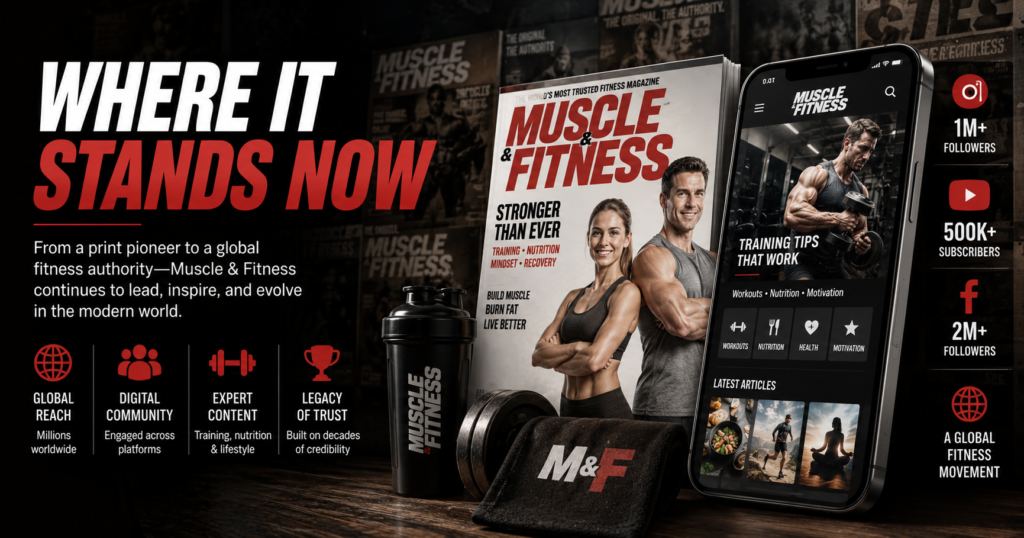
Muscle and Fitness exists primarily as a digital brand producing training guides, nutrition articles, product reviews and video. Occasional print special issues or partnerships appear, but there is no regular mass-market monthly magazine in the old Weider glossy format.
The shift is easy to frame as a loss, and in some ways it is. The experience of reading a physical issue — the weight of it, the photographs that filled full pages, the training programs you could fold over and take to the gym — does not translate to a website or a social media channel. My father’s annotated garage stack is not something that exists in digital form.
But the content Weider built his magazine around — the training principles, the nutritional fundamentals, the belief that ordinary people could transform their bodies through consistent, structured effort — has not disappeared. It has dispersed, through decades of influence, into the general vocabulary of how people think about training. The principles are in gym classes and personal training certifications and YouTube channels run by people who have never read a single issue of Muscle and Fitness.
That is what a truly influential publication looks like forty years later. Not preserved in a museum. Dissolved into the culture it helped create.
What My Father Still Has in the Garage
The stack is smaller now. He gave several issues to a nephew who started training a few years ago and wanted something physical to read rather than a YouTube video. He kept the ones with the most extensive marginal notes — the ones from the programs that worked, the issues he came back to repeatedly.
He has not read one in years. He does not need to. The programs are in his body now, the principles translated into muscle memory across three decades of consistent training. He can tell you, without looking it up, the difference between a superset and a drop set, when to use each, why you would choose one over the other for a specific goal. He learned it in a garage in the 1990s from a Spanish-language edition of a magazine founded by a kid who made his first barbells from scrap metal.
That is the legacy of Revista Muscle and Fitness. Not the copies on eBay or the PDFs on Scribd. The people who read it and built something from it.

Mikhaila Olena is a lifestyle writer and content creator behind Living Smart Daily, dedicated to sharing practical ideas, thoughtful insights, and everyday inspiration. With a passion for simple living and meaningful choices, she crafts content that helps readers create a more balanced, organized, and fulfilling life.





One comment on “Revista Muscle and Fitness: The Magazine That Changed How the World Thinks About Training”