









For a long stretch, my exercise routine was forty-five minutes on the elliptical, four or five times a week, at a pace I could hold while reading the subtitles on the gym TV. My heart rate stayed comfortably in what the machine called the “fat burn zone.” I never missed a session for almost a year.
My weight didn’t move. My waist didn’t move. My clothes fit the same in month eleven as they did in month one.
What did change was my resting heart rate, which dropped a few beats, and my general stamina, which improved in a way that made stairs feel less annoying. Those are real benefits. They just weren’t the ones I was training for.
A friend who coaches recreational runners kept telling me to try HIIT instead of cutting my cardio time in half. I put it off for months, mostly because the workouts looked miserable in videos and I didn’t love the idea of feeling like I was going to throw up in my own living room. Eventually I ran out of reasons not to. Three months of doing it properly changed my body composition more than the entire previous year had.
That word “properly” is doing a lot of work in that sentence, and it took me embarrassingly long to figure out what it meant. Here’s what I learned, and the program that came out of it.
So What Is HIIT, Actually
Strip away the branding and high-intensity interval training is just this: short bursts of effort near your max, followed by short recovery windows, repeated for a set stretch of time. That’s the whole definition. The specific timing, the exercises you pick, how many rounds you do — all of that is just implementation, and it varies a lot between programs.
The part that actually matters is the word “high.” Not moderately challenging. Not a pace you could sustain for an hour if you had to. Genuinely hard — hard enough that finishing the interval feels like an accomplishment rather than a formality.
This is also the part most people, myself included, get wrong for the first few weeks.
Why It Works Better Than Slow Cardio for Fat Loss
The mechanism everyone mentions first is EPOC — excess post-exercise oxygen consumption, sometimes called the afterburn effect. Push your body hard enough and it spends hours afterward working to restore itself, burning extra calories along the way. This is a documented phenomenon, not a marketing claim, though I’d argue the fitness industry oversells how large the effect is on its own. It matters, but it’s not the whole story.
The bigger factor, at least based on what changed for me, is what HIIT does to muscle relative to fat. Long steady-state cardio tends to burn calories from both muscle and fat somewhat indiscriminately. HIIT seems to be kinder to muscle. A 2025 systematic review looking at younger adults found HIIT was particularly effective at promoting fat loss while preserving muscle mass — which lines up with something coaches have said anecdotally for years but that took a while to get proper research behind it.
There’s also a fairly large review — thirteen studies, over four hundred adults with overweight or obesity — that found both HIIT and traditional moderate cardio reduced body fat and waist size to a similar degree. The real difference wasn’t the outcome. It was the time it took to get there. The HIIT groups got there faster.
For anyone whose actual obstacle is “I don’t have an hour a day,” that’s not a small detail. It’s the whole appeal.
Who This Program Is (and Isn’t) For
If you’ve been sedentary for a long time, or you have joint issues, heart conditions, or you’re pregnant, talk to a doctor before jumping into anything below. HIIT is not gentle by design, and starting with genuinely high intensity when your body hasn’t built any base fitness tends to end in injury or in quitting — sometimes both, sometimes within the same week.
If you’ve got some baseline movement capacity already — you can walk briskly, climb stairs without much trouble, do a handful of bodyweight squats without your knees complaining — you’re probably ready to start where the program below begins.
The Program: Four Weeks, Three Sessions a Week
No equipment required beyond a timer and maybe a mat if your floor is hard. Rest at least a day between sessions. Each workout runs twenty to twenty-five minutes including warm-up.
Weeks 1–2: Learning What “Hard” Actually Means
Work: 20 seconds Rest: 40 seconds Rounds: 6–8
This ratio feels almost too easy on paper. It isn’t, once you actually push the work intervals. Most people — I certainly did — spend their first few sessions holding back without realizing it, because twenty seconds of genuine max effort is a lot more uncomfortable than it sounds. The forty-second rest should feel adequate, not generous.
Pick whichever movement lets you actually reach that intensity: sprinting outside or on a treadmill, hard cycling, rowing, or bodyweight moves like burpees, jump squats, and mountain climbers. There’s no prize for choosing the “harder” exercise if it means you can’t actually push your effort — a stationary bike sprint done at full intensity beats a burpee done at 60%.
Weeks 3–4: Closing the Gap Between Work and Rest
Work: 30 seconds Rest: 30 seconds Rounds: 8–10
Going from a 2:1 rest ratio to even is a real jump in difficulty, not a minor tweak. The thirty-second rest will feel shorter than you want it to be, especially in round six or seven. That discomfort is the point — it’s the signal that you’re training at an intensity that actually produces the adaptations you’re after, rather than just moving for twenty minutes.
A rough gut-check for whether you’re working hard enough: by the second interval of any session, talking in full sentences should be difficult. By the midpoint, the rest periods should start to feel slightly insufficient. If you’re finishing intervals feeling like you could easily keep going, push harder next round.
A Quick Word on Tabata
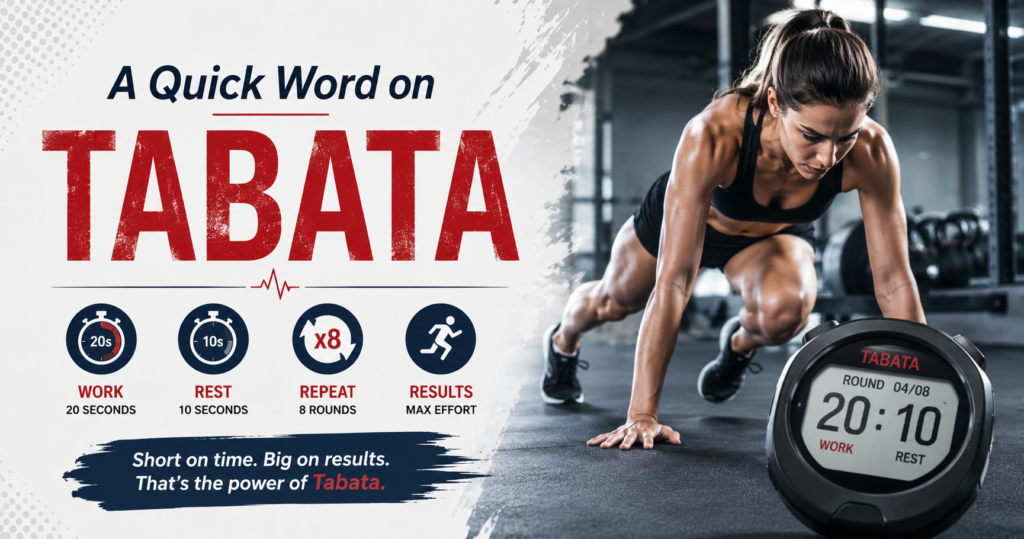
Tabata gets mentioned constantly in this space and it’s worth explaining properly, because most people use the name loosely. The actual protocol, developed by Dr. Izumi Tabata in the 1990s, is eight rounds of 20 seconds of maximum effort followed by 10 seconds of rest — four minutes total.
Four minutes. That’s the whole session.
The catch, and it’s a real one, is that the intensity required to get the results from Tabata’s original research is higher than almost anyone actually brings to it. Near-maximal effort for eight straight rounds is brutal in a way that’s hard to appreciate until you’ve tried it honestly.
Used as your entire training plan, four minutes at max effort burns fewer total calories than the twenty-minute sessions above, simply because there’s less total work being done. Used as an occasional add-on for a day when you genuinely have four minutes and nothing more, it’s far better than skipping training entirely.
The Mistake I Made for Six Weeks
I wasn’t going hard enough during the work intervals.
I thought I was. I’d finish a round breathing heavier, feel like I’d done something, and move on satisfied. In hindsight, I was probably working at somewhere around 70% of what the interval called for — enough to feel tired, not enough to trigger the specific response that makes HIIT different from any other cardio.
That’s technically a different kind of training, and it produces a different, more modest result. Real HIIT intensity is uncomfortable in a way that’s hard to fake. If you finish a work interval and think “I could keep going,” that’s the tell. The rest period exists because the effort level is supposed to be unsustainable past its length — if it were sustainable, it wouldn’t be doing what you need it to do.
What HIIT Won’t Do for You
It won’t replace paying attention to what you eat. Research consistently shows exercise — HIIT included — produces meaningfully better weight loss results when paired with a modest calorie deficit than when done alone. That’s not a knock on the training. It’s just accurate. Twenty minutes of hard intervals doesn’t cancel out a diet that’s working against you.
It also isn’t the right starting point for everyone. People with certain heart conditions, uncontrolled blood pressure, or joint problems that make impact risky should treat this as a conversation with a doctor, not a decision to make alone. And if you’ve never exercised consistently, building a basic fitness foundation first — a few weeks of walking, some light strength work — tends to make HIIT both safer and more effective once you get there, rather than skipping straight to intervals with no base underneath them.
What My Friend Said That Actually Stuck
When I told her what had shifted after three months, she said something I’ve thought about a lot since. She said most people don’t fail to get results from cardio because cardio doesn’t work — it does — but because it’s very easy to do cardio at a pace that’s comfortable rather than one that’s effective. With intervals, there’s less room to quietly cheat your own effort. The clock ends the work period whether you pushed or not. You either went hard, or you didn’t, and you know which one you did. That’s really the difference between the year on the elliptical and the three months of intervals. Same general idea — burn calories, build some fitness — but one let me coast without realizing it, and the other didn’t give me anywhere to hide.

Mikhaila Olena is a lifestyle writer and content creator behind Living Smart Daily, dedicated to sharing practical ideas, thoughtful insights, and everyday inspiration. With a passion for simple living and meaningful choices, she crafts content that helps readers create a more balanced, organized, and fulfilling life.





One comment on “I Tried HIIT After Years of Cardio That Went Nowhere — Here’s the Program That Finally Worked”