


My roommate in university had a wardrobe that I could not explain for about six months.
Not in a bad way. In a genuinely puzzling way. She was wearing things that did not look like anything I could find in the shops I went to — silhouettes that were slightly off from what was on the high street, fabrics that looked more interesting, layering combinations that seemed effortless in a way that took actual thought. When I finally asked, she laughed and said she had been shopping Asian fashion online since she was sixteen. She mentioned YesStyle. She mentioned Musinsa. She said she had never paid full price for anything good.
I spent the next few weeks going down a rabbit hole that I have not fully come back from. Here is everything I learned — where to actually shop, how to navigate the sizing situation that nobody warns you about, and which platforms are worth the effort versus which ones are not.
Why Asian Fashion Is Worth the Effort
The straight answer is that Asian fashion — specifically Korean, Japanese, and Chinese fashion — is doing things stylistically that western high street brands are following rather than leading. This has been true for longer than most people realize.
The best Asian fashion websites include YesStyle, Uniqlo, Stylenanda, and Zalora, offering a diverse mix of trendy and affordable clothing across the region. Whether you’re into minimalist Japanese styles, bold Korean trends, or vibrant Southeast Asian fashion, these websites have something for everyone.
But the reason my roommate’s wardrobe looked the way it did was not just the individual pieces. It was the availability of specific aesthetics that simply do not exist in western retail. Korean ulzzang. Japanese mori girl. The particular kind of oversized layering that Seoul streetwear had been doing for years before it showed up in London or New York. These are not trends that trickle down from western fashion weeks. They are distinct visual languages with their own logic, and finding them requires going to the source rather than waiting for the western interpretation.
The Platforms — What They Are and What They Are Good For
YesStyle
YesStyle offers the best in women’s Asian fashion. From K-pop-inspired outfits, Korean ulzzang, and Korean streetstyles to Japanese Lolita, mori girl, cosplay, and the latest Taiwanese fashion, their huge womenswear catalog is fresh and new, and always sets the trend.
YesStyle is where most people start and where many people stay. It is based in Hong Kong, ships internationally, and aggregates clothing from brands across Korea, Japan, Taiwan, and China. The scale of the catalog is both its main strength and its main complication — there is a lot of everything, which means filtering and knowing what you are looking for matters more than it would on a smaller site.
The reviews on YesStyle are genuinely useful, more so than on many western platforms, partly because the community of regular shoppers is specific and knowledgeable enough to tell you things like “this runs two sizes small” or “the color in the photograph is significantly more saturated than the actual garment.” Read them before buying anything, particularly anything with a price point that would hurt to get wrong.
Musinsa
Musinsa is Korea’s largest online fashion platform and a top destination to shop Korean clothing online. The best way to shop Korean clothing online is through popular multibrand platforms like Musinsa and Zigzag. These platforms gather a wide range of top Korean fashion brands in one place, making it easier to browse and compare styles. They offer user-friendly interfaces, advanced filters, and exclusive discounts that individual brand websites often lack.
Musinsa is where Korean fashion insiders actually shop. It is a hub for Korean streetwear specifically — the brands that are setting trends rather than following them. If the aesthetic you are after is urban, layered, slightly oversized, and genuinely current, Musinsa is more relevant than any western alternative.
The global version ships internationally, which is relatively recent and still being improved. Sizing on Musinsa trends Korean-standard, which I will address properly in a separate section, but the brand pages usually include detailed measurements rather than just S/M/L designations, which makes it manageable.
W Concept
W Concept is a leading Korean fashion platform known for spotlighting emerging designer brands, making it a premium choice to shop Korean clothing online. Unlike fast fashion marketplaces, W Concept focuses on high-end, trend-forward labels such as EENK, LOW CLASSIC, and OPEN YY — many of which now have significant international followings.
W Concept is the answer for anyone who finds Musinsa overwhelming. It is curated in a way that the larger platforms are not — the brands on the site are there because someone made a deliberate choice to include them. The price point is higher than YesStyle or the fast-fashion end of Musinsa, but the quality is meaningfully better, and the discovery element — finding a brand you had never heard of that makes exactly the kind of thing you have been looking for — is part of why people come back.
Uniqlo
Uniqlo is the most popular clothing brand in Asia, known for its minimalist designs, high-quality materials, and affordable prices. Innovative Fabrics: Products like Heattech and AIRism showcase the brand’s commitment to functionality and comfort.
Uniqlo is a different category from the others — less about trend and more about wardrobe fundamentals done exceptionally well. If the aesthetic you are after is Japanese minimalism — clean lines, high-quality fabrics, pieces that work with everything — Uniqlo delivers this at a price point that is difficult to argue with. Their collaborations, particularly with designers like Jil Sander (the +J line) and Christophe Lemaire, bring design credibility to the basics ethos.
My roommate had a specific Uniqlo linen shirt that she wore constantly for three years. Still looks fine. That longevity is part of what the brand is offering, and it is relevant when you are thinking about cost per wear rather than cost per item.
CHINASQUAD and Emerging Chinese Fashion
CHINASQUAD curates Chinese designer fashion, clothing brands, statement dresses, streetwear, and modern Hanfu-inspired styles for global shoppers. Premium logistics. Seamless global returns.
Chinese fashion deserves separate attention because it has historically been underrepresented in conversations about Asian style relative to Korean and Japanese fashion, and the current generation of Chinese designers — particularly the independent labels coming out of Beijing and Shanghai — are doing work that is genuinely interesting and distinct from what either Korea or Japan is producing.
CHINASQUAD curates a specific tier of this — independent labels rather than the mass-market end. The aesthetic tends toward structural, conceptual, and often incorporating elements of traditional Chinese clothing culture in contemporary ways. It is not for everyone but for the right buyer it is unlike anything available through western retail.
The Sizing Situation — The Thing Nobody Warns You About Properly
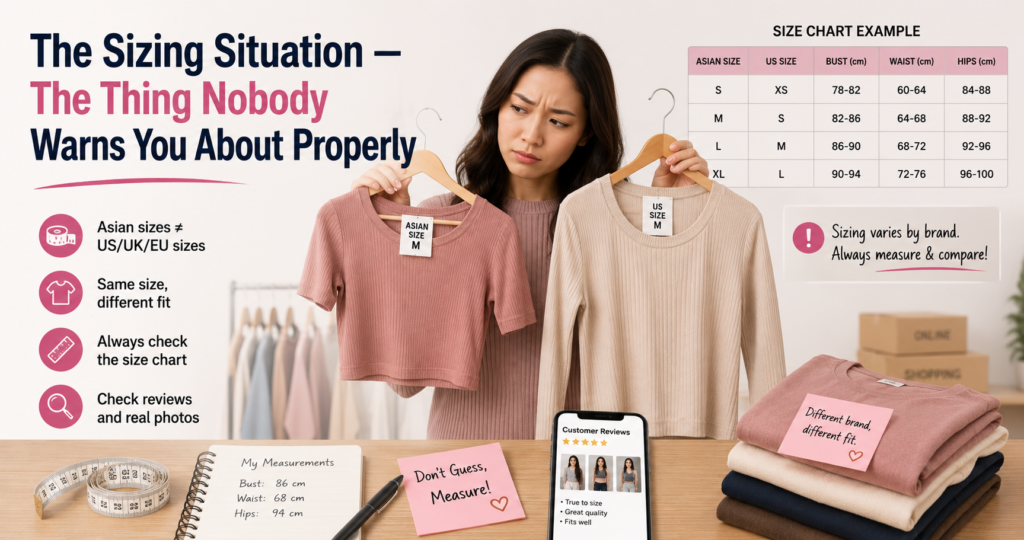
This is the part of Asian clothes shopping that causes the most problems for first-time buyers and that needs to be addressed directly rather than buried at the bottom of a shopping guide.
All garments are produced in Asian sizing. For Asian customers, please select your usual size. For non-Asian customers, sizing may feel smaller — consider the garment’s nature and choose accordingly. For fitted styles, we recommend sizing up if in doubt.
This is the polite version of what is actually a significant size difference that catches people off guard repeatedly. Korean sizing in particular runs smaller than western sizing as a general rule — not universally, not on every brand, but consistently enough that treating it as the default assumption is the right approach.
When you shop Korean clothing online, keep in mind that sizing can be different from what you’re used to. Many Korean brands use smaller, Asian-standard measurements, and “free size” often fits only a limited range. To avoid returns or confusion, it’s best to check measurements carefully before buying.
“Free size” is a specific term used widely in Korean fashion that means a single size intended to fit a range of bodies. In practice, free size typically fits a western XS to S range. Occasionally it extends to a western M. Almost never beyond that. If you are a western M or above, any listing marked “free size” without specific measurements is worth treating with caution.
The practical approach: always find the measurements rather than the size label. Most reputable platforms provide bust, waist, hip, and length measurements for each garment, usually in centimeters. Measure yourself in the same places and compare. This is more effort than checking a size label but it is the only reliable method.
Shipping, Customs, and the Practical Reality
International shipping from Asian platforms has improved substantially in recent years. Most major platforms offer tracked international shipping, and the arrival times are more reliable than they were five years ago.
Customs and import duties are the variable that most guides gloss over and most buyers discover on delivery. Depending on your country and the declared value of the order, you may be charged import duties and taxes on arrival. In the UK and EU particularly, this is an increasingly consistent reality for international orders above a certain threshold.
The practical approaches that experienced buyers use: consolidating orders into fewer, larger shipments rather than multiple small ones, checking the specific threshold for your country before ordering, and factoring the potential customs cost into your budget calculation before you decide whether the item is worth buying.
Some platforms, including YesStyle, offer shipping options that include duties paid upfront — more expensive at checkout, no surprise on delivery. Worth considering for larger orders.
Starting Without Getting Overwhelmed
My roommate’s advice when I first asked, and the advice I have given everyone since, is to start with one platform and one aesthetic rather than trying to understand everything at once.
If you are new to Korean fashion and want to understand the landscape: Musinsa global, with the filters set to whatever category you actually need clothes in. Spend time looking before you buy anything.
If you want something more curated with higher quality: W Concept. Narrower catalog, clearer editorial point of view.
If you want the broadest possible starting point and maximum variety: YesStyle, with the reviews treated as seriously as the product photographs.
If you want Japanese minimalism done properly: Uniqlo, full stop.
The sizing knowledge takes a few purchases to develop into instinct. The platform knowledge takes longer. The payoff — a wardrobe that looks like it has a point of view rather than a collection of things that were available near you — takes as long as it takes and is, genuinely, worth it. My roommate still has that wardrobe. I have been shopping Asian fashion for three years now. I have not bought anything from the high street in about fourteen months. This is not a statement I planned to make. It is just where consistent access to better options eventually lands you.

Mikhaila Olena is a lifestyle writer and content creator behind Living Smart Daily, dedicated to sharing practical ideas, thoughtful insights, and everyday inspiration. With a passion for simple living and meaningful choices, she crafts content that helps readers create a more balanced, organized, and fulfilling life.


2 Comments on “Asian Clothes Shopping: The Honest Guide to Finding What You Actually Want”