





I bought my first leg roller because my calves were destroying my sleep.
Not dramatically — no injury, no diagnosis, just that specific kind of deep muscle tightness that starts somewhere around 11pm and makes sleeping feel like a negotiation. I had been running three or four times a week for about six months. My body had adapted to the distance. My calves had not fully gotten the memo. A physiotherapist I saw for something unrelated mentioned foam rolling while I was complaining about it. I went home and typed “leg roller” into YesStyle that evening, mostly because I already had the tab open from buying something else.
What I found was considerably more varied than I expected. Here is what I learned, what I ended up buying, and what has actually made a difference.
Why YesStyle for This Specifically
YesStyle is primarily known for Korean and Japanese beauty and fashion, but the wellness and self-care section — which includes massage tools, foam rollers, and various recovery devices — has grown substantially over the last few years. The advantage is not that YesStyle carries products you cannot find anywhere else. The advantage is the combination of Asian-market brands that do not always appear on western retail platforms, pricing that tends to undercut what you would pay for equivalent products elsewhere, and the reviews, which for wellness tools specifically tend to be detailed and practical in a way that is useful when you are trying to decide between a $12 option and a $35 option without being able to feel either of them first.
The range on YesStyle covers foam rollers, handheld massage sticks, vibrating rollers, textured ball rollers, and electric leg massager wraps — essentially the full spectrum of what exists in the category, from the simple to the elaborate.
The Different Types — What They Actually Do Differently
Foam Rollers
The cylindrical foam roller is the classic version and still the most widely used. You place it on the floor, lower the target muscle onto it, and use your body weight to apply pressure while you roll back and forth.
Foam rollers are known to help reduce muscle and tissue soreness and tension. They also help increase flexibility, especially when used as a warm-up before exercise. When you press muscles and fascia against a foam roller, you’re loosening those tissues, releasing tension and easing pain. Think of it like giving yourself a massage — without the trip to the spa.
For legs specifically, foam rollers work well for quads and hamstrings — the large muscle groups where the roller can span the full width of the muscle. They are less effective for calves, which was my problem, because the smaller surface area of the calf makes it harder to position the roller correctly and maintain the angle needed for effective pressure.
The surface texture matters. Smooth rollers are better for beginners — the pressure is distributed more evenly and the sensation is easier to manage. Textured rollers with ridges or knobs create deeper pressure in specific points, which can be more effective for releasing stubborn muscle knots but is genuinely uncomfortable until you have built up some tolerance.
Handheld Massage Sticks and Rollers
The handheld version is different in a way that matters for how you actually use it. Unlike traditional foam rollers, where you are basically using your body weight against the ground, massage sticks let you stand, sit, or move around while targeting specific muscles. Whether you are on a hike or at the airport, you don’t have to get on the ground — you can roll anywhere.
For calves, which was my specific problem, a handheld roller is considerably more practical than a floor roller. You can sit on a chair, cross one leg over the other, and work the calf from ankle to just below the knee with controlled pressure and without needing floor space. You can also adjust the pressure in real time by varying how hard you press, which foam rollers on the floor do not allow in the same way.
Clinical research backs this up — studies show that self-myofascial release using roller massage tools can increase joint range of motion and reduce muscle soreness without negatively affecting muscle performance.
Vibrating Rollers
Vibrating foam rollers add a motor to the standard cylinder design. The vibration penetrates tissue differently from static pressure — theoretically reaching deeper into the muscle faster and with less discomfort than a standard roller requires to achieve the same result.
The evidence for whether vibration adds meaningful benefit over standard rolling is mixed. Some studies show modest additional benefit for soreness reduction. Others show little difference. What is consistently reported is that vibrating rollers feel better to use, particularly for people who find standard rolling genuinely painful. If the reason you stopped using a standard foam roller was that it hurt too much, a vibrating version is worth trying.
The trade-off is cost and portability. Vibrating rollers are considerably more expensive than standard foam rollers, need charging, and are heavier.
Electric Leg Massager Wraps
These are a different category from the handheld and cylinder options. Electric leg massager wraps enclose the leg and use air compression, heat, or vibration — or combinations of all three — to massage without manual effort.
These automated leg massage machines can be used to massage the legs without requiring manual effort. They come in a variety of styles, including full leg massager machines, leg compression sleeves, and handheld massagers. They can offer a range of benefits, including pain relief, improved circulation, and relaxation.
On YesStyle specifically, the electric wrap options from Japanese and Korean brands tend to be more compact and travel-friendly than western equivalents. If you travel frequently and want recovery support without carrying a foam roller, the compression sleeve options are worth looking at.
What to Look for When Buying
Firmness. This is the most commonly underestimated variable. If you’re new to foam rolling, start simple and soft. Some foam rollers have bumps that provide deeper pressure, but if you’re new to the practice, start with a relatively soft, smooth roller. “The softer it is, the less painful it’s going to be,” says Dr. Marwa Ahmed from Harvard Medical School. “Then, as you roll out these tissues, it’s going to become harder to get much benefit from a softer foam roller, and so you can graduate to a harder foam.”
Size and design. A full-length foam roller — 90cm or more — gives you more surface area to work with for the quads and hamstrings. A shorter, denser roller is easier to transport and more suitable for targeting specific points. For calves specifically, a handheld stick or a short-format roller gives more control than the long cylinder.
Material quality. The density and material of the foam affects both how effective the roller is and how long it lasts. Closed-cell foam does not deteriorate or absorb moisture the way open-cell foam does. Cheaper rollers often use open-cell construction that compresses permanently over time and loses its effectiveness within a few months.
How to Use It — The Part That Changes Whether It Works
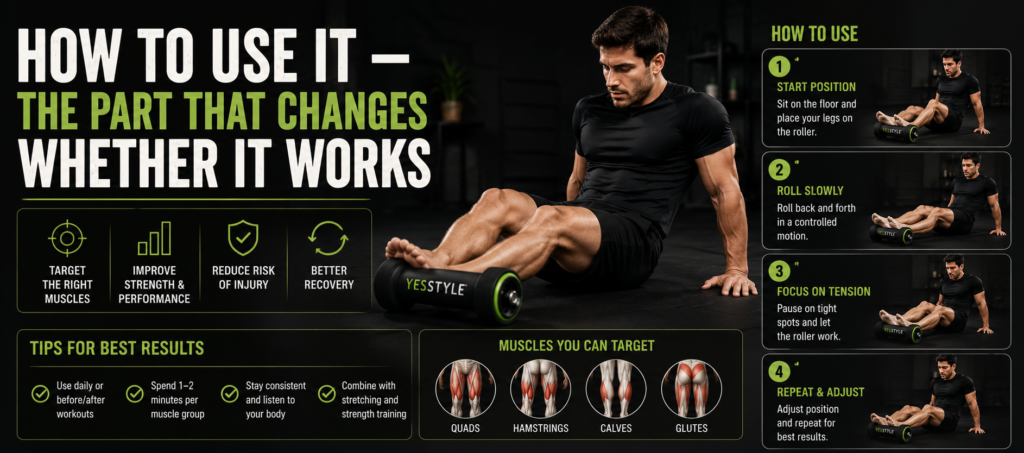
The technique matters as much as the tool, and most people get it wrong in the same way.
Roll slowly. Very slowly. The most common mistake is rolling back and forth quickly, which feels like it is doing something but does not give the tissue time to respond and release. Slow, sustained pressure on a tight area — pausing for several seconds before moving on — produces noticeably better results than the fast rolling most people default to.
Avoid bone. The biggest concern is rolling over bone. Avoid any bony areas like your knees, pelvis, or shoulder blades. For leg rolling specifically: do not roll directly over the shinbone, the knee joint, or the ankle. Keep the roller on the muscle belly.
For calves: sit on a chair with one leg crossed over the other, position the roller below the knee and above the ankle, and work in slow strokes from bottom to top. Pause anywhere that feels particularly tight. For quads and hamstrings: lie on the floor with the muscle on the roller, support yourself on your forearms, and roll from hip to knee slowly.
Continue for 10 to 20 minutes or as recommended. When finished, stretch the muscles you have worked to maximize the benefit.
What Made the Difference for My Calves
The handheld massage stick. Not the foam roller I also bought.
The foam roller was useful for quads after long runs. For the specific calf tightness that was disrupting my sleep, the ability to sit on the edge of my bed at 10:30pm and work through both calves with the stick — without getting on the floor, without needing much space, without waking my partner — was the practical difference between something I actually did and something I intended to do.
The results took about two weeks of consistent use to become clearly noticeable. The 11pm tightness that had been building since I increased my mileage reduced noticeably. Not eliminated, but changed enough to stop interfering with sleep, which was the original problem.
On YesStyle, the handheld options that consistently appear in positive reviews tend to have independently rotating beads — which reduce friction on bare skin compared to rigid rollers — and a flexible core that allows the stick to follow the curve of the calf rather than pressing in a straight line. These are not complicated requirements. They narrow the options down to a manageable number.
A Few Things Worth Knowing Before You Buy
Do not roll over varicose veins or areas of the skin with cuts, bruises, or rashes. Do not use excessive pressure, as it can cause tissue damage and pain. Always start with a gentle massage and gradually increase the pressure as you get used to it. Drink plenty of water after using the roller, as it can cause mild dehydration.
For anyone with a known circulation problem, deep vein thrombosis, or any vascular condition in the legs, check with a doctor before using any roller tool. The pressure applied is generally safe for healthy legs but is not appropriate for everyone without professional guidance.
The Honest Summary
A leg roller from YesStyle is not a particularly complicated purchase. The category is well-established, the products are relatively inexpensive, and the range on YesStyle specifically includes enough variety at enough price points that most people can find something useful without spending more than they need to.
The decision that matters most: foam roller or handheld stick. For large muscle groups — quads, hamstrings, glutes — the floor roller is more efficient. For calves, for targeted work on specific tight points, and for anyone who needs something they can use sitting on a chair without getting on the floor, the handheld option is more practical and tends to actually get used.
My calves sleep much better now. Most of the credit goes to the stick. Some of it goes to the open YesStyle tab.

Mikhaila Olena is a lifestyle writer and content creator behind Living Smart Daily, dedicated to sharing practical ideas, thoughtful insights, and everyday inspiration. With a passion for simple living and meaningful choices, she crafts content that helps readers create a more balanced, organized, and fulfilling life.


One comment on “Leg Roller YesStyle: The Complete Guide to Finding the Right One”