






I bought the Tsubaki hair mask because my colleague would not stop talking about it.
She had been using it for two months. Every time her hair came up — which happened more often than you might expect once I noticed how good it looked — she mentioned the mask. Same answer every time: Japanese brand, camellia oil, she bought it on a whim, now she can’t stop. When I finally asked her to show me the tub, I recognised the name. Tsubaki. Shiseido‘s line named for the camellia flower. I had walked past it in shops without picking it up because the packaging is fairly understated and I had not read anything about it.
I bought it that week. I have now been using it for just under four months. Here is the honest version of what happened.
What Tsubaki Actually Is
Tsubaki is the Japanese word for camellia — specifically the Camellia japonica plant, which has been used in Japanese beauty for centuries. Geishas used camellia oil on their hair and skin. It was considered one of the most valuable beauty ingredients in Japan long before the modern cosmetics industry existed.
The Shiseido Tsubaki line takes its name from this ingredient. The Premium Repair Hair Mask specifically is a deep conditioning treatment built around camellia seed oil combined with several other actives — royal jelly extract, glycerin, hyaluronic acid, and amino acid derivatives that the brand calls its “infiltration technology,” designed to open the cuticle temporarily, deliver ingredients into the hair shaft, and then seal back down.
This is what Tsubaki oil does that most other conditioning ingredients cannot: the molecules are small enough to slip between cuticle scales and actually enter the hair shaft rather than sitting on the outside. Camellia oil molecules are small enough to penetrate the hair shaft and deliver nutrients exactly where they’re needed, repairing at the molecular level rather than coating the outside. External coating is what gives you shine immediately after using most conditioners. What you feel when you run your fingers through your hair two days later is the difference between the two.
The Ingredients and What They Are Actually Doing
I spent more time on the ingredient list than I usually do, partly because of how consistently good the results were and partly because I wanted to understand why.
Camellia seed oil is the headline ingredient and the reason the line exists. Rich in oleic acid and antioxidants, it deeply moisturises without leaving the greasy film that heavier oils tend to leave. Oleic acid mimics the natural oils your scalp produces, which is why it absorbs so efficiently and does not build up in the same way.
Royal jelly extract — the substance bees produce for their queen — contains amino acids, vitamins, and fatty acids that support keratin production and strengthen the hair fiber from within. It sounds like marketing language. The evidence for its effectiveness in hair care is more substantial than most people expect, though the concentration in any given product matters and is not always disclosed.
Glycerin is a humectant — it draws moisture from the air and holds it in the hair shaft. Combined with acetyl hyaluronate, which is a more stable form of hyaluronic acid that penetrates better than the standard form, the moisture retention effect is meaningful and sustained rather than immediate and brief.
Amodimethicone is the silicone in the formulation, and it is specifically chosen rather than generically included. Unlike standard dimethicone, amodimethicone has a positive charge that attracts it specifically to damaged areas of the hair, where the cuticle is lifted and exposed negatively charged protein. It concentrates where the damage is. This is why the mask does not just make hair uniformly smooth — it specifically targets the areas that need the most attention.
My Hair, for Context
Fine to medium, naturally straight, color-treated. My ends are the chronic problem — I have the kind of damage from years of heat styling and regular coloring that makes my hair feel fine at the roots and significantly worse from about mid-length down. Standard conditioners get me through the day. They do not fix anything.
I have tried several treatments that claimed to do what Tsubaki does. Most of them worked for about three days, then faded back to normal and required repeat application to maintain the effect. A few left buildup that I had to clarify away. One made my hair feel coated in a way that I found unpleasant even though it looked fine.
What Actually Happened, Week by Week
Week one. I applied the mask after shampooing, mid-length to ends, left it for about two minutes because I was not sure how long it needed, rinsed. My immediate reaction was that it was fine — softer than after conditioner, slightly more shine. I did not think I had found anything remarkable.
Week two. I used it twice, leaving it slightly longer the second time — around three to four minutes. The ends started feeling different in a way that was hard to describe for a day or two. Eventually I worked out what it was: they stopped feeling dry halfway through the day. Normally, by mid-afternoon, my ends revert to feeling coarse regardless of what I used in the morning. For the first time in a while, that was not happening.
Week four. A friend I see infrequently said something about my hair looking different. She could not specify exactly what — she said it looked healthier, which is the kind of vague compliment that usually means nothing but in this context felt significant because she had not been told I was trying anything new.
Month three. The baseline condition of my ends has genuinely improved. Not dramatically — this is not a one-month keratin treatment situation — but measurably. There is less single-strand breakage when I brush it out. There is less frizz in humidity, which used to be my single biggest frustration. I can blow dry it without extra serum and the result is close to what I used to only get with additional products.
How to Use It
This is the part that matters more than the ingredient list for most people.
Apply after shampooing, on towel-dried damp hair — not soaking wet, not fully dry. Damp gives the mask something to work with while still allowing penetration. Apply from mid-length to ends. If your scalp is very dry, you can go a little higher, but applying to roots generally creates buildup and weight without benefit.
The mask does not need a long leave-in time. Shiseido states that even rinsing the mask immediately after application provides benefits, and while I personally get better results from two to four minutes rather than immediate rinsing, I have seen no significant difference between four minutes and fifteen. Save yourself the fifteen minutes.
Rinse thoroughly with lukewarm water. Warm water helps, very hot water works against you by lifting the cuticle and reducing the sealing effect of everything you just applied.
Frequency depends on your hair. For genuinely damaged or dry hair, two or three times a week is recommended. For maintenance on healthier hair, once a week. For fine or oily hair — the mask can feel heavy if overused — once every two weeks and applied only to the ends.
Who It Works For and Who It Might Not
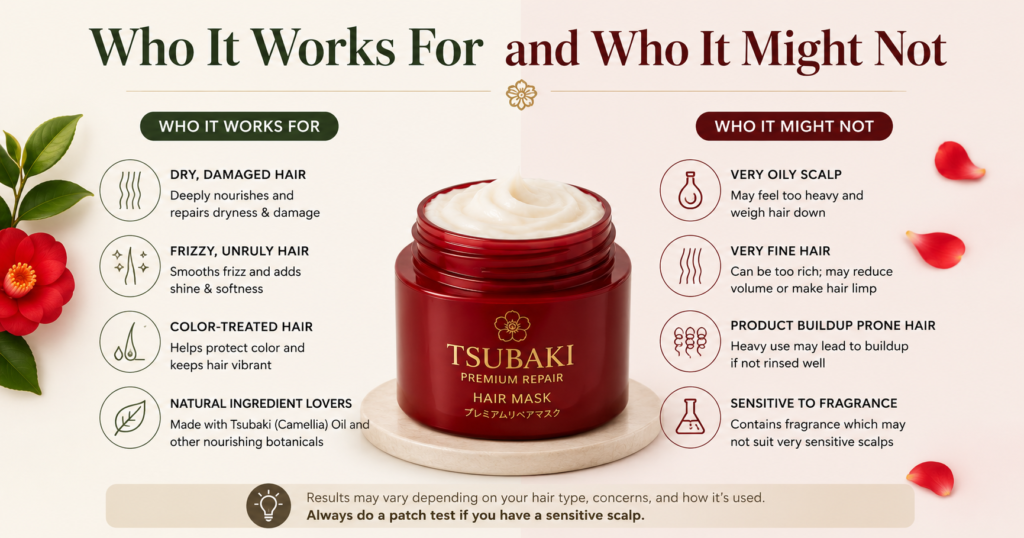
It works best for medium to thick hair that is dry, damaged, or color-treated. This is the majority of the people I have heard from about it, and the majority of the positive reviews in Japanese beauty communities. My colleague’s hair is thick and moderately damaged from coloring. The results for her were faster and more dramatic than mine, which tracks with how the product is positioned.
For very fine or oily hair, there is a real risk of the mask feeling heavy, particularly with frequent use. The amodimethicone and dimethicone in the formula are not lightweight silicones, and on fine hair they can create the coated feeling I described earlier. Use sparingly, on ends only, and less frequently than the standard recommendation.
For curly hair, the hydrating properties are relevant and many people with curly hair report excellent results — the mask helps define curls while reducing frizz and improving elasticity. Apply on freshly washed curls, leave on for ten to twenty minutes for this specific hair type, and use the praying hands method to distribute evenly without disrupting curl pattern.
For color-treated hair — which is my situation — the mask is explicitly color-safe and does not strip dye. More than that, the deep conditioning appears to slow color fade, which is the part of the color-treated hair experience that no topical product should be able to influence and yet here we are.
The Scent Question
Two versions exist in the market, and they smell different.
The Premium Repair Mask has a light, floral camellia scent. Clean and faintly floral, not heavy, and it does not linger meaningfully after rinsing. If you are scent-sensitive, this is the version that will cause fewer issues.
The Premium EX version, which some people prefer for more damaged hair, has been described by multiple people as “fruity gummy candy” — not unpleasant but stronger and more synthetic-smelling than the original. It rinses out more thoroughly, so the scent on dry hair is minimal, but the experience in the shower is more intense.
I use the original. I find the camellia scent genuinely pleasant in a way that is not common in hair care products, which tend toward either overwhelming florals or the clinical smell of nothing in particular.
Where to Buy and What to Pay
The Tsubaki mask is available through Amazon, YesStyle, and various Japanese beauty retailers. Pricing typically runs $12 to $20 for a 180g tub, which lasts between six weeks and three months depending on how much hair you have and how frequently you use it.
It is consistently priced lower than comparable salon-quality treatments — significantly lower than professional keratin treatments and in the same range as mid-tier drugstore masks that do considerably less. The value proposition is unusual in a category where you are normally paying for either premium ingredients without results or results delivered by products full of ingredients you cannot pronounce.
In this case, the ingredients are legible and the results are real. Which is not something I say about many products in this price range. My colleague has been using it for six months now. She still mentions it approximately once a month, unprompted. Some habits are harder to break than others.

Mikhaila Olena is a lifestyle writer and content creator behind Living Smart Daily, dedicated to sharing practical ideas, thoughtful insights, and everyday inspiration. With a passion for simple living and meaningful choices, she crafts content that helps readers create a more balanced, organized, and fulfilling life.