









The first groomer I took my dog to came highly recommended by the internet.
Four and a half stars. Over two hundred reviews. Professional photographs of happy dogs on the website. A booking system that worked without calling anyone. I felt reasonably good about the decision when I dropped him off at 9am. When I came back at noon, he had a haircut I had not asked for, a demeanor I had not seen before, and a small cut on his ear that the groomer mentioned as I was paying — briefly, almost as an afterthought.
Minor. It healed in a week. But picking up a dog who is visibly distressed and finding out something went wrong as an afterthought — that feeling does not go away quickly. I spent the following month trying to understand what I should have done differently.
Here is everything I found.
Why “Near Me” Alone Is Not Enough
The search works in the technical sense. It returns results. The problem is that proximity tells you nothing about what happens to your dog inside the building once you leave.
Too many pet owners trust their pets to underqualified staff, substandard facilities, and potentially dangerous conditions because they aren’t sure how to screen a groomer. That is the gap I fell into — I had found a groomer, not a good one. Knowing the difference requires more than a star rating and a booking form.
Ask Your Vet Before You Ask Google
I wish I had done this first.
Veterinarians, pet sitters, and dog walkers are tuned in to the local pet services community and a great resource for recommendations and warnings when you’re looking for a new groomer. A vet who has been in the same area for years knows which groomers their patients come from without incident and which ones they come from looking like my dog did that afternoon in November.
I called my vet’s office the week after the bad appointment, explained what had happened, and asked if they had recommendations. The receptionist gave me two names immediately. She said they had been recommending the same two groomers for about five years. Neither of them had a particularly impressive online presence. Both of them had a waiting list.
The person walking a well-groomed dog in the park is also more useful than a review platform. I ask now. Every time I see a dog looking genuinely well-kept, I compliment the owner and ask who their groomer is. The conversation takes about ninety seconds. It has produced three recommendations, two of which I have used.
Visit Before You Book. Not Optional.
My mistake was trusting the photographs on the website.
Any reputable groomer will be more than happy to show you their grooming stations. A well-run facility will expect a visit. If a groomer is reluctant to let you see the space, that reluctance is your answer.
What you are looking for: a well-ventilated salon, clean workstations, sturdy tables, and tubs, as well as pet-friendly products. Ask yourself — is this a place I’m comfortable leaving my dog? But go beyond the reception area. The reception area of almost every business looks presentable. You want to see the actual grooming space and the area where animals wait between being dropped off and being groomed.
Pets should be in a crate to themselves, with clean padding, plenty of air, and in view of salon personnel. Watch how the staff speaks to the animals already there. Watch how they speak to each other. Notice the smell — a facility that is cleaned between appointments smells different from one that is not.
Take your dog on this visit if you can. A short, low-stakes introduction before the first real appointment changes the experience significantly for an anxious animal. The groomer meets the dog. The dog smells the space without anything stressful happening. That context matters on appointment day.
The Conversation That Matters
Before I found my current groomer, I had a list of questions I had not thought to ask before that first November appointment.
Ask about experience with your specific breed. A groomer with breed-specific knowledge will ensure your dog’s coat is groomed appropriately. The groomer who gave my dog a haircut I had not asked for had, I later established, limited experience with his coat type. She had made a decision she thought was reasonable. It was not the decision I would have made if asked.
Ask specifically what happens when an animal becomes stressed. A groomer who has handled anxious dogs before has an answer to this question — breaks, reduced session length, a quiet space, a specific approach to de-escalation. An answer that sounds vague or dismissive tells you something.
Ask about liability insurance. Knowing that your groomer has liability insurance can give you peace of mind. If for any reason your dog is injured while under the groomer’s care, any medical expenses you incur as a result should be covered. I did not ask this. The vet visit to confirm the ear cut was minor cost me $85. A two-minute conversation upfront would have told me whether I was covered and would have signaled to me the level of responsibility the salon operated at.
Ask about certifications — not because uncertified groomers are automatically worse, but because participation in continuing education programs like AKC S.A.F.E. Grooming is a good sign that the groomer is committed to improvement. Certifying bodies include the NDGAA, the ISCC, and International Professional Groomers Inc. Someone who invests their own time and money in enrichment programs on a voluntary basis is typically someone who takes the work seriously.
After the Appointment — What to Watch For
This is the part most guides skip entirely. Finding the groomer is only half the decision. The appointment itself tells you whether you have found the right one.
Before is your baseline. You know your dog. You know how they behave in the car, in unfamiliar places, when they are stressed and when they are not.
After is where the information is. A dog that comes out tail up, greeting you normally, had a manageable experience. A dog that is flat-eared, low, or unusually withdrawn had a different kind of experience. One difficult appointment does not condemn a groomer — new environments and new people are genuinely stressful for many dogs and it takes time to build familiarity. A pattern of difficult appointments means something else entirely.
My current groomer texts a photo update mid-appointment. I did not ask for this — she started doing it on the second visit without being prompted. It is a small thing and it made an immediate difference to how I feel about leaving my dog with her. Not every groomer does this. Worth asking if they can.
How Often Is Often Enough
You should aim to schedule grooming services every 4 to 6 weeks, though this varies significantly by breed. If you have a Bichon or Shih Tzu that you like to keep long and fluffy, they may need to see a groomer more often to avoid becoming matted. On the other hand, shorter-haired dogs may only need to see the groomer on occasion for a cleanup and nail trim.
The frequency matters for finding a groomer because it shapes the relationship. A dog that sees the same person every six weeks for three years has a different experience than a dog that sees whoever is available whenever a bath feels overdue. Finding the right groomer for your pet can be just as hard as finding your favorite hairdresser — it may take a few visits before you get exactly what you want.
Finding a good groomer and booking regularly with that groomer are two different commitments. The second one is what makes the first one pay off.
When Mobile Grooming Makes More Sense
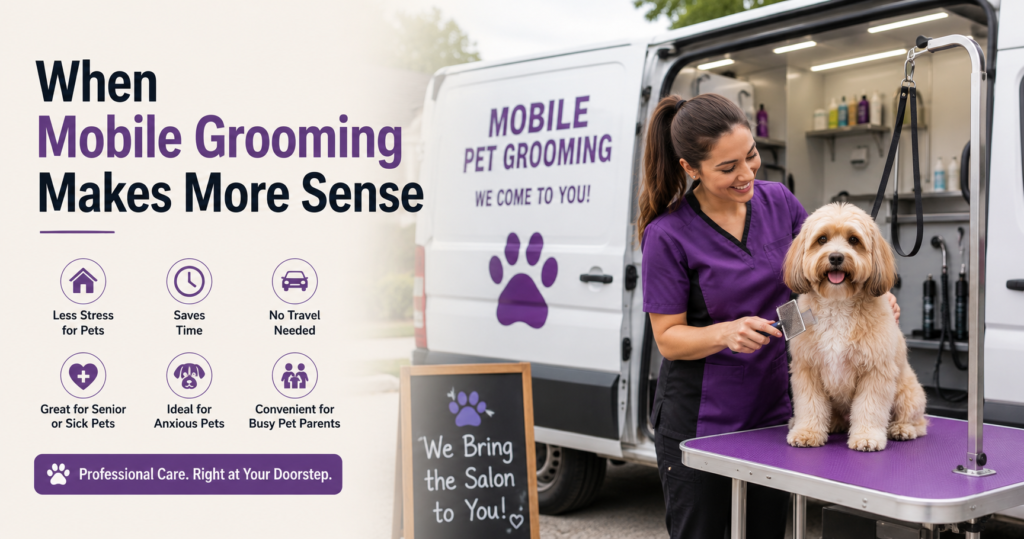
A mobile groomer usually offers the same services as a traditional salon but travels to your location. The absence of the car journey and the waiting kennel removes two significant stressors for anxious dogs. The trade-off is price — mobile grooming typically costs more than salon services — and availability, which in some areas is limited.
For dogs that have had traumatic salon experiences — the kind where they need days to return to normal afterward — mobile grooming is worth the additional cost. The groomer comes to an environment the dog already knows. That variable alone changes the experience significantly.
Ask mobile groomers the same questions you would ask a salon. See the van if you can. A well-equipped mobile unit should have the same cleanliness and equipment standards as a fixed facility, not a lower bar because it is harder to inspect.
What I Know Now That I Did Not Know Then
My current groomer has been seeing my dog every six weeks for fourteen months. He does not love going. He is not distressed about going. He comes out clean, well-trimmed, and ready for his post-groom nap, which is the outcome I wanted from the start and did not get at the four-and-a-half-star place with the two hundred reviews.
The research I did after that bad November appointment should have been done before it. Every conversation. Every facility visit. Every question about what happens when something goes wrong. None of it takes very long. All of it matters more than the star rating. Do it before the first appointment. Your dog will not thank you for it, because dogs do not operate that way. But you will know you did it right.

Mikhaila Olena is a lifestyle writer and content creator behind Living Smart Daily, dedicated to sharing practical ideas, thoughtful insights, and everyday inspiration. With a passion for simple living and meaningful choices, she crafts content that helps readers create a more balanced, organized, and fulfilling life.





One comment on “Pet Groomer Near Me: How to Find One You Actually Trust”