




Fish have this reputation as the easy pet. No walks. No litter box. Nothing chewing up your shoes at 2am. And honestly, that reputation isn’t entirely wrong. But easy isn’t the same as effortless, and a lot of beginner fish deaths — more than people expect — trace back to just a handful of mistakes that are completely avoidable once you know what to look for. An uncycled tank. Wrong size setup. Overfeeding because it feels like the caring thing to do. Not knowing the warning signs until it’s already too late.
Get the fundamentals right and this really can be one of the lower-maintenance hobbies out there. Skip them, and even the toughest species can struggle. So let’s go through what actually matters, roughly in the order it tends to matter — starting before you’ve even put a single fish in the water.
Cycle the Tank First. Seriously.
This is the step almost everyone skips, and it’s probably the single biggest predictor of whether new fish make it past their first few weeks. A brand new aquarium doesn’t have the bacteria colonies yet that break down fish waste. Fish produce ammonia — through breathing, through waste — and in an uncycled tank that ammonia just builds. Nowhere for it to go. The bacteria that would normally convert it into nitrite, then into much less harmful nitrate, simply haven’t had time to establish themselves.
This whole process is called the nitrogen cycle, and it usually takes several weeks to set up from nothing. Two main approaches: “fishless cycling,” where you add an ammonia source — commercial ammonia solution, or even just fish food — with no fish present at all, or the slower “fish-in” method using a small number of very hardy fish while you test water constantly and do frequent partial changes to keep things from spiking too high while the colony builds.
Either way, same goal: test until ammonia and nitrite read at or near zero consistently, and nitrate shows up, which means the bacteria have actually established themselves. It’s boring. Genuinely one of the least exciting parts of the whole hobby. But it’s the difference between a tank that supports life and one that’s quietly poisoning it.
Bigger Tanks Are Actually Easier
Everyone says start small. In fishkeeping that’s backwards, mostly. Smaller tanks are harder to manage well, not easier, because water chemistry in a small volume swings fast — a bit of extra food, a slightly late water change, one sick fish, and a five-gallon bowl can go bad in a way a twenty- or thirty-gallon tank just won’t. More water means more dilution. More stability. More room to mess up while you’re still learning, which you will, because everyone does.
Also — and this catches people constantly — research a fish’s adult size before you buy it, not just what it looks like in the store tank. Common goldfish get sold at an inch or two long and can grow to nearly a foot given the right conditions. People buy them expecting a small bowl-dwelling pet and end up completely unprepared. Oversized fish crammed into undersized tanks end up stunted, immune-compromised, shorter-lived, even when the water itself is technically fine.
Water Changes Aren’t Optional
Even a fully cycled, well-established tank builds up nitrate and other dissolved waste over time that basic testing doesn’t always fully catch. Weekly partial water changes — somewhere around 10 to 25 percent of total volume — are the standard maintenance task that keeps everything stable long-term. This is something you do on a schedule, not something you do only once a problem’s already visible.
Always treat tap water with a dechlorinator first. Chlorine and chloramine get added to municipal water specifically to kill microorganisms, and that makes them just as harmful to your filter’s beneficial bacteria and to your fish’s gills as it is to whatever pathogens it’s meant to kill in drinking water. Takes seconds to treat. One of the cheapest, most important habits in the whole hobby.
Try to roughly match the temperature of new water to what’s already in the tank too — a sudden swing can stress fish even when the chemistry itself is otherwise fine.
Feeding: Genuinely, Less Is More
Overfeeding might be the most common beginner mistake there is, and it causes trouble two different ways at once. Fish that consistently overeat can develop digestive issues, including swim bladder problems affecting how they control buoyancy. And uneaten food breaks down and adds straight to the ammonia load, which undoes a lot of the stability your water changes and filtration were working to build.
Good rule of thumb — feed only what fish can finish in about two minutes, once or twice a day depending on species. If food’s still sitting on the bottom several minutes later, cut the portion. A lot of experienced fishkeepers skip feeding entirely one day a week too, which mimics how these fish would actually eat in the wild and gives the digestive system a break.
Pick Fish That Actually Fit Your Setup
Tempting to buy fish based on looks and sort out compatibility later. This is a common source of avoidable stress, aggression, death — genuinely, a lot of tank problems trace back here. Different species have wildly different territorial tendencies, social needs, sometimes very different requirements around temperature, pH, water hardness.
Tetras and rasboras, a lot of the shoaling species, need groups of six or more to actually feel secure. Kept alone or in pairs, they get stressed, reclusive, sometimes aggressive in ways they simply wouldn’t be in a proper group. Bettas go the opposite direction — famously territorial, usually best alone or with very carefully chosen tankmates, not thrown into a busy community tank.
Before buying anything, research not just what one fish needs but how it fits with everything else already swimming around in there.
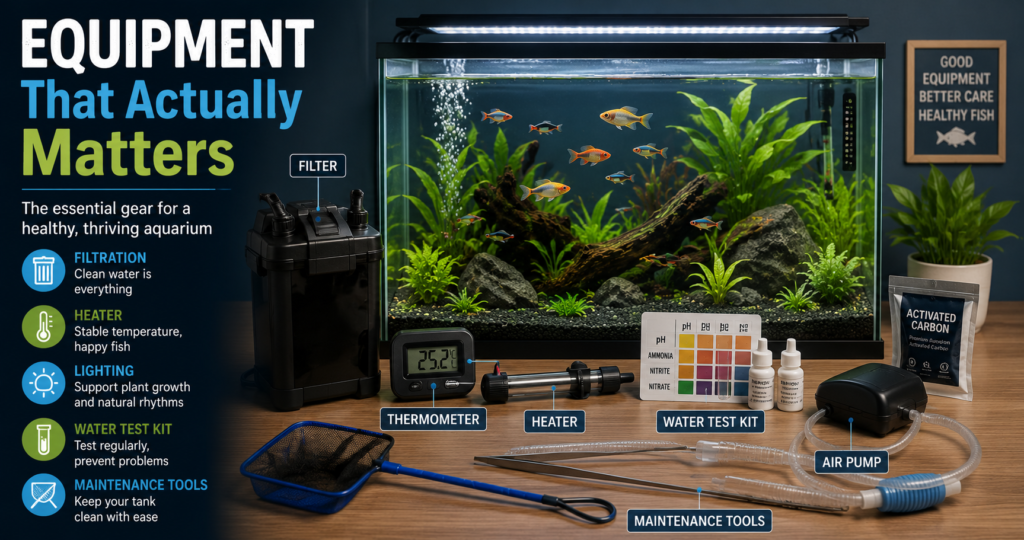
Equipment That Actually Matters
Equipment That Actually Matters
Filtration does more than keep the water clear — it’s the physical home for the bacteria processing ammonia and nitrite, which arguably makes it the single most important piece of equipment you own. Don’t replace all the filter media at once, and don’t rinse it in chlorinated tap water. Either one can wipe out a big chunk of your bacterial colony and basically restart the whole cycling process.
Heaters matter for most popular freshwater species, which are tropical and need stable temperatures usually in the mid-to-high 70s Fahrenheit. Even swings within a tank that’s “warm enough” on average can stress fish and wear down their immune response over time. A reliable heater with an accurate thermostat is worth paying more for than the budget option.
Lighting matters for visibility, and for photosynthesis if you’ve got live plants. Too much light duration can feed algae growth, so a lot of people run lights on a consistent 8-to-10-hour schedule instead of leaving them on all day.
Substrate and decor aren’t just decoration either — a lot of species use rocks, driftwood, plants for shelter and territory. A completely bare tank can leave more skittish fish chronically stressed, even if nothing else is wrong.
Watching for Illness Before It’s Obvious
Fish can’t tell you something’s wrong. No whining at the door, no obvious limp. So you have to actually know the subtle signs instead of waiting for something dramatic. Clamped fins held tight against the body. Hiding more than usual. Not eating. Rapid or labored gill movement. Visible spots, discoloration, growths.
Most illness in home tanks traces back to water quality issues, stress, or both together, which is part of why consistent maintenance does double duty — prevention and diagnosis at once. Catch problems early, often well before symptoms get severe, and treatment succeeds far more often.
The Ongoing Rhythm of It
Beyond the weekly water change, there’s a broader rhythm worth building. Testing water regularly — more when the tank’s new, less once things settle. Wiping algae off the glass as needed. Trimming live plants if you’ve got them. Checking equipment actually still works — filters, heaters, pumps — instead of assuming it does just because the tank looks fine from where you’re standing.
The Short Version
Cycle the tank fully before adding anything. Size the tank for what your fish will actually grow into, not what they look like now. Change water on a schedule, not in reaction to a problem. Don’t overfeed, even though it feels generous. Watch closely for the early, subtle signs something’s off. Research compatibility before you buy, not after you’re already attached. None of this takes special skill. Just patience during the cycling phase, and consistency after. This hobby rewards steady, unglamorous maintenance way more than any single gadget or additive or trick — and the payoff is a tank that stays healthy and genuinely fun to watch for years, not months.

Mikhaila Olena is a lifestyle writer and content creator behind Living Smart Daily, dedicated to sharing practical ideas, thoughtful insights, and everyday inspiration. With a passion for simple living and meaningful choices, she crafts content that helps readers create a more balanced, organized, and fulfilling life.


One comment on “Fish Care: A Complete Beginner’s Guide to Keeping Fish Healthy”