




It’s 1am, then it’s 2am, and you’ve done the math three separate times on how many hours of sleep you’ll get if you fall asleep right this second. That specific kind of exhausted-but-wired feeling is one almost everyone knows, whether it shows up once in a while during a stressful stretch or it’s been going on for months. Insomnia isn’t just “having trouble sleeping” in some vague sense — it’s a real, well-studied condition, and the good news is that a lot of it responds to changes that don’t require medication at all. Not all of it. But a lot.
This isn’t a list of the same twelve tips you’ve already seen a hundred times, recycled from one sleep blog to the next. It’s a walk through what actually tends to move the needle, why some of the “obvious” advice doesn’t work as well as people assume, and where the line is between something you can handle on your own and something worth bringing to a doctor.
What Insomnia Actually Is
Insomnia isn’t one single thing. Clinically, it gets split into a few categories — trouble falling asleep, trouble staying asleep, or waking up too early and not being able to get back to sleep. Some people deal with one of these. Some deal with all three on different nights. Acute insomnia is short-term, usually tied to a specific stressor, and tends to resolve once that stressor does. Chronic insomnia is defined as happening at least three nights a week for three months or longer, and it often keeps going even after whatever originally triggered it has passed, because the sleep problem itself becomes its own source of stress.
That last part matters a lot. A huge amount of chronic insomnia isn’t really about the original cause anymore. It’s about the anxiety that builds up around sleep itself — lying in bed dreading not being able to sleep, which makes falling asleep even harder, which reinforces the dread the next night. Breaking that loop is often the real work, more than any single trick or supplement.
Your Sleep Schedule Matters More Than Your Bedtime
Most people fixate on bedtime — going to bed earlier, forcing themselves to lie down at a set hour even when they’re not remotely tired. This usually backfires. Lying awake in bed, frustrated, actually trains your brain to associate the bed with wakefulness and frustration instead of sleep.
What tends to matter more is a consistent wake-up time, every single day, including weekends. This sounds almost too simple to be useful, but it’s one of the most reliably effective changes people can make. Your body runs on a roughly 24-hour internal clock, called the circadian rhythm, and it’s largely regulated by when you wake up and get light exposure, not by when you go to bed. A wildly inconsistent wake time — sleeping in until 11 on Saturday after a rough week — throws that rhythm off in a way that makes the following few nights harder, not easier.
Get up at the same time regardless of how the night went. It’s uncomfortable at first, especially after a bad night, but it’s often the single biggest lever for getting a sleep schedule back on track.
Light Exposure Does More Than People Realize
Morning light exposure — ideally within the first hour of waking, ideally outdoors rather than through a window — helps anchor your circadian rhythm and makes it easier to feel sleepy at the right time that night. This is one of those pieces of advice that sounds almost too simple, but the research behind it is genuinely solid. Even ten to fifteen minutes of outdoor light in the morning can shift how easily you fall asleep later that day.
The flip side matters just as much. Screens in the hour or two before bed — phones, laptops, TVs — expose you to light that can suppress melatonin production, the hormone that signals to your brain it’s time to wind down. It’s not just about blue light specifically; brightness in general, at the wrong time, sends the wrong signal. Dimming lights generally in the evening, not just avoiding screens, helps more than people expect.
The Bedroom Should Basically Only Be for Sleep
This one gets mentioned constantly and gets ignored just as constantly, mostly because working from bed or scrolling in bed feels harmless in the moment. But the association your brain builds between “bed” and “sleep” (versus “bed” and “work” or “bed” and “anxiously refreshing your phone”) genuinely affects how quickly you fall asleep.
The practical version of this: if you’re lying in bed for more than about 20 minutes without falling asleep, get up. Go to another room, do something quiet and low-stimulation — reading a physical book, something boring, nothing on a screen — and go back to bed once you actually feel sleepy again. This feels counterintuitive when you’re exhausted and just want to force it, but lying there getting more frustrated rarely leads to sleep. It just adds another restless memory tied to that bed.
Temperature matters here too. A cooler room, generally somewhere in the mid-60s Fahrenheit, tends to support better sleep than a warm one — your core body temperature naturally drops as part of falling asleep, and a warm room works against that process.
Caffeine Lingers Longer Than People Think
Caffeine has a half-life of roughly five to six hours in most people, which means a coffee at 2pm can still have a meaningful amount of caffeine in your system at 8pm. For people who are especially sensitive — and sensitivity varies a lot from person to person based on genetics — even an afternoon coffee can measurably affect how easily they fall asleep that night, even if they don’t consciously feel “wired.”
Alcohol is a trickier one, because it does make a lot of people feel sleepy initially. But it disrupts sleep architecture later in the night, particularly REM sleep, which is part of why a night with a few drinks often ends in waking up at 3 or 4am and struggling to fall back asleep, even though falling asleep initially felt easy.
Racing Thoughts and the Mental Side of Insomnia
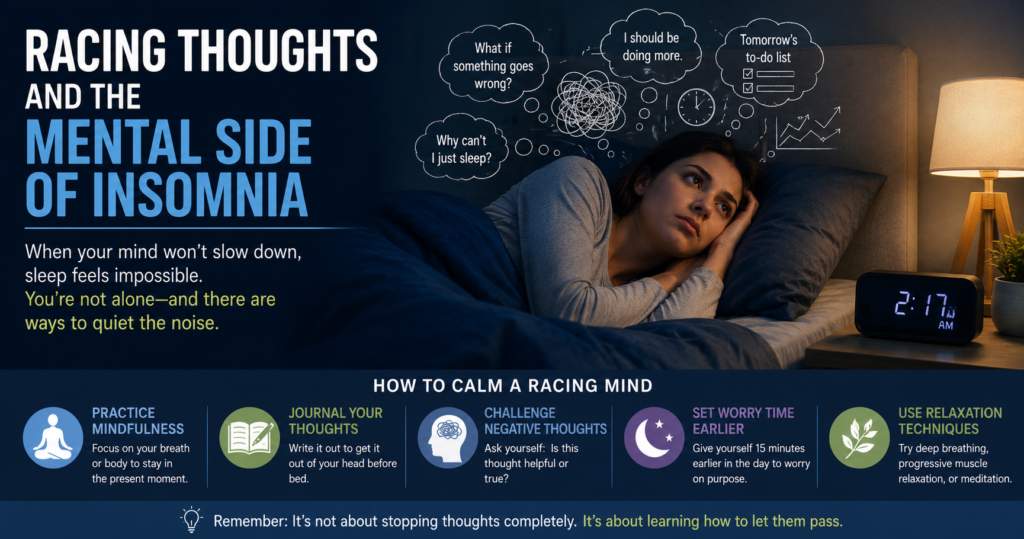
For a lot of people, the physical sleep environment isn’t really the problem — it’s the mind not switching off. Lying in bed running through tomorrow’s to-do list, replaying a conversation, worrying about something that isn’t even urgent yet.
A few things genuinely help here, beyond just “try not to think about it,” which almost never works.
Writing things down before bed — a quick brain dump of whatever’s looping, or a specific list of tomorrow’s tasks — can measurably reduce the mental rehearsal that keeps people awake. There’s actual research on this specific technique, sometimes called “cognitive offloading,” and it holds up better than a lot of other sleep advice floating around.
A structured wind-down routine matters too, not because any single step is magic, but because a consistent sequence signals to your brain that sleep is coming. Doesn’t have to be elaborate — dim the lights, do something quiet, maybe some light stretching or a few minutes of slow breathing. The specifics matter less than the consistency.
Breathing techniques can genuinely help calm a racing nervous system in the moment. Slow, extended exhales — longer than the inhale — activate the parasympathetic nervous system, which is the part of your body responsible for winding down rather than staying alert. It’s not a guaranteed fix, but it’s a real physiological lever, not just a distraction technique.
Naps Are More Complicated Than They Seem
A short nap, especially for someone who’s chronically sleep-deprived, isn’t inherently bad. But long or late-afternoon naps can genuinely make nighttime insomnia worse by reducing what’s called sleep pressure — the natural buildup of tiredness that helps you fall asleep at night. If insomnia is an ongoing issue, it’s often worth either cutting naps entirely for a while or keeping them very short, ideally before mid-afternoon, to protect that nighttime sleep pressure.
What Doesn’t Actually Help as Much as People Think
A few pieces of common advice deserve a little skepticism.
“Just try harder to sleep” is close to the opposite of helpful — sleep isn’t something you can will into happening, and the harder people try, the more alert and frustrated they usually become.
Melatonin supplements get treated like a universal fix, but they’re really more useful for shifting the timing of sleep — like adjusting to a new time zone — than for insomnia itself, and higher doses aren’t necessarily more effective; often the opposite.
Watching the clock during a bad night makes things worse, not better. Checking the time repeatedly tends to spike anxiety about how little time is left before an alarm, which is exactly the wrong direction for actually falling asleep. Turning the clock away, or leaving the phone in another room, removes that specific trigger.
When It’s Time to See a Doctor
Most of what’s covered here falls under general sleep hygiene, and it genuinely helps a lot of people. But insomnia that’s persisted for several months, especially if it’s affecting daytime functioning — concentration, mood, safety while driving — is worth bringing to a doctor rather than continuing to troubleshoot alone indefinitely.
Chronic insomnia sometimes has an underlying cause worth ruling out: sleep apnea, restless leg syndrome, thyroid issues, medication side effects, or an underlying mental health condition like anxiety or depression that’s presenting primarily as a sleep problem. A doctor can help sort out whether something specific is driving the insomnia, rather than it being a more general pattern that sleep hygiene changes can address on their own.
Cognitive behavioral therapy for insomnia, usually referred to as CBT-I, is generally considered the gold-standard treatment for chronic insomnia — often more effective long-term than sleep medication, and without the dependency concerns that come with relying on pills night after night. It’s structured, typically delivered over several weeks, and directly targets the anxious thought patterns and behaviors that keep chronic insomnia going. Worth asking a doctor about specifically, since it’s underused relative to how effective it tends to be.
The Bottom Line
There’s no single trick that fixes insomnia for everyone, and anyone promising one specific hack that works universally is probably oversimplifying. What actually tends to help is a combination of things working together: a consistent wake time, real morning light exposure, a bedroom that’s reserved mostly for sleep, some attention to caffeine and alcohol timing, and a way to quiet a racing mind before bed rather than just willing it to stop. None of this is instant. Sleep habits, like most habits, take a few weeks of consistency before the effects really show up. But for a lot of people, especially those dealing with insomnia that’s more situational than deeply chronic, these changes make a real difference — and for the people whose insomnia doesn’t respond to any of it, that’s useful information too. It’s a sign the problem might need a doctor’s help rather than another sleep hygiene checklist.

Mikhaila Olena is a lifestyle writer and content creator behind Living Smart Daily, dedicated to sharing practical ideas, thoughtful insights, and everyday inspiration. With a passion for simple living and meaningful choices, she crafts content that helps readers create a more balanced, organized, and fulfilling life.





One comment on “Insomnia Tips That Actually Work: A Real Guide to Falling and Staying Asleep”