




My father had his first cardiac event at sixty-one.
Not a heart attack. A warning. An angiogram that found partial blockages his cardiologist described as significant but manageable. The management involved medication, a conversation about exercise that my father half-listened to, and a conversation about diet that he fully disagreed with. The cardiologist mentioned the Mediterranean diet. My father, who had been eating the same way for six decades with no particular regrets until that moment, asked what it involved.
More olive oil. More vegetables. More fish. Less red meat. Less processed food.
“That sounds like a diet for people who have nothing better to think about,” my father said.
He tried it anyway. Three months later, his LDL cholesterol had dropped by eighteen points. He had lost six kilograms without ever counting a calorie. And he had, despite considerable initial resistance, started enjoying what he was eating in a way that surprised him.
I watched this happen from nearby. Then I started reading everything I could find about why it worked.
What the Mediterranean Diet Actually Is
It is worth saying directly: the Mediterranean diet is not a diet in the way most people understand diets. There is no phase one, no banned food list, no app to log your intake, no point at which you are technically finished.
It is a description of how people in southern Italy, Greece, coastal Spain, and parts of the Middle East ate before industrialized food processing arrived and changed what was available to them. Researchers began studying these populations in the 1960s because something unusual was happening: communities that were relatively poor by post-war western standards were outliving their wealthier counterparts. The rates of heart disease and certain cancers were significantly lower than in northern Europe and the United States.
The researcher who documented this most systematically was Ancel Keys, an American physiologist who noticed the pattern during time spent in southern Italy in the early 1950s. The Seven Countries Study that followed tracked diet and cardiovascular disease across seven nations over decades. What it found held up: the Mediterranean eating pattern was consistently protective in ways that other diets were not.
My father had not heard of Ancel Keys. He had heard of his cardiologist, and his cardiologist had mentioned the Mediterranean diet, which was enough to get him to try it.
Why It Works The Non-Technical Version
My father’s first question, after agreeing to try it, was whether it actually worked or whether it was one of those things that sounded good in studies and turned out to be irrelevant in practice.
Fair question. The honest answer is that the Mediterranean diet has more consistent evidence behind it than almost any other dietary pattern studied. It has been the top-ranked diet in U.S. News and World Report’s annual evaluation conducted by a panel of nutrition and health professionals every year since 2019. Not because the judges have a preference for olive oil, but because the research supporting it is broader and more consistent than the research supporting its competitors.
The mechanisms are genuinely understood at this point, not just speculated about. The olive oil provides monounsaturated fats that improve lipid profiles in ways that saturated fats do not. The fish provides omega-3 fatty acids that reduce inflammation particularly arterial inflammation, which is the underlying process in heart disease. The vegetables, legumes, and whole grains provide fiber that supports blood sugar regulation, gut health, and the kind of sustained satiety that prevents the mid-afternoon food crisis that derails most eating plans.
The specific finding that changed my father’s cardiologist’s expectations was the LDL result. Not just that it dropped that it dropped as much as it did within three months of dietary change, without the medication increase his cardiologist had been considering.
Extra virgin olive oil was the change he made first, and it was probably the most significant. He had been using a generic “light” olive oil for years, assuming it was comparable. It is not. Cold-pressed extra virgin olive oil retains polyphenol compounds that are removed during refining. The anti-inflammatory effect is meaningfully different between the two, and the lipid impact appears to be as well. His cardiologist made this distinction explicitly. My father switched.
What You Actually Eat
The Mediterranean diet’s practical reputation is sometimes built on the assumption that it requires specific Mediterranean ingredients, elaborate preparation, or access to a specialist food shop. None of those things are true.
The Foundation What You Eat Freely
Vegetables in whatever variety and form suits you. The traditional Mediterranean approach was simply whatever was seasonal and available locally which meant the diet varied significantly by season and by location. Tomatoes, courgettes, aubergines, peppers, leafy greens, cucumbers, onions, garlic. These were abundant and inexpensive. They became the backbone of the diet not because of nutritional planning but because they were there.
Legumes. This is the element most often missing from western plates and most central to the Mediterranean pattern. Lentils, chickpeas, cannellini beans, broad beans, black-eyed peas. These appear multiple times per week in the traditional diet. They are the protein and fiber infrastructure that allows meat to play a much smaller role without any nutritional deficit.
Whole grains. My father was confused by this because he had assumed heart-healthy eating meant avoiding bread. The Mediterranean diet includes bread substantial amounts of it because bread was central to the diet of these populations. The distinction is in the bread itself: traditionally made from whole grain flour, without added sugar, eaten with olive oil rather than butter.
Fruits, nuts, and seeds as the default snacking option rather than processed alternatives. My father replaced his afternoon biscuit with a handful of walnuts. He did not enjoy this for approximately two weeks. Then he stopped noticing.
The Regular Elements
Fish and seafood at least twice weekly. The fatty fish specifically sardines, mackerel, salmon, anchovies provide most of the cardiovascular benefit through their omega-3 content. My father had eaten fish occasionally before. He moved it to twice weekly and discovered, in the process, that he had been overcooking it for decades. Simply cooked fish with olive oil, garlic, and lemon is a better meal than he had previously given it credit for.
Eggs, poultry in moderate quantities, yogurt and modest amounts of cheese. These are regular elements of the diet rather than occasional ones.
The Occasional Category
Red meat in the traditional Mediterranean pattern appears rarely several times monthly rather than several times weekly. This is the change that produces the most resistance and the most question marks about compliance.
My father’s approach was practical. He did not eliminate red meat. He moved it from appearing in approximately four meals per week to appearing in approximately one. This single shift changed the composition of his weekly diet significantly without requiring him to never eat steak again, which was a psychological boundary he was not willing to cross.
Processed food, refined sugar, and processed grain products are not explicitly banned. They are simply absent from the dietary pattern because there is no room for them on a plate that is primarily vegetables, legumes, olive oil, and whole grains. The hunger regulation that comes from fiber and healthy fat also reduces the craving for them in ways that most people notice within two to three weeks.
The First Week What to Actually Do
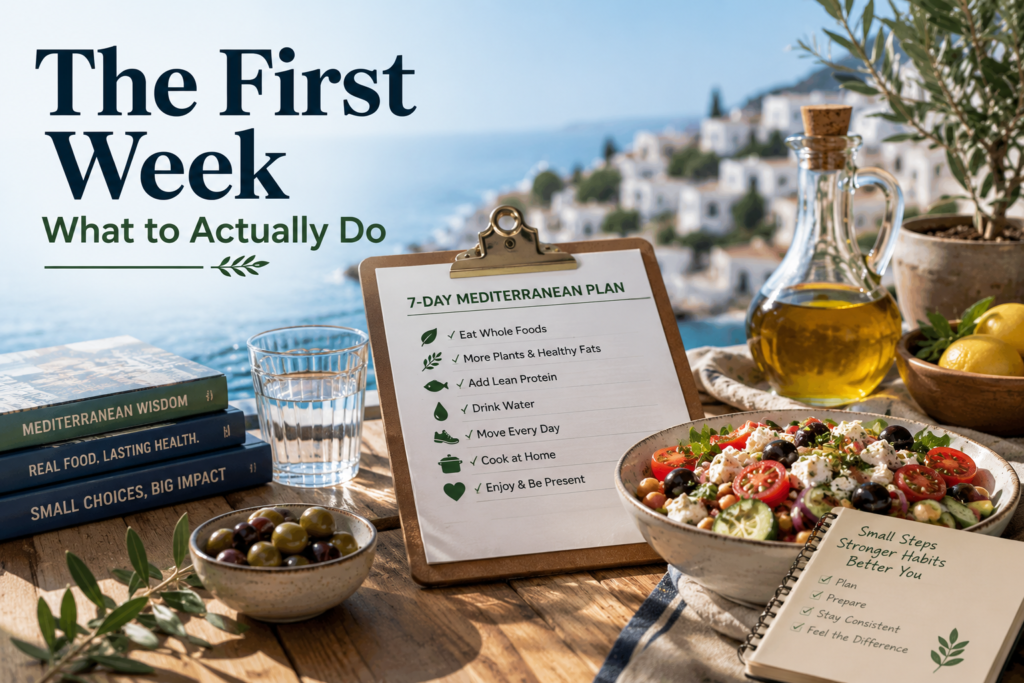
The most common mistake when starting the Mediterranean diet is attempting a complete dietary overhaul simultaneously. This produces short-term success and medium-term failure, which is the arc of most dietary changes.
The approach that produces durable results is different.
Switch the oil first. Replace butter and vegetable oil in your cooking with extra virgin olive oil. This affects every meal and begins altering the nutritional baseline of everything you cook. My father made this change on day one and kept it permanently.
Add fish twice this week. It does not need to be expensive or elaborate. Canned sardines on whole grain toast with olive oil and lemon is genuinely good and costs approximately nothing. Canned salmon with chopped vegetables and a dressing of olive oil and red wine vinegar takes five minutes. Tinned oily fish is one of the most cost-effective and nutritionally dense foods available and the Mediterranean diet’s most underutilized resource in western kitchens.
Replace one meat-based dinner with legumes. A lentil soup with crusty bread. Chickpeas with roasted vegetables and olive oil. White beans with garlic and greens. None of these require new skills. They require the decision to make them instead of something else.
Make vegetables half the plate. Not a side dish, not a garnish half the plate, at every meal. This is the proportional shift that most characterizes the Mediterranean eating pattern and the one that most changes how meals feel from a satiety perspective.
My father implemented these four changes in the first week. He found them manageable rather than transformative and was doubtful they would produce any measurable result. The blood work at his three-month review changed his position.
What the Research Actually Shows
The cardiovascular evidence is the strongest and the oldest. The PREDIMED trial, conducted in Spain with over seven thousand participants at high cardiovascular risk, found that those eating a Mediterranean diet supplemented with extra virgin olive oil or mixed nuts had significantly fewer major cardiovascular events over the study period than the control group. This trial is among the most influential nutrition studies conducted in the past three decades and has been replicated in various forms across multiple populations.
The blood sugar and diabetes evidence is nearly as strong. The high fiber content of the diet slows glucose absorption and reduces blood sugar spikes after meals. The anti-inflammatory properties of olive oil and the polyphenol content of vegetables appear to support insulin sensitivity over time. Clinical bodies in multiple countries now specifically recommend the Mediterranean pattern for people with prediabetes or type 2 diabetes.
The cognitive health research is the most recent and still developing, but the direction is consistent: adherence to the Mediterranean diet appears to be associated with slower cognitive decline and reduced risk of dementia. The omega-3 fatty acids, the polyphenols, and the anti-inflammatory profile of the overall pattern are all implicated in ways that are being studied actively.
None of this is why my father started the diet. He started it because a cardiologist told him to. But it is why the cardiologist told him to.
What Three Months Looked Like
He stopped eating butter. He started using extra virgin olive oil for everything including bread. He added fish twice a week. He replaced one steak dinner per week with lentil soup, which he initially described as eating regret and later revised to admitting was actually quite good.
His six-month review produced a result his cardiologist described as better than expected. The LDL had dropped enough to warrant reconsidering one of the medications. His weight was down six kilograms without any deliberate caloric restriction. His blood pressure had improved.
“It’s not a diet for people who have nothing else to worry about,” he said to me afterward, which was not quite an apology but was as close as he typically gets.
He is sixty-four now. He still eats red meat occasionally. He uses olive oil for everything. He eats fish twice a week and has developed opinions about which tinned sardine brand is best, which is a personality development I did not anticipate. The Mediterranean diet does not require Mediterranean cooking, expensive ingredients, or a complete personality change. It requires shifting proportions making olive oil and vegetables and legumes and fish the center of the plate rather than the periphery of it.

Mikhaila Olena is a lifestyle writer and content creator behind Living Smart Daily, dedicated to sharing practical ideas, thoughtful insights, and everyday inspiration. With a passion for simple living and meaningful choices, she crafts content that helps readers create a more balanced, organized, and fulfilling life.





2 Comments on “Mediterranean Diet: What It Actually Is (And Why It Keeps Winning Every Year)”