









I typed “hotels near me” into my phone once, standing outside a train station at eleven at night after a delayed connection, and got exactly what you’d expect a map full of pins, sorted by some combination of distance and whatever the algorithm decided I wanted to see, none of it telling me the thing I actually needed to know: which of these places would actually have a room, right now, for a reasonable price, within walking distance of where I was standing.
That search taught me that “near me” is doing a lot of work in that phrase, and most of it isn’t about geography. It’s about urgency. And urgency searches need a different approach than the leisurely, plan-two-months-ahead kind of hotel booking.
Distance on the Map Isn’t the Same as Distance on Foot
The pin closest to the center of the map isn’t necessarily the closest hotel to where you’ll actually be standing. Map apps measure straight-line distance by default, not walking distance, and the difference matters more than people expect a hotel that looks four blocks away as the crow flies can be across a highway, a river, or a stretch of road with no pedestrian crossing for half a mile.
Before committing to whichever pin looks closest, I switch the map to walking directions specifically, not just distance. Takes ten extra seconds and has saved me from more than one unpleasant walk dragging luggage along a road that clearly wasn’t built for pedestrians.
Call Ahead When It’s Last-Minute
Online availability for same-day bookings lags behind what’s actually happening at the front desk more often than people realize. A hotel can show as sold out on a booking app because a block of rooms was held for a group that just released them back into inventory, or show availability for a room type that got booked ten minutes ago and hasn’t synced yet.
For anything same-day, a phone call beats the app. The front desk knows their actual current inventory in a way the third-party listing might not, and hotels are often more willing to work out a rate over the phone for a walk-in-adjacent booking than the app’s rigid pricing suggests.
Check Reviews for Recency, Not Just Rating
A 4.5-star rating built from reviews spanning five years tells you less than it looks like it does. Hotels change ownership changes, renovations happen, a property can decline sharply after new management takes over, or improve dramatically after one. The overall star average smooths all of that into a single number that can be badly out of date.
When I’m choosing between two similarly rated nearby options under time pressure, I sort reviews by most recent and read only the last month or two. That narrow window tells you what the hotel is actually like right now, not what it averaged out to across years of changing circumstances.
Neighborhood Safety Matters More at Night
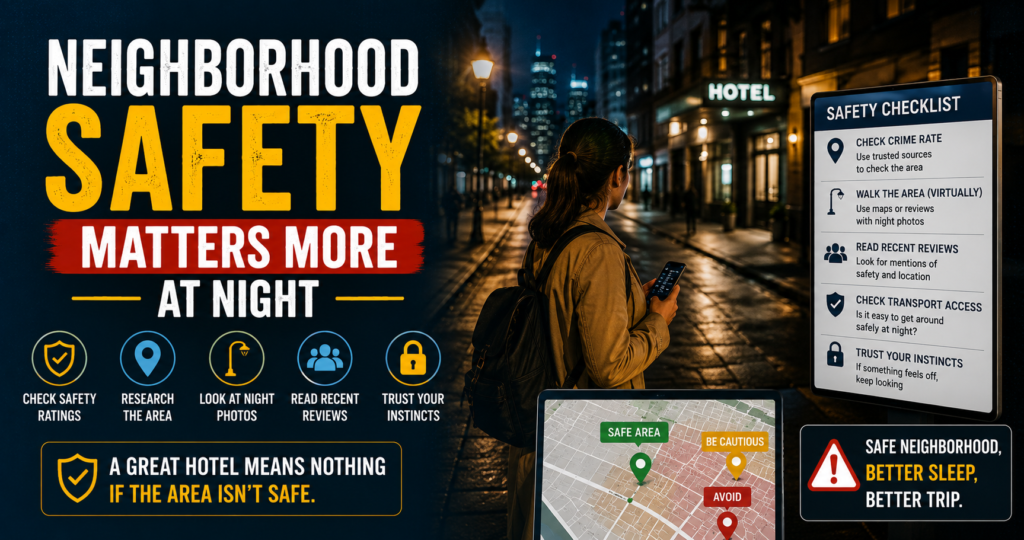
A location that’s perfectly fine to walk through at 2 p.m. can feel different at midnight, and “near me” searches disproportionately happen during exactly those later, less convenient hours after a delayed flight, after an event runs long, after plans changed. It’s worth a quick look at street view for the actual walking route, not just the hotel’s front entrance, before committing to a place based on proximity alone.
If something about the route gives pause, a slightly farther hotel with a clearer, better-lit path is usually worth the extra few minutes.
Don’t Skip the Price Check Just Because It’s Urgent
Urgency makes people skip comparison shopping, understandably nobody wants to price-compare five hotels while standing on a curb with luggage. But even under time pressure, checking two options instead of booking the very first result usually takes under a minute on a phone and can mean a meaningfully different price for what amounts to the same night’s stay.
I’ve made it a habit to open two tabs before booking anything last-minute, even rushed. It rarely changes my decision. Occasionally it changes it by quite a lot.
The Short Version
Switch to walking directions before trusting the map’s default sort. Call ahead for same-day bookings instead of relying purely on app availability. Read recent reviews, not the all-time average. Glance at the actual walking route before deciding proximity outweighs safety. And even under pressure, take the extra sixty seconds to check a second option before booking the first one you see. None of this turns a stressful, last-minute hotel search into a leisurely one. But it does turn “whatever pin is closest” into an actual decision, made with the same five minutes you’d have spent anyway just spent a little more deliberately.

Mikhaila Olena is a lifestyle writer and content creator behind Living Smart Daily, dedicated to sharing practical ideas, thoughtful insights, and everyday inspiration. With a passion for simple living and meaningful choices, she crafts content that helps readers create a more balanced, organized, and fulfilling life.





One comment on “Searching “Hotels Near Me”? Here’s How to Actually Get It Right”