









Two summers ago a rash showed up on my forearm on a Tuesday. By Thursday it had spread past my elbow. I did what everybody does pulled up my phone, typed in a description, started scrolling through image after image trying to match what I was looking at to what was on my arm. Contact dermatitis. Maybe eczema. One site suggested something involving my liver, which, sure, that’s a fun thing to read at 11pm.
None of it told me anything useful. Because here’s what I didn’t understand yet: a lot of rashes that come from completely different causes look almost the same, especially early on. An allergic reaction and a fungal thing and a reaction to a new laundry detergent can all show up looking like some version of “red, itchy, slightly raised.” You genuinely cannot tell them apart from a photo. Not reliably. Not even, it turns out, doctors not from a photo alone anyway.
What actually got me somewhere was figuring out how the diagnosis process actually works, and doing a bit of homework before I walked into the appointment. That’s what I want to walk through here.
Why the Photo-Comparison Thing Doesn’t Really Work
I want to be blunt about this because I wasted two days on it. Comparing a picture of your skin to search results is close to useless as a diagnostic method. A dermatologist doesn’t usually diagnose off appearance alone there’s a physical exam, questions about what’s changed recently, sometimes a look under magnification with a little handheld tool, and every so often a scraping or a small biopsy if the exam doesn’t make things obvious.
You can’t replicate any of that by scrolling. It’s not that you did the research wrong. It’s that the research method itself doesn’t work for this particular problem, and that took me longer to accept than I’d like to admit.
The One Thing Worth Doing Before Your Appointment
Skip the self-diagnosis. Do this instead: write down when it started. Note whether it’s spreading, and roughly how fast. Think back did anything change around that time? New soap, new medication, a food you don’t normally eat, a plant you brushed against, a cold you had the week before. Does it itch? Burn? Nothing at all, just looks bad? Has anything made it better, or worse, including stuff you already tried on your own?
I keep a note on my phone now that I start the second something looks off, updated once a day, sometimes just one line. Feels like overkill for something that’ll probably clear up in three days on its own. When it doesn’t clear up and sometimes it doesn’t that timeline turns out to be the most useful thing you bring into the room.
Signs That Mean Don’t Wait
Most rashes aren’t emergencies. A day or two of watching and waiting is fine for a lot of mild, contained irritation. But a few things change that calculus: it’s spreading fast, there’s a fever with it, your face or throat is swelling, breathing feels off, the pain doesn’t match how it looks, or it’s showing up alongside other signs you’re generally unwell.
If you’re not sure which category you’re in, call someone a nurse line, urgent care, your doctor’s office — instead of trying to answer that question yourself at midnight with a search bar. That’s genuinely not a call you’re equipped to make alone, and there’s no shame in it. I’ve made that call twice. Once it was nothing. Once it wasn’t nothing.
Urgent Care, Primary Care, or Dermatology Which One
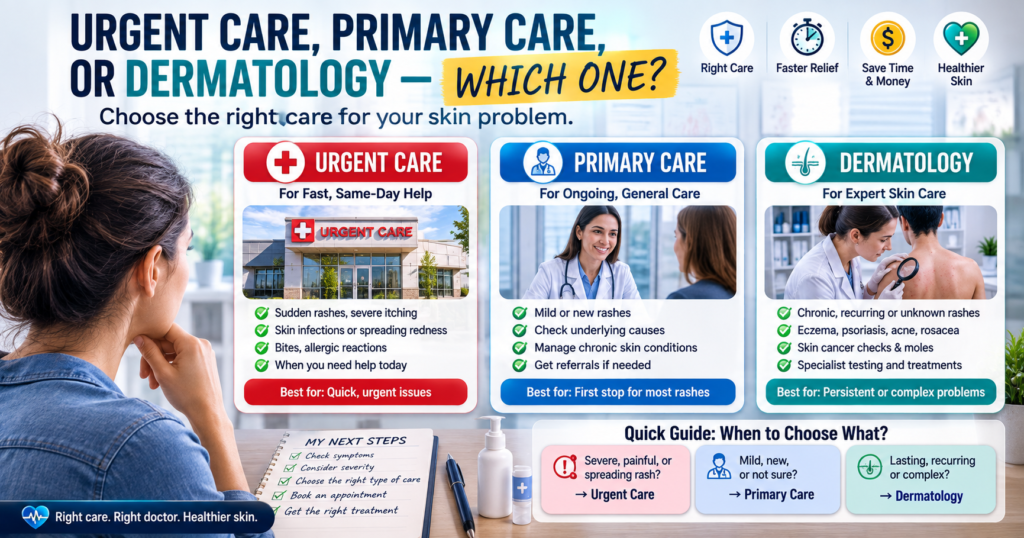
Something new that’s spreading fast, especially outside office hours? Urgent care, probably. Something persistent but not alarming? Start with your regular doctor, they’ll refer you onward if it’s beyond them. Something recurring, or anything involving a mole that’s changed shape or color? Dermatology, and be prepared to wait new-patient dermatology appointments can run weeks out in a lot of places, so ask about cancellation lists when you call. It’s a small ask and it’s saved me time before.
What Actually Happens in the Room
Nobody tells you this part, so here it is. There’s a visual exam, sometimes with a little lit magnifier called a dermatoscope pressed against the skin. There are questions the ones from your timeline notes, basically. Depending what they see, there might be a scraping, a swab, occasionally a small biopsy if nothing’s obvious on sight. None of it is a big deal physically. Results can take a few days though, so ask upfront how you’ll hear back call, portal message, whatever so you’re not left refreshing an app.
Where That Leaves You
A photo and a checklist can’t diagnose a rash. Not because you’re bad at research because that’s genuinely not how this works, even for people who’ve spent years doing it professionally. What actually helps: a timeline of when it started and what changed around then. Knowing which symptoms mean “wait and see” versus “go now.” Picking the right kind of provider for how urgent and how long-running the thing is. And walking in expecting an actual exam, not a five-second glance. The urge to search before you’re seen is normal I still do it, honestly, even knowing better. Just point that energy at building a timeline instead of guessing at a diagnosis. That’s the version of “doing your research” that actually helps the person who’s about to look at it in person.

Mikhaila Olena is a lifestyle writer and content creator behind Living Smart Daily, dedicated to sharing practical ideas, thoughtful insights, and everyday inspiration. With a passion for simple living and meaningful choices, she crafts content that helps readers create a more balanced, organized, and fulfilling life.





One comment on “Getting a Skin Rash Diagnosed: What Actually Happens and How to Prepare”